LINES OF THE DAY

". . . But the past does not exist independently from the present. Indeed, the past is only past because there is a present, just as I can point to something over there only because I am here. But nothing is inherently over there or here. In that sense, the past has no content. The past -- or more accurately, pastness -- is a position. Thus, in no way can we identify the past as past." p. 15

". . . But we may want to keep in mind that deeds and words are not as distinguishable as often we presume. History does not belong only to its narrators, professional or amateur. While some of us debate what history is or was, others take it into their own hands." p. 153

Silencing the Past: Power and the Production of History (1995) by Michel-Rolph Trouillot

Showing posts with label historical novel. Show all posts

Saturday, June 28, 2014

Faulkner -- The South -Writing History in Fiction

Faulkner on writing in the South, a 1000 word introduction for a special 1933 edition of The Sound and the Fury, five years after its initial publication. From the first volume of Joseph Blotner's massive Faulkner: A Biography (Random House 1974, pp. 810-11).
"Art is no part of Southern life," he wrote.  He described how it was different in New York and Chicago.  The reason was simple: the latter two -- representing the East and the Middle West -- were young and vigorous, whereas the South was "old since dead ... killed by the Civil War."  The "new South" was not Southern at all but merely a land of immigrants trying to remake the South along Northern lines.  "Yet this art, which has no place in Southern life, is almost the sum total of the Southern artist.  It is his breath, blood, flesh, all."  He went on from there to the most conscious scrutiny of Southern writing he had ever attempted.
"Because it is himself the Southern is writing about, not about his environment; who has, figuratively speaking, taken the artist in him in one hand and his milieu in the other and thrust the one into the other like a clawing and spitting cat into a croker sack.  And he writers. We have never got and probably will never get, anywhere with music * or the plastic forms.  We need to talk, to tell, since oratory is our heritage.  We seem to try in the single furious breathing (or writing) span of the individual to draw a savage indictment of the contemporary scene or to escape from it into a make-believe region of swords and magnolias and mockingbirds which perhaps never existed anywhere.  Both of the courses are rooted in sentiment, perhaps the one who writes savagely and bitterly of hte incest in clayfloored cabins are [sic] the most sentimental. Anyway, each course is a matter of violent partizanship, in which the writer unconconsciously writes into every line and phrase his violent despairs and rages and frustrations or his violent prophesies [sic] of still more violent hopes.  That cold intellect which can write with calm and complete detachment and gusto of its contemporary scene is not among us; I do not believe there lives the Southern writer who can say without lying that writing is any fun to him.  Perhaps we do not want it to be."
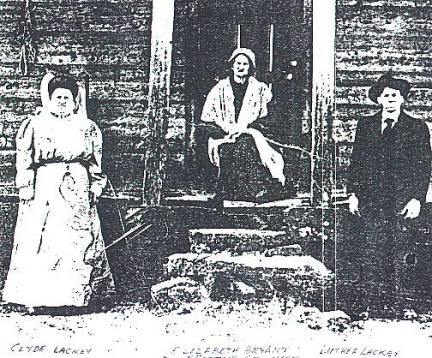
Residents of Lafayette County, out of which Faulkner imagined his Yoknapatawpha County

Blotner, p. 831; February 1934; Faulkner letter to his publisher, Harrison (Hal) Smith:


" .... "I believe that I have a head start on the novel," he began.  "I have put both the Snopes and the Nun ** one aside.  The one I am writing now will be called DARK HOUSE *** or something of that nature.  It is the more or less violent breakup of a household or family from 1860 to about 1910.  It is not as heavy as it sounds.  The story is an anecdote which occurred during and right after the civil war; the climax is another anecdote which happened about 1910 **** and which explains the story. Roughly, the theme is a man who outraged the land, and the land then turned and destroyed the man's family.  Quentin Compson, of the Sound & Fury [sic}, tells it, or ties it together; he is the protagonist so that it is not complete apocrypha.  I use him because it is just before he is to commit suicide because of his sister, and I use his bitterness which he has projected on the south in the form of hatred of it and its people to get more out of the story itself than a historical novel would be.  To keep the hoop skirts and plug hats out, you might say." *****
In my mid-twenties I was fascinated by Faulkner's fiction.  I read and re-read all the great American novelists with profound wonder and care. The Novel!  it was my grande amor, to which I'd faithful to death and after! Slowly, fighting it every realization along the way, I gave into despair about these 20th century white male writers, because they depressed me with their unexamined presumptions about women. Faulkner, as much as Fitzgerald and Tennessee Williams is responsible for the crazy women who populate southern fiction. Then, to my terror, all fiction, with a few exceptions began to read increasingly repetitive, predictable, complacently stuck on adolescent matters, nay, even infantile obsessions.

Finally, in these days, slowly I’m creeping back into some of joy and admiration of fiction.  It seems to have begun with Fitzgerald, and then Faulkner.  Perhaps it's because I came to them more in terms of historical fiction (as with Faulkner) and in terms of history embedded in fiction (as with Fitzgerald).  As well, since my mid-twenties – the South has become the center of my scholarship. Mastery of a variety narrative approaches is as essential for a writer of history as it is for a writer of fiction.  It always pays to study the best.

Life takes you places you never expected, which perhaps is why we remain reluctant to leave it.

----------------------

* He evidently didn't think Jazz qualified as musical art, much less all the other forms of southern black music with which he was more than familiar, both in his home region and from the time he spent in speaks in Memphis and New York.  He'd spent a lot of time in his youth dancing to W.C. Handy playing live, with his band, in Oxford.  He attended a lot of dances, and by all accounts, if he wished to dance, he danced well.  He was a musical person.

**


The Nun refers to Requiem for a Nun (1950) the sequel to Sanctuary (1931). It was in Requiem for a Nun Faulkner wrote what may be the most famous line of American literature, maybe even the requiem for the fate of the nation, as we repeat endlessly our cycles of psychic bigotry and violence, as well as the economic cycles of boom and bust: “The past is never dead.  It’s not even past.” There are those who would argue that the most famous line in American Literature comes from Gone With the Wind, and will quarrel over which one that is, whether, "My dear I don't give a damn," or "I'll think about it tomorrow."

*** THE DARK HOUSE is what will become Absolom, Absolom! (1936).

**** 1910 is years after Faulkner was born (1897), which makes even more interesting he might think an historical novel is.  One aspect of Faulkner's genius in terms of narrative capacity as a novelist was how he could sail around in his history. Characters and events in single works, in his short fiction as well as his novels,  emerge out of a variety of temporal locations: before the Civil War, during the Civil War, and return to the present, i.e. the present in which he the author was putting these words on paper.  This is not easy to do, particularly not with narratives as multiply populated as Faulkner's are. He groped intensively for years as how to accomplish this. It was the tools of  modernist narrative, forms with which he grew up, in fertile collision with the local language and oral storytelling modes with which he also grew up, that made works such as The Sound and the Fury successful and enduring.

*****  It’s interesting to see contemporary Mississippi novelist, Greg Illes, working in the post-Faulknerian south now, attempting to bring to light the non-dead past of the Civil Rights era sins, crimes and evil. These are the matters of a trilogy Illes is writing. The first volume, Natchez Burning, was published this year. The Bone Tree and Unwritten Laws will follow. As Natchez Burning's  as protagonist, Penn Cage, is Mayor of Natchez, it seems likely the two sequels will also feature that center of true historical evil, Natchez. Judging by the material of the first installment this trilogy appears to follow the arc from the JFK assassination to that of Martin Luther King, or maybe Bobby Kennedy as well.  The perpetrators are a coalition of the New Orleans – Miami mob and bigoted corporate interests, employing generationaly violent criminals,  sharpshooting Mississippi lowlifes – “white trash”.  Freedom Summer in Mississippi is the sort of material Illes may be working with.

What for me, at this time, is most interesting about Faulkner the man as well as his fictional world, is that, unlike Natchez, Yoknapatawpha County is not part of the Delta, center of Mississippi aristocracy past and present. This mattered very much to Faulkner, a part of his sense that most southern fiction was phony, and his determination to show the real South, through hisknowledge of his own country and people.


Tuesday, February 25, 2014

Historical Fiction -- The So-Called Sixties!

On her excellent  blog, Reading the Past, Sarah Johnson describes herself as:
Reference librarian, readers' advisor, avid historical fiction reader, NBCC member. Book review editor for the Historical Novels Review, Booklist reviewer, and NoveList contributor. Winner of ALA's Louis Shores Award for book reviewing (2012). Blogging since 2006.
She frequently hosts guests, who write about various aspects of historical fiction. Her recent guest is Richard Sharp, with an essay about which perhaps not that many authors have contemplated previously, The Sixties: The New Frontier for Historical Fiction. Sharp's essay is of interest equally to the historian as it is to the novelist.

In the last few years I've seen the occasional feature show up in a variety of venues that regularly discuss fiction, describing why it's not possible to write the Great American Novel of the 60's.  The reasons given is that supposedly all the aspects of that era were covered beyond extensively in the contemporary journalism and sociology of the time -- the time that also hosted the "new journalism" that employed the techniques of fiction for big feature stories.*

Sharp thinks otherwise, since he's not thinking of the Great American Novel, but rather of dealing with the profoundly various matters that collectively we think of as "the 60's" in terms of writing historical fiction.


For me, so far, the best fictional treatment of the period isn't a novel at all, but the short-lived CBS television series, Swingtown (2008),that starred the wonderful Molly Parker (whom most of us came to via her role as Alma Garret on Deadwood) -- and -- which you can see clearly from the clothes and hair, it was set in the early 70's.  This seems to me to be what has happened with most of the fiction, whether on the page or on the screen -- it's really set in the 70's, not the 60's themselves, which were in so many ways, a very different set of very brief years: 1965-1966 -- 1969-1970.

While Swingtown gave the adults most screen time, it wouldn't have mattered, I wouldn't be remembering it with such vivid detail if it hadn't provided equal respect to the children of these suburban couples, and their reaction to the political and social upheaval of the era. Even more convincingly the children range in age groups from adolescents down to middle-school, to toddlers and babies. Each age cohort experiences and perceives the upheavals in a different way.

The upheaval contained and compressed in that brief half-decade was like bomb going off throughout the U.S.  -- so much so that my own parents divorced and re-married other people, in a rural world where nobody got divorced, NOBODY, ever  -- and particularly not upstanding community and church members who were my parents! In the context of who they were, where they came from, and where they remained, what my parents and the people they remarried did was far more of a revolution than anything most people under thirty did in that brief half-decade.

I still haven't read a single novel set in the era that is in the least convincing though.

------------------------

*  My personal opinion about this is profoundly affected by how much of that was written by ignoramuses, who, one would think, as adults, should really have known better.


To get a sense of what I mean, just watch - listen to the insulting inanities the so-called reporters and journalists throw at the Beatles and Bob Dylan, in the television and film clips of the era, or in Pennebaker's 1967 documentary of the Baez-Dylan tour, Don't Look Back, 


and even in the Beatles' Help! (1965). In fact, that's pretty much the premise on which Help! is hung. It's a mystery how these artists managed not to start shooting into the press pool.

In the meantime this enforces another of my deeply held opinions that for history, popular music is the treasure chest for historians, cultural or otherwise to dig into, as well as for fiction writers.

Friday, December 27, 2013

Speaking of Historical Fiction -- Dumas's The Three Musketeers on BBC1

Following Sir Walter Scott and then James Fenimore Cooper's new romantic fictions,  Alexandre Dumas, brought to birth the joys and delights of what we now call the historical novel.

It's also a pleasure is to contrast Scott and Dumas's different approaches to what they invented. Scott was an earnest author, who, despite frequent flights of fancy in his poetry, seldom left unconsidered within his tale-spinning,  the impact of the past upon the present, for good or for bad.  Scott was always hoping for reconciliation among oppositions. Dumas, an author concerned with the nakedness of political power, however, accomplished what writers to this very day, particularly in the U.S., attempt so hard to emulate, while seldom if ever living up to their inspiration, that deft, precise, lightness of touch, tone, style and speech, for which particularly The Three Musketeers is famous.*  What USians writers in particular lack in their attempts to emulate Dumas is what feels eminently French, which is best described in a term from ballet -- the vocabulary of which, like the form, is also classically French -- ballon.

In this light, the BBC1, ten-part production of The Three Musketeers should be interesting: will the ballon remain among the promised filth and grit?

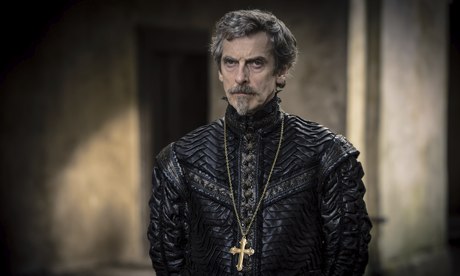
Peter Capaldi plays the arch-schemer, Cardinal Richelieu
The 10-part drama, which will begin next month and appears destined for a Saturday-night slot, is a modern take on the Alexandre Dumas tale without doing what its writer Adrian Hodges described as the "full Sherlock".
The feathers and the tabards are gone – fans of the 1973 Richard Chamberlain film will be disappointed – and in their place is a world that is a "bit smelly, a bit dirty", said Hodges. "But it's still about heroes," he said. "There are lots of anti-heroes on TV, and there is always room in the world for heroes." 
. . . . Hodges' updating includes a mixed-race Porthos, played by newcomer Howard Charles. "He was born in the 'court of miracles', the 17th-century version of the ghetto," said Charles. A long roll call of guest stars includes Vinnie Jones, Tara Fitzgerald, Ashley Waters, John Lynch and Sean Pertwee.
Unusually for a story about the musketeers perhaps, it also features a number of prominent roles for women. "In modernising the series, we wanted the women to be as equally powerful and impressive as the men," Jessica Pope, its executive producer, said.
----------------
*  Did Dumas invent swashbuckling in his Three Musketeers, set in the 17th century, serialized March - July 1848?
Before deciding we might consider Scott's verses, "Young Lochinvar," embedded in his epic poem, Marmion about the 1513 Battle of Flodden Field. Marmion was published in 1808. Agree or disagree: Young Lochinvar is not swashbuckling, though it is heroic and adventurous, in the Romantic style.

Wednesday, December 4, 2013

Reading Wednesday - Hild by Nicola Griffith

The narrator of Nicola Griffith’s Hild (2013, FSG) is its subject, the English St. Hilda of Whitby, one of the Church’s patron saints of learning and culture.


The tale of her life begins when she’s barely three years old, and concludes while she’s still a young woman, about to marry the warrior with whom she grew up. By then, she’s only recently baptised, not yet an abbess, and certainly not a canonized saint. (It's a pleasure to encounter a female saint canonized for something other than being subjected to protracted torture and death.) But already she's an advisor and counselor to kings -- a precarious position in the early years of the Christian conversion of multitudes of  cut-throat, treacherous, ambitious Anglo-Saxon kings striving to become overking of all the rival domains, one of whom is Hild’s uncle, King Edwin.

Despite some gruesome scenes of battle and torture, it’s a lovely novel, because it’s a book about seeing. Through the eyes of Hild, who, in early childhood, becomes seer for Edwin, we see a beautiful land still touched only lightly by the effect of human transformation. She has the capacity, perhaps inherited from her mother, to notice and recall what most eyes slide over.


Though her relationship with her mother is often uneasy and uncomfortable, whenever they are together she drills Hild in honing her capacity to see and remember. Equally important, her mother shows Hild how to shape what she sees into word-stories that will sway a king’s thinking, thereby keeping herself and those she cares for safe from a capricious ruler perpetually suspicious of conspiracy. Pondering everything she sees, she seeks to find the significance in the behaviors of weather and seasons, trade and agriculture, and people and animals from the smallest to the largest.

In the way that women who are married to unite kingdoms are called peace weavers, Hild is a pattern weaver. She creates original patterns on her loom in the weaving house, which not every woman can do -- i.e. not everyone has her imaginative power to re-create materially what she sees first in her mind. The place of weaving in seventh-century women's lives is part of Hild’s thematic matrix, as it describes how the women of this time and place weave relationships among each other, for themselves as individuals and within the larger weaving patterns that include family alliances -- at least for women who are of high enough status to have places at the fortress-courts from which powerful men exert dominance, extract tribute and launch their wars.

In the society this novel describes, a woman’s female relatives are her primary security.  Even if they dislike each other, mothers, daughters, sisters, aunts, and cousins will never repudiate each other, because they don’t dare. When posted as a stranger to another court, if a lady's retinue contained a member of an ally's weave, she would find a place ready-made for her within that member's weave.

Of nearly equal importance in this social system is a formally recognized companionship between two young girls called gemæcce (pronounced something like yem-ATCH-ee). This pair bond is decided upon, or consented to, by mother, lady, queen, or other influential woman.  Typically, this pair bond will be with someone the girl grew up with, whose own female relatives have ties to her relatives. The gemæcce partnership is for life, is nearly as important as who is chosen to marry the girls, and sometimes supersedes their relationships with the men. Hild's gemæcce is a charming young person named Begu, who is her polar opposite, with different valuable qualities; for instance, Begu gets Hild to play, she can make her laugh.

Though they cannot enter into a gemæcce pairing with women of the higher ranks, the weave of female allies in this seventh-century world can include women of lower status and even an enslaved woman. For a seer, to whom information is essential, these women are invaluable sources as well as a web through which the seer can transmit ideas and information she wishes to be widely spread.

Women are not warriors in this time, but are permitted to learn how to fight if they want to. For some women, knowing how to fight is necessary because a king going to war wants his seer at his side. If a battle goes against the king, the seer needs to be able to defend herself.

The book's research is meticulous. More to the point, the author understood her research so well that she weaves a fine, taut pattern of the past in the form of an historical novel. It's beautifully written, sentence by sentence. It's also skillfully composed: tension where it's needed; action that rises and falls in appropriately timed phrases; at times suffering, disease and death; other times women get giggling drunk together; in another phrase a vision is dreamed into water rippling over leaves. Though the characters are like all human beings who have ever lived and who live now -- they compete for power, they fall in love, they enjoy their food and drink -- it's a world very different from this one.

Hild is a splendid way to submerge, particularly in the season of the Winter Solstice and the Yule log.

Friday, April 20, 2012

I Will Be In London

When the Historical Novel Society Conference 2012 meets.

I jetlag so hard. I have to plan this stay very carefully to get the fullest benefit from it I can. I will have a lot of free time on my own since I'm not involved with the production at all, other than to keep el V grounded. But as I don't know yet even where we're staying, it's hard to start that planning.

Tuesday, January 17, 2012

*The Long Ships* - Winter Recreation

The Swedish author, Frans G. Bengtsson's The Long Ships, is an old-fashioned historical novel, in the sense of Scott and Dumas having a child, while the Polish Nobel for Literature Prize winner, Henryk Sienkiewicz's brilliant historical novels stand in as Godparents.  Allow me the lazy cutpasta from wiki:
[ "With Fire and Sword (Ogniem i mieczem, 1884), which took place during the 17th century Cossack revolt known as the Khmelnytsky Uprising; made into a movie with the same title. A video game based on the novel, Mount&Blade: With Fire & Sword, has been released by Turkish studio TaleWorlds.;[5]

The Deluge, (Potop, 1886), describing the Swedish invasion of Poland known as The Deluge; made into a movie with the same title;

Fire in the Steppe also called Pan Michael (Pan Wołodyjowski, 1888), which took place during wars with the Ottoman Empire in the late 17th century; made into a film titled Colonel Wolodyjowski.

The Teutonic Knights, also translated as The Knights of the Cross, (Krzyżacy, 1900, relating to the Battle of Grunwald); made into a movie with the same title in 1960 by Aleksander Ford." ]

These are among my favorite historical fictions, whether as novels or films -- the films are splendid recreations of time, place and historical events. However, Sienkiewicz's novelist's narrative voice at least, is somewhat humorless, though not entirely so. There is some situational comic moments -- and if one can imagine oneself into the milieu it is funny.
It's interesting to contrast these four writers' sense of comic as they are all different. Scott finds most of his humor in character -- he deliberately writes comic characters. Dumas's sense of the comic is that of bouyant reparte among characters in conflict, whether they are friends or enemies, that often leads to a ridiculous and dangerous contretemps that resolves via an equally witty series of antic words and actions among the actors within the scene. Yes it's difficult not to visualize these scenes as upon a theater's stage, as Dumas's characters were as successful there as on the pages within book.

What is different about Bengtsson's humor is that the narrative voice contains an ironic lighteness, a twentieth century quality (though Bengtsson was born in 1894, the novel's first section was published in 1941 and the second in 1945). The narrative voice puts a slight distance between the reader and Bengtsson's characters. This is mostly pointed at 10th century Christianity and its aggressively proselytizing priests, as judged so wanting in real gods and real manhood, by the tenths century Scandinavians, Muslims, Jews and Saxons. As we read along it seems that Bengstsson's novel may likely haven been a resource-inspiration for several of the current nordic adventure series (the hero is named Orm -- and it seems that the protagonists of all these current series is named Orm) from Robert Low to M.D. Lachlan.

Though I will say that Bengtsson feels to me a more consistently graceful writer than Bernard Cornwell, Cornwell's protagonist of his Saxon Stories, Uthred, is as finely created a protagonist as Bengstsson's Orm -- whether or not he was influenced by The Long Ships.

Tales filled with the men of the old sagas and their companions, their adventures a-viking and their strife with each other -- these are what I love to read or watch, snug by my fire in my bed, in the dark, frigid days and nights of winter. The Long Ships fills this desire to perfection.

Thursday, October 13, 2011

My Heart & My Head Get Full of Friendship and Lukács

Two amigas from C'town roused themselves in the 4:30 of the dark AM yesterday, met each other and drove in the pouring rain to the town where one catches the bus that takes passengers to NYC.  We ate a lovely lunch at Tea and Sympathy (one of them lived a long time in London, and her husband's mother is English), wandered and shopped and talked and talked and talked.  We walked so much that when I got home bout 6 AM I felt crippled. I had gone over the edge of what I can do.

Crashing hard I was able to curl up with Georg Lukács (have you ever heard anybody employ that locution in connection with Lukács before?).  It's not quick reading, reading this theorist's study of the historical novel.  Last night's reading in this work was the chapter focused on the predecessor foundations of the historical novel and the18th century view of history and historigraphy.  One of the passages that bounced me into calling out to el V, "Please, listen to this!" was this one:

[ " It was the French Revolution, the revolutionary wars and the rise and fall of Napoleon, which for the first time made history a mass experience {itals translator-Lukács's}, and moreover on a European scale.  During the decades between 1789 {me -- two years after the Philadelphia Constitutional Convention} and 1814 {two years after the U.S. declares the war with England called the War of 1812, the Napoleonic wars affecting this nation's part of the globe -- particularly in the part of this nation from when my C'town friends and their forebears were born and still live -- which claimed then as consquence all these lands that immediately became the heart of the slaveholders' Cotton Kingdom} each nation of Europe underwent more upheavals than they had previously experienced in centuries.  And the quick succession of these upheavals gives them a qualitatively distinct character, it makes their historical character far more visible than would be the case in isolated, individual instances: the masses no longer have the impression of a "natural ocurrence".  One need only read over Heine's reminiscences of his youth in Buch le Grand, to quote just one example, where it is vividly shown how the rapid change of governments affected Heine as a boy. Now if experiences such as these are linked with the knowledge that similar upheavals are taking place all over the world, this must enormously strengthen the feeling first that there is such a thing as history, that it is an uninterrupted process of changes and finally that it has a direct effect upon the life of the individual. " ]

We are in one of those eras in which the global masses realize there is such a thing as history that affects each of us individually. This was one of the many topics of the talk talk talk with mis amigas yesterday, via the Occupy Wall Streets and the Arab Spring, how the economic perception the youth of the world has digested that their future has been eaten by the collusion of corporations and politicians.  As both of my friends are grandmothers you don't need to think a moment of how much in sympathy they are with the Occupiers whereever they are located.  But that's only one reason they are in sympathy.  As Lukács points out, back in Russia, in the winter of 1936/7, history affects all of us in personal ways that we see and evaluate.

As part of this subject we spoke of how much we are fearing the winter, not only the weather, which if as bitter and long as last year will eat my friends' budget to heat their homes, but because there are so many destitute people, and the price of food and shelter continues to increase rapidly, while the banks are instituting new ways to squeeze us nearly every week, and our politicians give them all assistance.  The three of us are reminded of scenes of many a novel of Louisa May Alcott, in most of which are characters who are actively attempting to alleviate some of the winter miseries of the destitute classses. What I didn’t know back when I first read these books as a girl is how often those miseries were caused by the financiers’ and the greed, competition and corruption of these new corporations that exploded in the wake of the Civil War, causing financial panics, shutting down credit, going bankrupt, foreclosing, with the additional victimization of inflation and ever-spiraling costs of food and other necessities. Not to mention the labor-capital clashes, the racism against the emancipated and the hostile anti-immigrant exploitation.
So why does it help us to cast what’s going on within the perimeters of Little Women and Rose in Bloom? But it does. It’s also history.  In novels. Couched in terms of personal, individual cause and affect.  Novels didn't do this prior to Scott, whose first historical fiction was published in 1814.

My friends are no tbaggers and never have been -- always staunch dems.  But no longer.  They too know that neither party is an answer, and that both of them are actively enabling the misery of the 99%.  That my friends see this clearly and understand that the Occupiers do as well, says a great deal about the effectiveness of this movement, despite the mediapundocracy superiors instruct us their actions are meaningless.