LINES OF THE DAY

". . . But the past does not exist independently from the present. Indeed, the past is only past because there is a present, just as I can point to something over there only because I am here. But nothing is inherently over there or here. In that sense, the past has no content. The past -- or more accurately, pastness -- is a position. Thus, in no way can we identify the past as past." p. 15

". . . But we may want to keep in mind that deeds and words are not as distinguishable as often we presume. History does not belong only to its narrators, professional or amateur. While some of us debate what history is or was, others take it into their own hands." p. 153

Silencing the Past: Power and the Production of History (1995) by Michel-Rolph Trouillot

Showing posts with label U.S. Literature. Show all posts

Sunday, August 19, 2018

The Battles of Saratoga and Rip Van Winkle

     . . . . At the Saratoga battlefields Friday, we were surrounded by birds, butterflies and bees, as well as the multiple varieties of wild flowers I didn't know, milkweed, Queen Anne's Lace as well as lots of chamomile flowers -- the air was delightfully sodden with chamomile scent.

Neilson Farm, where Major General Benedict Arnold had his headquarters during Freeman's Farm battle, first battle of Saratoga, September 17, 1777.  Farmer Neilson was a Patriot.  Farmer Freeman was a Loyalist.  Freeman's farm was entirely destroyed by the British Army. Farmer Neilson brought enforcements from Schyulerville for the American army.

As at the pivotal War of the Rebellion Gettysburg battle site, at this pivotal battle site of the War of Independence, we were surrounded by contemporary farmland and -- vast tracks of trees and swathes of grass and dense woods, which one knew were filled with deer, deer who were populated with ticks.

There are still uprooted trees and broken trees everywhere from the terrible storm this last spring. Park service employees, or at least hired help with chain saws, were working in various parts. They sent up so much sawdust / chaff that people with allergies and other respiratory sensitivities had to stay far from where they were working.  So we missed some overlook sites of significant events of the two battles and the surrender.

Bemis Heights.  The American's cannon were able to shoot down at Burgoyne's forces holed up in a mess of gullies, ravines, and woods, where it was very hard to maneuver.  Way over, past that ridge of  woods, was the Hudson River, which the Americans controlled.
The battle of Freeman's Farm was September 19th, 1777, which Burgoyne barely won, with a greater loss of men than the Americans.  The battle of Bemis Heights was October 7, 1777, which Burgoyne definitively lost. The surrender by General Burgoyne came, finally, ten fuming days later, on October 17th, 1777.  General Burgoyne negotiated with Gates to turn the signing of a surrender into the signing of a "convention."  (How could he, a British lord, lose and surrender to hicks?) So we have the "Convention of Saratoga."  General Gates allowed Burgoyne to keep his sword, and the mostly Hessian army was awarded the honors of war -- doubtless the cause of yet another heated exchange between him and Arnold.

Both Colonel Morgan. who had served in Arnold's abortive campaign to take Quebec, and Colonel Andrzej Tadeusz Bonawentura Kościuszko played important roles in this pivotal historical event. 

Kościuszko Bridge across the Mohawk River

We, meaning our dear friend, Ben, Ned and me, cheered wildly when we crossed the  Kościuszko Bridge, on our way to the GWB -- i.e. the George Washington Bridge, which always tells us we're nearly home -- well, nearly home, depending on the traffic.  We happened to make great time Saturday -- no traffic.

At the battlefield park, we often we chose not to walk to overlooks of various sites of the battles because, despite the grass have been mowed short, it was still grass and we kept thinking of ticks, even though there were no overhanging tree branches -- but the grass was surrounded by trees. 

Despite the great damage wreaked by the spring storms up there, with the high heat, the high humidity, the rain -- it's become jungle-like. Things are beginning to look more like what the Dutch must have seen when they arrived in the 17th century, one imagines. 

Our Saratoga experiences were far from our everyday lives and environment. Monsoon Friday night -- Host's pool had to be out-pumped as it was overflowing from the amount of rain (more than one deluge) and then again starting about 7 PM. There are so many large windows in his wonderful house, that Saturday morning when we got up to go home, with the mist, the lowering skies, intermittent mizzle, and the condensation on the pane glass -- we felt we had been put in a massive, comfortable, mysterious aquarium. There was a world outside but we were imprisoned, thus shielded from it. Internet remained wonky at best, which it often is up there, particularly with as much thunder and lightning as went on Friday night. Somehow, nobody thought to turn on a tv or a radio. There are televisions in Host's house and state-of-the-art video / streaming hookup to them though there are no radios.

Host says he's forgotten about the televisions. They were used constantly while, over a very long year, his beloved, still mourned, wife died of a terrible cancer. During that year she watched repetitiously a certain cycle of BBC series. Once they reached the end of the final season, they'd start over immediately from the first episode of the first season. He hasn't bothered with television since her funeral.

As we drove home yesterday through the encroaching dense tree verges, under low clouds and rising mist we felt out of time, speeding silently among the strange and unknown. "Where are we?" Our lives seemed very far away and long ago. We were just -- here. We couldn't believe how short the time by clock was that we actually had been gone. In fact, almost immediately we arrived in his driveway, Host lost his watch. Had we been enchanted, we wondered as we drove south, back to New York City. 

Catskills, Adirondacks, they are really all one. Maybe we caught a whiff of what inspired Washington Irving to pen “Rip Van Winkle.”

It didn't hurt anything either that several sign-ups for Postmambo events came in while in Saratoga, and more after we arrived back home. -- events which also take the participants entirely out of their lives and where time stops, except for the rhythms measured by the drums.  Our Host has been on these with us.  He is going on two more -- to Haiti and to Havana. El V played Host Vodun muisc and showed videos recorded during his prospecting journey back in July.

Within 15 seconds of we having left his driveway, Our Host's watch reappeared.

Monday, February 20, 2017

Look Homeward Angel, You Can't Go Home Again

    . . . . During his lifetime, Thomas Wolfe (1900 - 1938) was one of the most celebrated American novelists, in an era when this nation was graced by many great novelists.  


After the publication of Look Homeward Angel, it wasn't unusual to see critics speak in all sincerity of Wolfe as the Great American Novelist.

I still have this book, one of the first I bought for myself when I began to earn money.
 It didn't hurt that he was a publisher's promotional dream either. Wolfe was stamped with many of the Romantic signatures of the Great Artist that this nation's intelligentsia and critical establishment still values and reveres.

The five room house located 92 Woodfin Street in Asheville, NC where all eight children lived.  About two blocks away is the larger establishment that his mother purchased and operated as a boarding house. She took Thomas, her youngest, to live in the boarding house, away from his father and the rest of the family.  There were issues between his mother and father.
Wolfe was an outsider, the youngest in a family of eight children, born in Asheville, North Carolina's Blue Ridge Mountains. He flamed onto the New York City literary stage, scored Maxwell Perkins, the greatest editor in our national literary history, to pull together his huge reams of text, succeeds in all his endeavours, including writing for the theater. Surely if Henry James had been alive he would have died of envy, and not only because he always failed writing for the theater. A tall and rangy, masculine man, if not conventionally handsome, beautiful, rich influential women helped him, loved him, wept for him. Best of all he then had the good sense to die young and tragically of a pneumonia provoked by a miliary tuberculosis surely acquired while growing up. Behind him he left a body of work the control of which others wrangled, and about which the critics could argue ad infinitum.

But it didn't quite turn out that way.  His contemporaries, Hemingway and Fitzgerald and Faulkner may have have had their moments of disfavor, but they've ever come near falling out of the pantheon of great American novelists.  But for Wolfe, both popular and academic interest evaporated. There was never a course that included Wolfe while I was in under or grad school. His contemporaries, as famous as he was when alive, remain in the American literary canon, and where there are still liberal arts and English departments, they are on the syllabus, with courses devoted to their work. Wolfe isn't even in the anthologies.

Yet he's at least as classically in the American vein as these this trinity of 20th century great literary novelists.

The title and subjects of Thomas Wolfe's first published novel, Look Homeward Angel (published 1929, only days before the stock market crashed, yet sold very well) is in perfect contrasting literary parallelism with his final and posthumous publication (1940), You Can't Go Home Again. This last work takes an overtly historical view of the United States and Europe, that, among many other subjects includes a jaundiced view of capitalism.

This sense of looking back on the nation may be why Wolfe fell out of the American literary canon's favor so quickly in the years of WWII and after.  First, he wrote very large, never using a single word when he could come up with a dozen, and that over-abundant rhetorical exuberance was falling thoroughly out of favor even before 1940 as undisciplined and sentimental. And it was no longer the Great Depression, it was WWII, and there was no room to look backwards, or for criticisms of America's wartime economic juggernaut bringing back the good times in terms of employment and wages -- even after Stalin became a wartime ally.  Yet here was a novelist overtly thinking through American history, which included the national conundrum of race. This didn't hurt Faulkner's reputation. However, Wolfe's historical expression was as baggy as his prose  -- though, in my opinion, neither his historical thinking nor his text, were necessarily, if ever, saggy, and don't contain the petty, small-minded sneering at Jews or other others, or the constant anxiety about manhood, that both Hemingway and Fitzgerald's fiction exhibit.

When I look at Wolfe's novels today, they provide more than any of our other great writers do, even Faulkner, the sense that I am looking backward at a world that is so long ago that it hardly exists now, except in his prose.


It feels that way despite for so long I have lived and walked in streets of the city where he spent most of his short adult life.  The excitement with which wrote about life in New York City penetrated my imagination that summer of my adolescence when I discovered his novels in the public library and never went away. That he wasn't a part of the American literary canon by then shows because he wasn't on the shelves of my high school library, where all the other writers were.  I found them in the public library by poking about, which I did often, drawn particularly to volumes that obviously hadn't been checked out for years. O, he lived New York very, very large, a literary legend's life, worthy of the literary center of the nation, in an age when literature had pride of place in the realms of art, entertainment and politics.

O Lost!

I have come to think of him again, after a long period of forgetting, especially when in the Blue Ridge Mountains.  A sensitive reader can see there, how these mountains and these people would have made a Thomas Wolfe. They should be proud of their native son as much now as in his days of fame, nearly seventy years ago.

These are some of the things that roll through my mind on nights I wake and cannot get back to sleep.


--------------------------------------

Not many have read Thomas Wolfe in these last decades. From the comfort of their homes, with their devices, readers can get a sense of Look Homeward Angel on these sites:

Look Homeward Angel can be downloaded in various formats here for no fee.

It can also be accessed here.  And here too, if your library participates.

Sunday, October 4, 2015

Rhode Island Rules

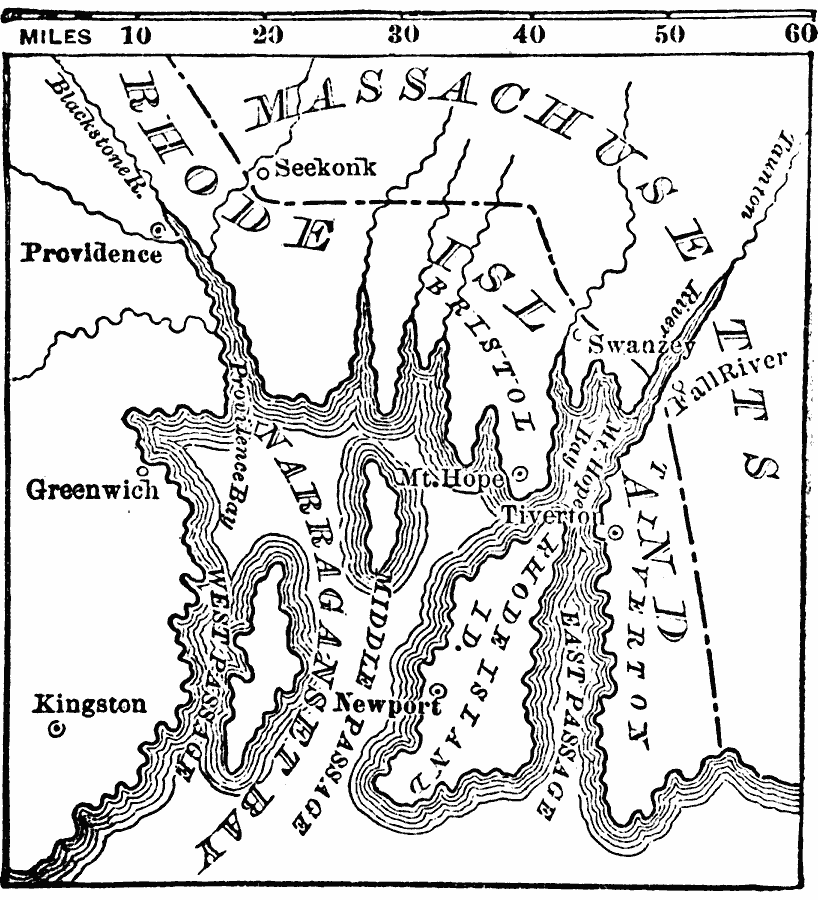
What a wonderful afternoon with Ted showing us about Rhode Island, which is only something 24 miles one way and 30 another -- but how much interesting to see there is in small territory -- and i'm not even talking the coast, inlets, islands and bays here.

He took us to King Philip's Throne, set in what one immediately feels is sacred space.  The sky was glowering grey, the wind was so up that the bay was white-capped, and it was cold.  Yet, in that dell in the woods, though the wind was whipping the high tree branches, down where we stood, it was still and quiet. When Ted was a boy his teachers brought his class there during their study of American - New England colonial history.  King Philip's War 1675 - 1678 (a/k/a Metacom's Rebellion) was the culmination of the native tribes unity through Metacom's (Philip's tribal name) efforts to drive the white man out.  It had been a long war over most of the 17th century in New England and Virginia, and the Natives lost.

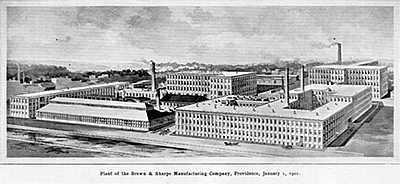
We tracked the Portuguese settlements in Providence when Rhode Island was still the heart of the U.S. textile industry.


It was here that the English technology was first smuggled, and the Rhode Island entrepreneurs in the pattern of  mill manufactury and factories created all the goods from clothes and shoes to hoes and shovels that the southern plantation labor wore and worked with, as well as the California Gold Rush and Nevada silver miners.  The slave commerce was effortlessly re-purposed to supplying the Union armies after Fort Sumter.  Recall Lincoln's Treasury Secretary, Salmon P. Chase's daughter, Kate, married Rhode Island textile mill millionaire (and governor) William Sprague.  It was a scandal or at least rumored to be a scandal as Sprague was breaking blockade to bring cotton up to mills in Rhode Island from the CSA ports -- surely Sprague could not do that unless Lincoln's Treasury Secretary was aiding and abetting?

We ended with a party of people our host went to high school with, who all do interesting things, but have nothing to do with universities, though many of them do work in the environmental non government and government agencies and institutes.

This looked very different yesterday under petulant, cold skies. 
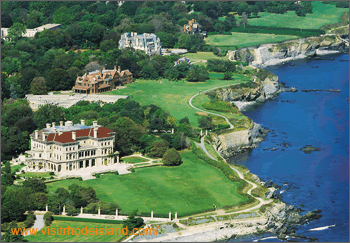
 I saw Gilded Age mansions on the Newport coast. Thus I dreamed of Wharton's Age of Innocence all night and Scorcese's film of same all night, while sleeping in a Gilded Age Providence Victorian pile.

Today the sun shines and now that we've had a most satisfying old time (50 years on the same spot) Family Diner breakfast special, we head to Boston.

Saturday, June 28, 2014

Faulkner -- The South -Writing History in Fiction

Faulkner on writing in the South, a 1000 word introduction for a special 1933 edition of The Sound and the Fury, five years after its initial publication. From the first volume of Joseph Blotner's massive Faulkner: A Biography (Random House 1974, pp. 810-11).
"Art is no part of Southern life," he wrote.  He described how it was different in New York and Chicago.  The reason was simple: the latter two -- representing the East and the Middle West -- were young and vigorous, whereas the South was "old since dead ... killed by the Civil War."  The "new South" was not Southern at all but merely a land of immigrants trying to remake the South along Northern lines.  "Yet this art, which has no place in Southern life, is almost the sum total of the Southern artist.  It is his breath, blood, flesh, all."  He went on from there to the most conscious scrutiny of Southern writing he had ever attempted.
"Because it is himself the Southern is writing about, not about his environment; who has, figuratively speaking, taken the artist in him in one hand and his milieu in the other and thrust the one into the other like a clawing and spitting cat into a croker sack.  And he writers. We have never got and probably will never get, anywhere with music * or the plastic forms.  We need to talk, to tell, since oratory is our heritage.  We seem to try in the single furious breathing (or writing) span of the individual to draw a savage indictment of the contemporary scene or to escape from it into a make-believe region of swords and magnolias and mockingbirds which perhaps never existed anywhere.  Both of the courses are rooted in sentiment, perhaps the one who writes savagely and bitterly of hte incest in clayfloored cabins are [sic] the most sentimental. Anyway, each course is a matter of violent partizanship, in which the writer unconconsciously writes into every line and phrase his violent despairs and rages and frustrations or his violent prophesies [sic] of still more violent hopes.  That cold intellect which can write with calm and complete detachment and gusto of its contemporary scene is not among us; I do not believe there lives the Southern writer who can say without lying that writing is any fun to him.  Perhaps we do not want it to be."
Residents of Lafayette County, out of which Faulkner imagined his Yoknapatawpha County

Blotner, p. 831; February 1934; Faulkner letter to his publisher, Harrison (Hal) Smith:


" .... "I believe that I have a head start on the novel," he began.  "I have put both the Snopes and the Nun ** one aside.  The one I am writing now will be called DARK HOUSE *** or something of that nature.  It is the more or less violent breakup of a household or family from 1860 to about 1910.  It is not as heavy as it sounds.  The story is an anecdote which occurred during and right after the civil war; the climax is another anecdote which happened about 1910 **** and which explains the story. Roughly, the theme is a man who outraged the land, and the land then turned and destroyed the man's family.  Quentin Compson, of the Sound & Fury [sic}, tells it, or ties it together; he is the protagonist so that it is not complete apocrypha.  I use him because it is just before he is to commit suicide because of his sister, and I use his bitterness which he has projected on the south in the form of hatred of it and its people to get more out of the story itself than a historical novel would be.  To keep the hoop skirts and plug hats out, you might say." *****
In my mid-twenties I was fascinated by Faulkner's fiction.  I read and re-read all the great American novelists with profound wonder and care. The Novel!  it was my grande amor, to which I'd faithful to death and after! Slowly, fighting it every realization along the way, I gave into despair about these 20th century white male writers, because they depressed me with their unexamined presumptions about women. Faulkner, as much as Fitzgerald and Tennessee Williams is responsible for the crazy women who populate southern fiction. Then, to my terror, all fiction, with a few exceptions began to read increasingly repetitive, predictable, complacently stuck on adolescent matters, nay, even infantile obsessions.

Finally, in these days, slowly I’m creeping back into some of joy and admiration of fiction.  It seems to have begun with Fitzgerald, and then Faulkner.  Perhaps it's because I came to them more in terms of historical fiction (as with Faulkner) and in terms of history embedded in fiction (as with Fitzgerald).  As well, since my mid-twenties – the South has become the center of my scholarship. Mastery of a variety narrative approaches is as essential for a writer of history as it is for a writer of fiction.  It always pays to study the best.

Life takes you places you never expected, which perhaps is why we remain reluctant to leave it.

----------------------

* He evidently didn't think Jazz qualified as musical art, much less all the other forms of southern black music with which he was more than familiar, both in his home region and from the time he spent in speaks in Memphis and New York.  He'd spent a lot of time in his youth dancing to W.C. Handy playing live, with his band, in Oxford.  He attended a lot of dances, and by all accounts, if he wished to dance, he danced well.  He was a musical person.

**


The Nun refers to Requiem for a Nun (1950) the sequel to Sanctuary (1931). It was in Requiem for a Nun Faulkner wrote what may be the most famous line of American literature, maybe even the requiem for the fate of the nation, as we repeat endlessly our cycles of psychic bigotry and violence, as well as the economic cycles of boom and bust: “The past is never dead.  It’s not even past.” There are those who would argue that the most famous line in American Literature comes from Gone With the Wind, and will quarrel over which one that is, whether, "My dear I don't give a damn," or "I'll think about it tomorrow."

*** THE DARK HOUSE is what will become Absolom, Absolom! (1936).

**** 1910 is years after Faulkner was born (1897), which makes even more interesting he might think an historical novel is.  One aspect of Faulkner's genius in terms of narrative capacity as a novelist was how he could sail around in his history. Characters and events in single works, in his short fiction as well as his novels,  emerge out of a variety of temporal locations: before the Civil War, during the Civil War, and return to the present, i.e. the present in which he the author was putting these words on paper.  This is not easy to do, particularly not with narratives as multiply populated as Faulkner's are. He groped intensively for years as how to accomplish this. It was the tools of  modernist narrative, forms with which he grew up, in fertile collision with the local language and oral storytelling modes with which he also grew up, that made works such as The Sound and the Fury successful and enduring.

*****  It’s interesting to see contemporary Mississippi novelist, Greg Illes, working in the post-Faulknerian south now, attempting to bring to light the non-dead past of the Civil Rights era sins, crimes and evil. These are the matters of a trilogy Illes is writing. The first volume, Natchez Burning, was published this year. The Bone Tree and Unwritten Laws will follow. As Natchez Burning's  as protagonist, Penn Cage, is Mayor of Natchez, it seems likely the two sequels will also feature that center of true historical evil, Natchez. Judging by the material of the first installment this trilogy appears to follow the arc from the JFK assassination to that of Martin Luther King, or maybe Bobby Kennedy as well.  The perpetrators are a coalition of the New Orleans – Miami mob and bigoted corporate interests, employing generationaly violent criminals,  sharpshooting Mississippi lowlifes – “white trash”.  Freedom Summer in Mississippi is the sort of material Illes may be working with.

What for me, at this time, is most interesting about Faulkner the man as well as his fictional world, is that, unlike Natchez, Yoknapatawpha County is not part of the Delta, center of Mississippi aristocracy past and present. This mattered very much to Faulkner, a part of his sense that most southern fiction was phony, and his determination to show the real South, through hisknowledge of his own country and people.

Tuesday, January 7, 2014

Zora Neale Hurston's 123rd Birthday Gets a Google Doodle

Here is is.  Of course, googling Google, brings it up too.  Better, clicking Google's Doodle brings up links to this great African American writer that provide all the necessary information as to why Zora Neale Hurston rates a Google Doodle.


Today, one cannot help but wishing one could hear Ms. Hurston speak of this novel, or, this one, from last year, or, that one, from 2008, and those who wrote them?

Nice white ladies, still profiting from slavery and Jim Crow. I think about this all the time, in connection with The American Slave Coast, though we have been told frequently there is no comparison to spending years studying, researching this as history and writing fiction as a white person, in which, when African Americans speak or write, they write and speak their own words, as recorded in primary documents they made, not words put in their mouths by the white person. Whereas African Americans have told me that white people writing African Americans usually make them feel as through they're hearing a white singer sitting there on stage, moaning, "I always got trouble 'cause I'm a black-skinned man."

On the other hand, one of the links above goes to a site titled "Strange Fruit," an homage, presumably to Billie Holiday and the song Billie Holiday made famous. "Strange Fruit"  was written by a white Jewish American Communist, Abel Merrenopol.

In another instance, this time fiction too, the mystery series by white writer, Barbara Hambly, featuring Benjamin January, a free man of color in the New Orleans of the 1840's, has a feel that feels right: it is adventurous, it is always perilous for January and his loved one just because of who they are, even when they are free.  However, Ms. Hambly has lived in New Orleans; she's an historian in her day job, so she knows how to learn the past, how people live and speak.  As well, Benjamin January, his wife and most of the other people of color we encounter in this series are generally at least as well-educated as the white people in the novels, if not more educated.  They spend a lot of time in the company of white people too, particularly January, who is a professional musician, since his real day-job, that of a Parisian-educated physician isn't making him the sort of money a white Parisian-educated physicians would make in New Orleans.  For one thing the white doctor could / would treat well-off white patients, while this isn't going to happen for January.

Still, I keep going back to examining my conscience here.  If I were an Adams, at least an Adams of the generation of John Quincy or before, I'd be praying about this all the time.

Monday, December 23, 2013

McCrumb's Top 100 Novels Written In English - No. 14, Vanity Fair

William Thackeray's Vanity Fair (serialized in Punch, 1847 -1848), takes its title from the first work McCrum discusses in his Observer series, Bunyan's Pilgrim's Progress.  This delighted me, from the moment I learned of this novel's existence; the delight consisting in my knowledge that I knew this -- having already learned about The Pilgrim's Progress from both Louisa May Alcott's Little Women and history of literature sections in the volumes of The Book of Knowledge, part of a whole bookcase of series that included an encyclopedia, one on science and another on the geography and cultures of the world.


Just when I learned there was a novel titled Vanity Fair, or learned of William Thackeray for that matter, these things I cannot recall, as it was too long ago and too far away. I came of reading age in era and a place where the classic masterpieces of English and American literature, and especially the novels, were part of the educational air we breathed.  That is, they were part of that air if one were a bookish, imaginative child; for other sorts, awareness of book titles and authors was surely as negligible an interest as in any other time and other place.


Beyond The Book of Knowledge volumes, another principle reason for this childhood familiarity of authors and titles was that by this time of the post-modern and the American century, our English language masterpieces, had been relegated to publishers' Classics imprints, as the money now was in Saul Bellow & Co. Classics were classified as juvenile literature,* i.e. books that all children should know by the time they graduated from high school, so the books were on our school libraries' shelves -- particularly in the place I grew up, as we were so removed from the mainstream of contemporary, suburban American culture.  Even the game Authors, marketed to children, reflected that. So this is likely where I first learned of Thackeray and Vanity Fair; there was suite for Thackeray in our Authors game.

Novels had only (relatively) recently joined academic curricula in England and the U.S. as a fit subject of scholarly study;  And American fiction had been added even later than that.

When I got to high school age, my education in the classics and now in the moderns proceeded apace. I was so fortunate in having as my high school teacher a young fellow (though he looked old to me then) who was pursuing lit studies in grad school while teaching us.  He shared everything he studied with me, and loaned me so many books.  Among them, I'll never forget, was Kingsley Amis's Lucky Jim.  The first time I read it, the reading was mostly conducted sprawled upon the couch of one of my grandmothers.  I kept roaring with laughter.  My grandmother would ask me, reasonably enough, to share with her what was so funny.  I'd read out the passage and she, reasonably enough considering the circumstances, couldn't understand what it was about, much less why it was funny. This, of course, I am now ashamed to acknowledge, made me feel smug and smart. I was so stupid in those days. * *

In conclusion, do read the comments to this entry; they are for the most part an actual discussion not snark snerk sneer smirk by people who don't have anything informed or even quirky to add.  It's particularly so in the discussion of Austen's Emma (1815), which McCrumb puts into his No. 7 slot of best 100 novels in English.  This commentator's remark are particularly useful, as we all continue to grapple with how does Emma remain in our affections when she's such a bitch and snob?
  • The lead up to the Cole's dinner party is one of my favorite passages in fiction; a fabulous and funny study in self-deception.
    However it is also important because it shows clearly what a lot of people do not like to accept (perhaps influenced by the "Paltrowisation" of Emma), what a little bitch she is.
    The Coles are coming up in the world but their origins are in trade:

    The regular and best families Emma could hardly suppose they would presume to invite-- neither Donwell, nor Hartfield, nor Randalls. Nothing should tempt her to go, if they did; and she regretted that her father's known habits would be giving her refusal less meaning than she could wish. The Coles were very respectable in their way, but they ought to be taught that it was not for them to arrange the terms on which the superior families would visit them.
    This last bit is important. Emma doesn't just not want to go to the party, she wants her refusal of a hypothetical invitation (which in the first part of that passage she has decided is too presumptuous to occur) to be understood to be a slap that puts them in their place. It is truly horrible behaviour.
    It is also intellectually dishonest. Emma claims that she thinks that they will hardly presume to invite the best families. But she doesn't really think this because she knows fine well that there is only one person silly and snobbish enough to refuse in Highbury. Because in the next line:
    This lesson, she very much feared, they would receive only from herself; she had little hope of Mr. Knightley, none of Mr. Weston.
    So she is perfectly well aware that the other most "respectable" people, including the major landowner Mr Knightley, are not going to help her slap the Cole's down.
    Time passes and her invitation doesn't arrive. According to the forgoing she ought to be pleased by this. The Cole's have not presumed to invite the superior Miss Woodhouse. But of course she is not. She is a bit put out, in fact.
    Donwell and Randalls had received their invitation, and none had come for her father and herself; and Mrs. Weston's accounting for it with "I suppose they will not take the liberty with you; they know you do not dine out," was not quite sufficient. She felt that she should like to have had the power of refusal;
    Not so much now as to slap the Coles down but because:
    the idea of the party to be assembled there, consisting precisely of those whose society was dearest to her, occurred again and again, she did not know that she might not have been tempted to accept.
    The bare possibility of it acted as a farther irritation on her spirits; and her being left in solitary grandeur, even supposing the omission to be intended as a compliment, was but poor comfort
    So now she is starting to be put out about not getting the invitation that she was put up about the idea of having originally.
    Finally the invitation arrives.

    It was the arrival of this very invitation while the Westons were at Hartfield, which made their presence so acceptable; for though her first remark, on reading it, was that "of course it must be declined," she so very soon proceeded to ask them what they advised her to do, that their advice for her going was most prompt and successful.
    So she goes, and she has a good time. But the evolution of her ideas about this are a truly brilliant evocation about the way we delude ourselves, and also shows us why Austen thought she is " a heroine whom no one but myself will much like."
    For much of the novel, she is not just a snob but a rather nasty snob capable of looking forward to publicly snubbing people who have done absolutely nothing to her. Without Austen's mastery of free indirect narration it is hard to imagine that anyone would like her. But that mastery is such that the real unpleasantness of Emma's snobbery is largely masked.
---------------------------

*

As this process was completed,  Leslie Fielder noticed.  He provided an excellent discussion of the why of turning our great books into children's literature in his then ground-breaking work,  Love and Death in the American Novel (1960). This work of Fielder's remains an excellent starting place for education into the American novel. Though Fiedler's work fell out of favor in the last decades of the 20th century, there appears to be come-back, judging by citations and indices in studies of American social, media and literary history. This fall in Fielder's status coincided with academia's devaluing the hmanities generally and the rise in identity studies.  Among Fiedler's other interests, still de-classé in his time in academic circles, were Science Fiction,  film and television, particularly the western --


Richard Slotkin's trilogy defining the mythology of the Old West, particularly in the movies, refers frequently to Fielder.

* *  For that matter, as I potter along, I look back at even the most recent phrases of my life and am astounded at how stupid I was.  Alas, it seems this pilgrim's progress is doomed to stasis.

Wednesday, October 16, 2013

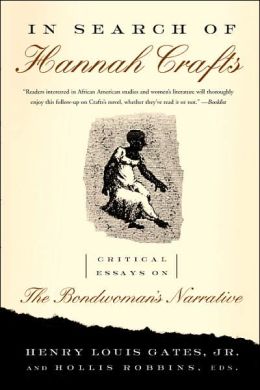
The Bondwoman's Narrative - Hannah Crafts / Hannah Bond

Composed in the last half of the 1850's, The Bondwoman's Narrative was not published until 2002, as part of the series of slave narratives Henry Louis Gates, edits.

What makes this particular narrative special is that it is a novel, the only novel we know of at this time, written by an escaped slave herself, about slavery and the lives of the variety of slaves commonly living on a southern plantation, that was owned by a wealthy, powerful secessionist, John H. Wheeler.

Among other career moves, in the 1850's Wheeler facilitated his friend, William Walker's filibusters in Nicaragua -- the second one concluded with Walker's execution, and Wheeler fleeing to the U.S. Wheeler was a member of his good friend Buchanan's administration. He occupied more than one high position in Jefferson Davis's abortive administration of the CSA.  He is the author of Historical Sketches of North Carolina from 1854 to 1851; early in the Introduction, Wheeler, tellingly, for a secessionist, quotes Walter Scott.  Published originally in 1851, it was republished in 1925 as part of the New York Confederate Carpetbagger literary movement that flogged the Glorious Lost Cause and whitewashed slavery out of the Civil War.

More to the point is that man who was able to compile a history and write a book, who references Sallust and Scott, would have a large library and have on hand ample paper and ink. This means a house slave such as Hannah Bond was, would have access to both books and writing supplies. If we are honest, this would not be the case in most planters' mansions, for whom writing and study were low on their list of preferred leisure activities.

Merely knowing, then,  who was the owner of The Bondwoman's Narrative's author, provides all sorts of information for an historian.  That this information comes to us from a slave's perspective is so rare as to be non-existant.

Only this year has the identity of the author been definitively tracked down and authenticated.


As described in the New York Times last month, here are the details of the conclusion of that quest to discover and authentic the identity of the author of The Bondwoman's Narrative.  This quest to uncover Hannah Crafts's identity was embarked upon by Henry Louis Gates after he bought the manuscript at an obscure auction in 2001. In his edition of the novel Gates details the frustration of dead end twists and turns of his own failure to learn who Hannah Crafts really was.

From the NY Times description of Bond's novel:
The book, whose language borrows from 19th-century Gothic novels, traces the story of its narrator, who endures life as a slave on a North Carolina plantation and, aided by her light complexion, successfully escapes to the North.
That tale closely mirrors the story of Bond. Enslaved on a plantation in Murfreesboro, N.C., Bond is believed to have been a self-educated woman who worked as a maid to the mistress of the house, Ellen Wheeler, assisting her with errands and personal duties, like styling her hair.
But around 1857, Bond disguised herself as a boy and escaped, fleeing first to upstate New York and then to New Jersey, where she eventually married and found work as a schoolteacher.
Beyond the interest The Bondwoman's Tale provides to an historian, due to the Victorian fiction models Bond employs, from the Brontean Gothic to Dickens's social commentary, the tale itself is an exciting one.

Most affecting in some ways for this reader, is the awareness that this novel was never published in Bond's own lifetime.  For years after its discovery scholars doubted that it was written by an escaped slave at all, due to the literary references and high degree of skill in both handwriting and composition.  Yet, finally, here it is, for the world to read, complete with the knowledge that Hannah Bond is the author.