Lordessa, was he ever a anti-semite, which makes me feel badly, very badly. Because he was a great historian. There simply is nothing in the discipline of history scholarship like his volumes of the administrations of Jefferson and Madison. There's nothing like his work about the Civil War or about the Haitian Revolution. There can't be because no one else who has ever worked with these events was alive and / or direct descendant of, who knew these relative in his life time, as well as so many of the other primary players. He also wrote penetratingly of other significant figures and events in American history, including John Randolph and Alfred Gallatin.
It's the Dreyfus Affair. It went on for years (1894 - 1906). It was a mobilization of ugliness and hate -- hate of everything -- as great any as we saw in the Civil Rights ere here, though, unlike here, it doesn't appear that anyone was actually killed for believing in the innocence of Dreyfus and the culpability of the French army and government in forging evidence and wrongful conviction.
By then Henry Adams was in the depths of bitterness, anger and resentment. It seems to have been triggered with the estrangement from his wife, Clover, her breakdown and suicide, as well as the lack of recognition by the public at large and his peers particularly of the startling achievement of his work with Jefferson and Madison. He turned his back not only on the U.S. but on American history. He spent most of his time in Europe, particularly in France and immersed himself in the medieval ages. For him, considering the results of this, it meant the French middle ages. As you see in that quite stupid book that was the result, Mont-Saint-Michele and Chartres, he didn't understand the Middle Ages at all, and beyond that created an idealized fantasy of them, in a French version, that wouldn't be out of place in a role playing fantasy game today.
These ideas, along with his personal bitterness, anger, and sense of betrayal, he projected upon poor Dreyfus -- as did all of France project whatever they wished upon him, and by the end, so did the world.
Mr Adams, Mr Adams, oh how I wish you had been a better man. But as well as their place in society and their brilliance, you inherited some of the bad qualities of your distinguished forebears, and it took over your life. But they died peacefully and happy. You died -- deeply disappointed
Thursday, May 22, 2014
Television Series, Hieroglyph - Coming Soon!
My prophesy is this series will be panned by puffers and 'critics' because spelling 'hieroglyph' and pharaoh' will be too much of a pain. Otoh, t&a + violence quotient in 'exotic' milieu may be just what the doctor ordered.
![]() |
| Doesn't he just look dynastic Egyptian as eff? Or -- Is he Young Merln all grown up? Or -- backwards as Merlin's legend has it? Also why is your name Ambrose? |
![]() |
| Why are most of the principals white? |
Description plus trailer, here. Is it a spoiler if it is suggested that while watching the trailer watch out for the fangs?
Wednesday, May 21, 2014
American the Beautiful
Hate, bigotry, ignorance are attractive, elegant and witty.
This is the legacy of slavery in this country, the consequence of which we all are heirs still, today.
Tuesday, May 20, 2014
Is This Caused by Gender?
The American Slave Coast, focused as it is on slave-breeding and the domestic slave trade, cannot avoid addressing certain matters such as actual birthing. One of the themes runs something like this: when all women, even the most elite and privileged women, have no rights to their own bodies, no legal standing to refuse sexual advances, predation, abuse and rape from their own husbands -- and even their husband's friends*, have no control over their reproduction, are shamed and blamed if they do not reproduce to the extreme of their reproductive capacity, when obstetrics were brutal when they existed at all, and the consequences are frequent and early death for both woman and infant -- what do you think it was like for the most powerless of all women, an enslaved, fertile woman? She is certainly not receiving adequate nutrition, doesn't even have a bed frame or floorboards in many cases, is overworked right up to and rapidly after birth.
But we needed to do some fact checking on some statements we've made, such as the enslaved frequently followed the birthing practice of many African cultures, squatting in the later stages of labor and the birth, which also helped expel the placenta-afterbirth more rapidly and completely, while white women did not do that.
Well, now, is that a fact, or is it a supposition merely? How do you find out?
Due to a computer problem my search privileges in my research library consortium were temporarily revoked. No access. El V couldn't find a thing: every search defaulted to present day Africa, African American, American, African birthrates, maternity care, etc. He couldn't find anything that addressed birthing practices in the pre-Civil War south. As this is was such an intimate matter, and one that was considered obscene -- no decent woman would be talking about this, much less keeping track and writing about it -- much less a man, who was interested only in the child arriving and living and increasing his wealth.**

When I was able to get back into the research libraries' resources and typed in a string, which I think was -- birthing slaves antebellum south. Voila, though the body of research published in this area is small, there is a group of dedicated historians who have been working to compile the information and stats. One title in particular, is a whole book, published in 2006, and is on the shelves here locally at Bobst. Now we can confirm the statements as false or fact: Birthing a Slave: Motherhood and Medicine in the Antebellum South, by Marie Jenkins Schwarz.
El V is a grand champion searcher. But he didn't get this, when I was able to on first try. Is it that he just didn't have the gender intuition of the right string of terms?
-----------------------------
* For notable example, Thomas Jefferson attempted "to seduce" forcibly, i.e. rape, the wife of one of his closest friends -- full account in Meacham's The Art of Power, an historian who deeply admires TJ. He tried it on more than once, while his friend was absent, in the army, and she was alone, even so much so he climbed on top of her while she was sleeping in her bedroom. She fought him off, was terrified and disgusted to be around him for years before she told her husband, who then wanted to fight TJ in a duel, but TJ managed to placate and get away. No way was the physically cowardly TJ capable of facing anyone in a duel. Then, of course, he bred his wife, whom by all evidence he dearly loved, to death.
** Note, how even today right wing white southern males demonstrate nearly every time they open their mouths their complete ignorance of how reproduction, birth and all their associated systems work, as well as maintaining contemptibly stupid convictions of how these matter do operate.
But we needed to do some fact checking on some statements we've made, such as the enslaved frequently followed the birthing practice of many African cultures, squatting in the later stages of labor and the birth, which also helped expel the placenta-afterbirth more rapidly and completely, while white women did not do that.
Well, now, is that a fact, or is it a supposition merely? How do you find out?
Due to a computer problem my search privileges in my research library consortium were temporarily revoked. No access. El V couldn't find a thing: every search defaulted to present day Africa, African American, American, African birthrates, maternity care, etc. He couldn't find anything that addressed birthing practices in the pre-Civil War south. As this is was such an intimate matter, and one that was considered obscene -- no decent woman would be talking about this, much less keeping track and writing about it -- much less a man, who was interested only in the child arriving and living and increasing his wealth.**

When I was able to get back into the research libraries' resources and typed in a string, which I think was -- birthing slaves antebellum south. Voila, though the body of research published in this area is small, there is a group of dedicated historians who have been working to compile the information and stats. One title in particular, is a whole book, published in 2006, and is on the shelves here locally at Bobst. Now we can confirm the statements as false or fact: Birthing a Slave: Motherhood and Medicine in the Antebellum South, by Marie Jenkins Schwarz.
El V is a grand champion searcher. But he didn't get this, when I was able to on first try. Is it that he just didn't have the gender intuition of the right string of terms?
-----------------------------
* For notable example, Thomas Jefferson attempted "to seduce" forcibly, i.e. rape, the wife of one of his closest friends -- full account in Meacham's The Art of Power, an historian who deeply admires TJ. He tried it on more than once, while his friend was absent, in the army, and she was alone, even so much so he climbed on top of her while she was sleeping in her bedroom. She fought him off, was terrified and disgusted to be around him for years before she told her husband, who then wanted to fight TJ in a duel, but TJ managed to placate and get away. No way was the physically cowardly TJ capable of facing anyone in a duel. Then, of course, he bred his wife, whom by all evidence he dearly loved, to death.
** Note, how even today right wing white southern males demonstrate nearly every time they open their mouths their complete ignorance of how reproduction, birth and all their associated systems work, as well as maintaining contemptibly stupid convictions of how these matter do operate.
Labels:
NYC,
The American Slave Coast,
U.S. slavery,
Women
Monday, May 19, 2014
The Most Pleasurable Part of the Publication Process
The very best part of the publication process (besides seeing that actual book as a book!) is writing the acknowledgments. We're working on them this week.
Sunday, May 18, 2014
Mapping the Spread and Distribution of U.S. Slavery
These are nineteenth century thematic maps.
From Lincoln Mullen's blog entry, "Mapping the Spread of American Slavery" -- and another version at the Smithsonian site:
![]() |
This one was a favorite of President Lincoln's."The map showed at a glance the large-scale patterns of slavery in the American South: the concentrations of slavery in eastern Virginia, in South Carolina, and most of all along the Mississippi. It also repaid closer examination, since each county was labeled with the exact percentage enslaved. The map of slavery was one of many thematic maps produced in the nineteenth century United States.
This is part of Mullen's commentary as to the utility of such maps to doing history and creating one's arguments:
The first thing to observe is that slavery spread more than it grew. The population of slaves in 1790 or 1800 was already very high compared the maximum population levels. In fact, in Charleston County, South Carolina (one of the counties with the highest populations of slaves) the number of enslaved people in 1860 was only 63% of what it had been in 1840. This is not to say that the total number of slaves in the eastern seaboard states did not go up over time. But the number of enslaved people in a particular place did not grow at anything like the rate of free people in the north. The free population in the north both grew in the same place and spread to the west. The slave population had a different dynamic. It grew in intensity in places around the Chesapeake bay, even as slavery was gradually abolished in the North. But primarily the slave population spread to the fertile crescent of lands in Georgia, Alabama, and Mississippi, and most of all to the Mississippi River valley. Below you can see two animations of the density of the slave population and the density of the total population (keep in mind that the scales are different). What you see in these maps is the spread of slavery through the domestic slave trade. You also see the origins of the sectional crisis in the continual expansion of slavery.
I.e. we see the domestic slave breeding industry and the domestic slave trade in action in his animated maps.
These maps, and their use for understanding populations' numbers, growth and distribution, demonstrate how important statistics are to understanding history, particularly within the context of both past and present. A person cannot understand or "do" history without numbers, starting, of course, with the first law of history: chronology. |
Tuesday, May 13, 2014
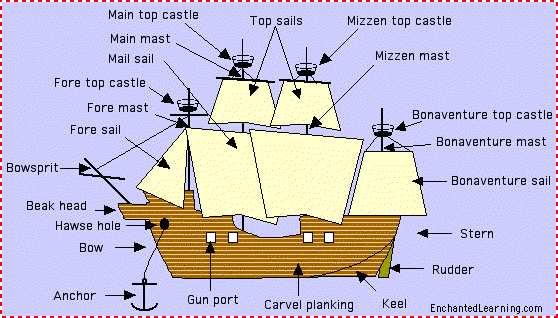
Found -- Perhaps -- Columbus's Santa Maria
From the UK Guardian, an announcement that perhaps the wreck of Columbus's flag ship, the Santa Maria, has been discovered in the waters off the coast of Haiti.
Shipwreck found off coast of Haiti thought to be one of the most significant underwater discoveries in history by David Keys:
Tragically, many of the signifying objects, such as the cannon, that would help investigators definitively identify the ship have already been looted since it was first looked at in 2003.
Shipwreck found off coast of Haiti thought to be one of the most significant underwater discoveries in history by David Keys:
The Santa Maria was built at some stage in the second half of the 15 century in northern Spain’s Basque Country. In 1492, Columbus hired the ship and sailed in it from southern Spain’s Atlantic coast via the Canary Islands in search of a new western route to Asia.
After 37 days, Columbus reached the Bahamas – but, just over ten weeks later, his flagship, the Santa Maria, with Columbus on board, drifted at night onto a reef off the northern coast of Haiti and had to be abandoned. Then, in a native village nearby, Columbus began building his first fort – and, a week later, leaving many of his men behind in the fort, he used his two remaining vessels to sail back to Spain in order to report his discovery of what he perceived as a new westerly route to Asia to his royal patrons - King Ferdinand and Queen Isabella of Spain.
Tragically, many of the signifying objects, such as the cannon, that would help investigators definitively identify the ship have already been looted since it was first looked at in 2003.
"The investigation into the wreck is being supported by the American TV network, the History channel, which has secured the exclusive rights to produce a major television programme on the subject."
Labels:
caribbean,
European history,
Haiti,
history,
U.S. History
Subscribe to:
Posts (Atom)