LINES OF THE DAY

". . . But the past does not exist independently from the present. Indeed, the past is only past because there is a present, just as I can point to something over there only because I am here. But nothing is inherently over there or here. In that sense, the past has no content. The past -- or more accurately, pastness -- is a position. Thus, in no way can we identify the past as past." p. 15

". . . But we may want to keep in mind that deeds and words are not as distinguishable as often we presume. History does not belong only to its narrators, professional or amateur. While some of us debate what history is or was, others take it into their own hands." p. 153

Silencing the Past: Power and the Production of History (1995) by Michel-Rolph Trouillot

Tuesday, January 7, 2014

Zora Neale Hurston's 123rd Birthday Gets a Google Doodle

Here is is.  Of course, googling Google, brings it up too.  Better, clicking Google's Doodle brings up links to this great African American writer that provide all the necessary information as to why Zora Neale Hurston rates a Google Doodle.


Today, one cannot help but wishing one could hear Ms. Hurston speak of this novel, or, this one, from last year, or, that one, from 2008, and those who wrote them?

Nice white ladies, still profiting from slavery and Jim Crow. I think about this all the time, in connection with The American Slave Coast, though we have been told frequently there is no comparison to spending years studying, researching this as history and writing fiction as a white person, in which, when African Americans speak or write, they write and speak their own words, as recorded in primary documents they made, not words put in their mouths by the white person. Whereas African Americans have told me that white people writing African Americans usually make them feel as through they're hearing a white singer sitting there on stage, moaning, "I always got trouble 'cause I'm a black-skinned man."

On the other hand, one of the links above goes to a site titled "Strange Fruit," an homage, presumably to Billie Holiday and the song Billie Holiday made famous. "Strange Fruit"  was written by a white Jewish American Communist, Abel Merrenopol.

In another instance, this time fiction too, the mystery series by white writer, Barbara Hambly, featuring Benjamin January, a free man of color in the New Orleans of the 1840's, has a feel that feels right: it is adventurous, it is always perilous for January and his loved one just because of who they are, even when they are free.  However, Ms. Hambly has lived in New Orleans; she's an historian in her day job, so she knows how to learn the past, how people live and speak.  As well, Benjamin January, his wife and most of the other people of color we encounter in this series are generally at least as well-educated as the white people in the novels, if not more educated.  They spend a lot of time in the company of white people too, particularly January, who is a professional musician, since his real day-job, that of a Parisian-educated physician isn't making him the sort of money a white Parisian-educated physicians would make in New Orleans.  For one thing the white doctor could / would treat well-off white patients, while this isn't going to happen for January.

Still, I keep going back to examining my conscience here.  If I were an Adams, at least an Adams of the generation of John Quincy or before, I'd be praying about this all the time.

Sunday, January 5, 2014

Louisa Catherine Adams In Winter

Louisa Catherine Adams met John Quincy Adams first in Nantes, when she was four-year-old Louisa Catherine Johnson, and he was twelve.


They met again in London, when he was thirty and she was twenty-two.  She married him, he who had already been a name in diplomacy from D.C. to Russia to Amsterdam and London, who had already experienced multiple perils and adventures.  Now Louisa's perils and adventures began -- starting with her father's bankruptcy and abscondence back to America while she and John Quincy were honeymooning in Scotland.  Her father's bankruptcy not only lost the couple the dowry-allowance Johnson had settled upon his daughter, but the creditors demanded that John Quincy be responsible for Johnson's debts.

In the meantime the couple had spent $2500 -- a very large amount in the currency of the time, and a substantial portion of their bank account -- to send their clothes and belongings to Portugal, where he was posted as minister, only to be told the American government changed its mind and was instead sending him to Prussia. What, what to do.  Somehow they did and become particularly beloved by the Prussian king and queen. Louisa miscarred more than once, which deeply concerned the queen. The queen gifted Louisa with a cosmetic set including rouge, which the Queen insisted she wear, as Louisa was pale from blood loss.  John Quincy scrubbed it off her face himself, her first encounter with the impossible John Quincy, rather than the passionate, poetic, tender JQ she'd heretofore known.  It was only the beginning of the impossibilities.


Perhaps the most impossible thing John Quincy did, while safely ensconced in himself, in France and the Netherlands, negotiating the Treaty of Ghent that settled the War of 1812, was to order his wife off to Paris from St. Petersburg, in the dead of winter, across the smoking ruin that was Europe in the tail end of the Napoleonic wars: hostile, conflicting armies, starvation, disease, desperation, bandits and criminals. Louisa was accompanied by her seven-year-old son, Charles Francis (Henry Adams's father), a man-servant, John Fulling, Madame Babet, a nursemaid hired the day before she departed from St. Petersburg, and Baptiste, a low-ranked prisoner of war who agreed to accompany them in exchange for his freedom. What the EFF was JQA THINKING???????  No wonder within the Adams family Louisa's journey became a thing of growing admiration and legend.  Even she began to see it that way, and was persuaded to commit the experience to paper.

The tale of her perils and her brilliance in extracting her tiny company from them is told by Michael O'Brien in Mrs. Adams in Winter:A Journey in the Last Days of Napoleon (2010).  Like her husband's 14,000 word diary, kept from the time he was twelve, Louisa's travelogue from St. Petersburg to Paris in the winter of  1815 is a unique document in American history. Her family and Louisa were correct,deeming this is one splendid tale.  Most of all, it is a tale of women, and how they do, not only Louisa, but all sorts of women she encounters along the journey.

Serendipitiously that O'Brien's book came as a gift this Christmas.  Like Nicola Griffith's Hild, this is another story centering women that feels so right to read in the dark days of the year, particularly this year that has brought the U.S. and the UK such terrible weather of cold and snow, ice and flood.

Saturday, January 4, 2014

Beat the Polar Vortex Assimilation With East Texas Woolly Bully!

G-D it's cold!  I haven't experienced cold like this since leaving North Dakota winters behind.  North Dakota winters were an excellent reason for leaving North Dakota behind.

It's only going to get worse They Say here and other places.

So pull up that Woolly Bully San Antonio heat with Sam the Sham and the Pharaohs:


Can you call this Gulf music?  San Antonio isn't that far from the Gulf. I swear I hear some New Orleans influence in this Chicano hit from the 60's.


Friday, January 3, 2014

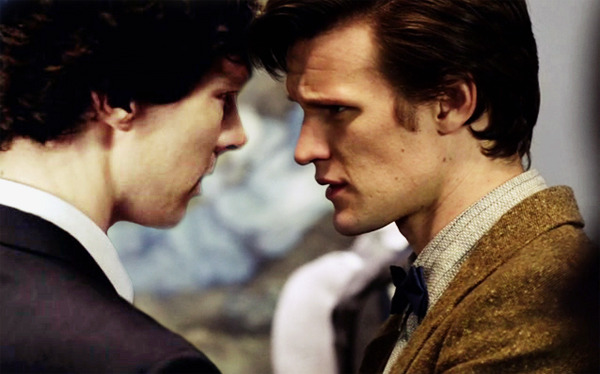
Shaping Series Sherlock

"Sherlock and the Doctor," by Mark Lawson, is an interesting article about the current development in television series, particularly those that have appeal to fans of certain genres, getting shaped more by what the segment of serious fans want than by what writers think are best, in terms of character development and relationship development, structure and composition.

Further, Lawson has noticed that the fans' pressure to turn Sherlock into Who and Who into Sherlock - that always favorite thing of fans, mashing-up.


It's been noticed over here too, that for a while now, a clamor for good parts, all good parts, only good parts and the good parts that I think are the good parts to become the shows. It's a reminder of elements that make other kinds of entertainment different from how it's done in porn. In porn, we don't want foreplay, we don't want characters doing surprising things, we don't even want a story, we just want to see it, and we want to see it now and always and forever, world without end, amen.

The discussion, mostly, in the many comments in response to the article is about evenly divided, as to agreeing with the article's writer, and those who say, being British, "Rubbish, I love good parts, I deserve to get all good parts, I demand all good parts!"


I Was Wrong

10 degrees here shortly before 9 AM, and still snowing, though fairly lightly by now.


Some flakes began to fall about a block after we set off for the subway at dinner time to hook up with our friends. By the time we arrived in the east 20's it was coming down smartly. When we left the Jazz Standard it was pouring snow with already about an inch accumulated. So far we've got at least 10 inches in Central Park. The wind is getting nasty. So I was wrong about what we'd get out of this storm. (But I like to be optimistic about these things -- since snow in the City is such a pita.)

Butler on the piano of course; Steve Bernstein, one of the best trumpet musicians currently around ; Steve also conducted the Hot 9.  Great performance, and I felt I was back in New Orleans.  Until I went outside again.
One of our friends had planned to take a bus back to Virginia after Henry Butler and the Hot 9's set. As her bus didn't leave until 3 AM I'm guessing this day will not find her back in Williamsburg, where she's on the music faculty at William and Mary.

My other prognostications for yesterday, however, all turned out correct.

Plus the pulled pork is now cooked. I turned on the crock pot about 3:30 PM yesterday, and by this morning it was perfect. Who knew? It was a lot easier than doing in the oven.

Everything is closed -- schools, etc. Except the subways, though a few of them have been barned to keep them out of harm's way.

Tonight it's supposed to be 5 degrees. A dramatic beginning to 2014, and to NYC's de Blasio's spanking new mayorship. Incidentally, there's a vid posted on the NY Times website of Bill de Blasio shoveling the snow in front of the family's Brooklyn house. I thought they'd agreed as a family to move into Gracie Mansion?  But on fb, again, according to the Times, when their son's friends asked him to pressure his dad to close school in NYC today, NYC's first lady posted as response to what Dante would be doing if the schools were closed, photos of a snow shovel and sack of salt.  Incidentally2, the video of the shoveling mayor is very short ....


Thursday, January 2, 2014

Frozen Bubbles

The bubbles in this photo gallery on the WaPo's site were created and frozen by photographer, Angela Kelly.

Take a look, here.


Wednesday, January 1, 2014

2014, tu es arrivée ...

The new year began with me sleeping until nearly noon.

Then off to the New Orleans gumbo and jumbalaya party uptown, where almost all the guests work with history and / or writing in some form or another, and / or music or other media such films, animation and so on in some way. The guests were as much a variety as the food.  Party made to order for the likes of us, if you ask me.


At one point Our Hostess asked el V to describe our book.  He began with the title: The American Slave Coast: A History of the Slave-breeding Industry.  And from then on everyone present in that part of the apartment hung on every word, and more and more people came from other parts to listen too.  Then all kinds of questions.  People -- and particularly the African Americans -- got out pen and notebooks to write down the title, authors, publisher and pub date.


People seem to want to know this material, are very interested in it..  Which is a very encouraging sign, since this happens everywhere we talk about the book.  But then, we're usually in a situation with people like this, so, who knows?