LINES OF THE DAY

". . . But the past does not exist independently from the present. Indeed, the past is only past because there is a present, just as I can point to something over there only because I am here. But nothing is inherently over there or here. In that sense, the past has no content. The past -- or more accurately, pastness -- is a position. Thus, in no way can we identify the past as past." p. 15

". . . But we may want to keep in mind that deeds and words are not as distinguishable as often we presume. History does not belong only to its narrators, professional or amateur. While some of us debate what history is or was, others take it into their own hands." p. 153

Silencing the Past: Power and the Production of History (1995) by Michel-Rolph Trouillot

Showing posts with label Vodun. Show all posts

Sunday, February 26, 2023

The Woman King

     . . . .  The Woman King (2022) on Netflix. 
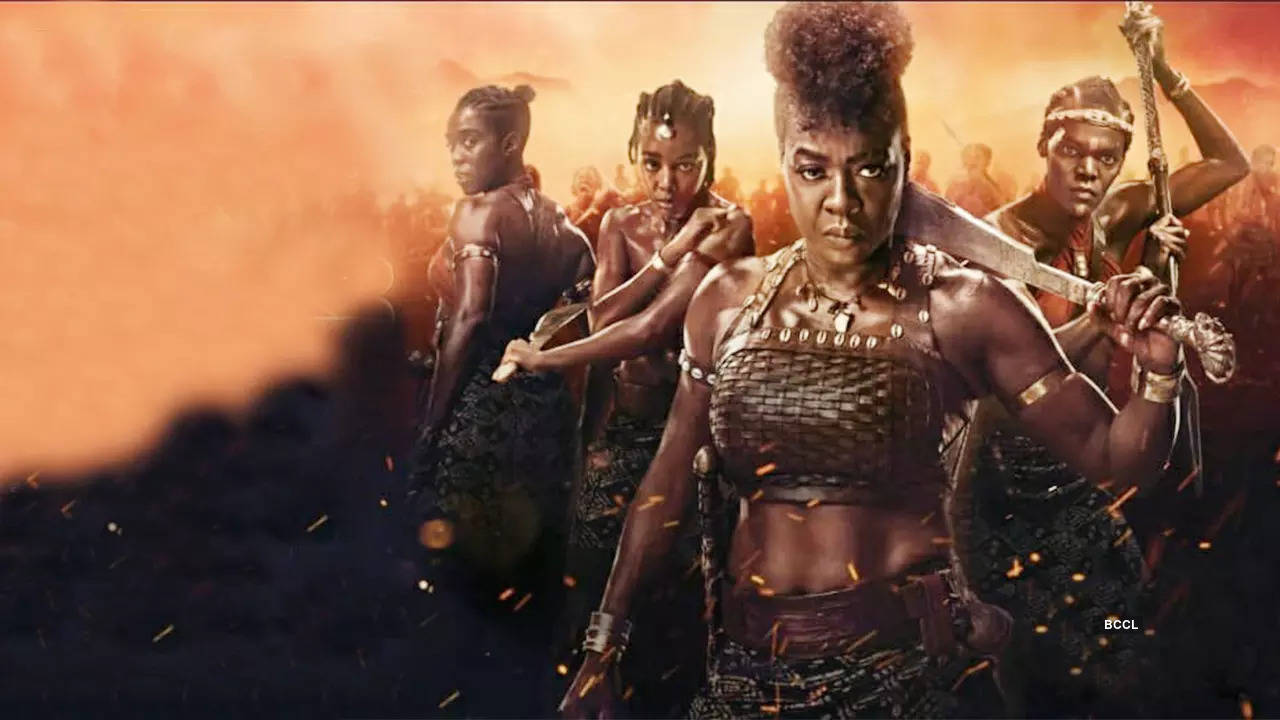


The film has been shut out from all the awards and their categories – too womanly. All the criticisms that declared it ignored or distorted Dahomey’s slaving of Africa must be from those who don’t know this history. just heard something somethingv from somebody somewhere. This slave or be slaved history is central to the narrative. That criticism seems to be pushing the relentless attitude that Africans remain ahistorical until white historians inform them of their own history.

The people of Dahomey/Ouida and Oyo knew why this condition was in place, and how it happened, and who was benefiting as well as how much Africans of every group were exploited and plundered as entire peoples. Those who benefited were the  Europeans and USians, as well as the Islamized tribes working in concert, such as the Fulani and the jihad of the time against the Oyo Empire, which too, was all about the riches from supplying the European slavers. 
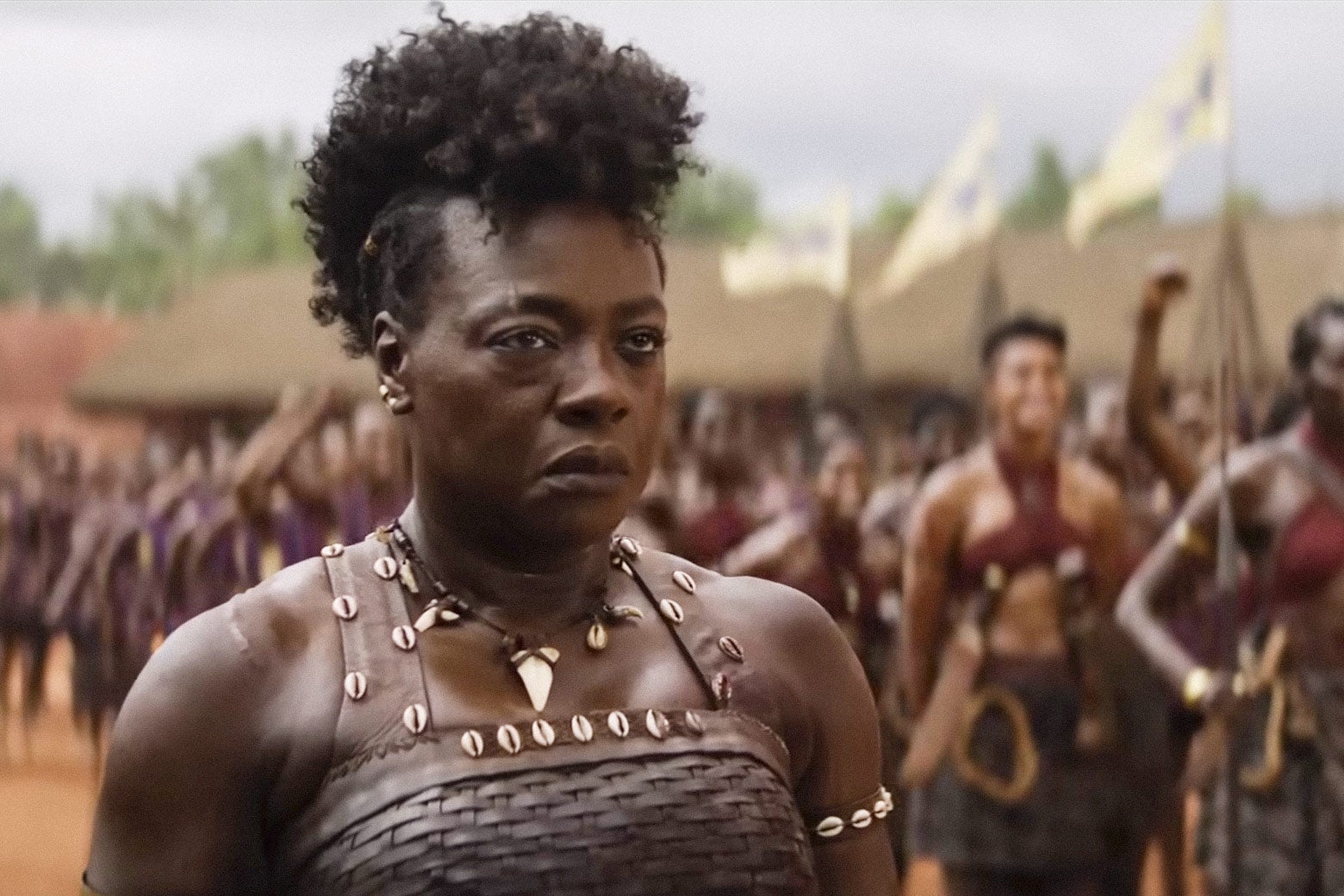


The Agojie commander, Nanisca, played by Viola Davis, is brilliant, as advisor, general and warrior who is at the prime of her strength, but whose body is scarred and has aches and pains from so many wounds, whose heart and mind carries just as many scars and pains. As right hand to the king Nanisca is expected to have wisdom as well as battle skills. And she does; Nanisca sees the future, not only of her own Dahomey, but all of Africa, being slaved and enslaved by the Europeans.  She has this vision, but how to change matters so they – and other kingdoms – stop slaving themselves and each other, and instead create wealth and prosperity through other means. Ah, that is very difficult, not only to do, but to even envision, much less convince others to do, such as the 'nobles' and queens of the Dohomean king's palace.  Slaving is embedded throughout the continent as economy, offense and defense, and status.

The milieu of this woman army is a fascinating, welcome contrast with both Wonder Woman’s Greek vase and statuary fantasy landscape, superhero comic girlhood training, and with the super hero Afro Futurism of Wakamba. Those superhero comix adaptations are slick, smooth, cheesy and tacky when viewed in company with what we see here, as the film reaches to recreate the dust, mud and natural world of historic reality, including how women are physically, who have been trained from youth to be "Agojie",  warriors who command armies, who fight, kill and are killed – or are captured. Taking a famed Agoji ewarrior is a coup indeed.
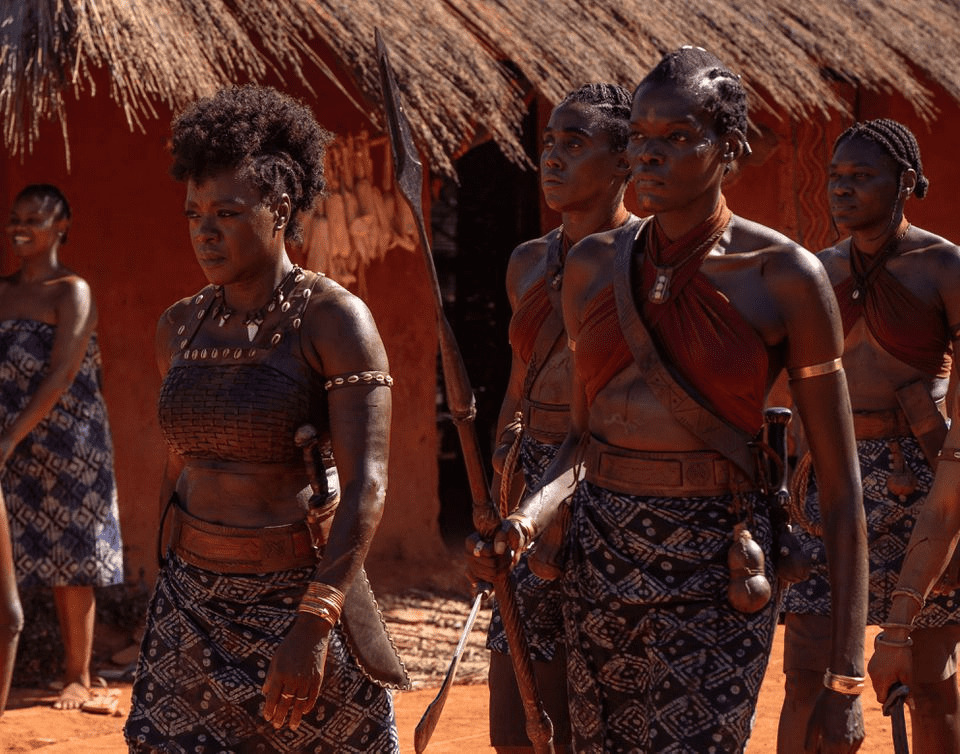


As an army of warriors these women claim physical space in a way one never sees women who are to be good, traditional women do.  They claim physical space in the same matter-of-fact, unconscious way that men do. They walk differently, sit differently, move and are still, differently from traditional women. These women are like men, while – and this is what is so brilliant in the acting, one would never mistake them for men, ever.  They are fully womanly, women like all women, but who have all the masculine space and entitlement – except to have partners and children. 

Dahomey's indigenous religion is depicted in a most matter of fact manner.  This is what we know in the US as Vodun, as it was imported via slavery to San Domingue/Haiti, Bahia in Brasil, and to the US, via French slave owners who refugeed to Cuba. and, when Spain and France went to war, to New Orleans.  The altars where our figures meditate and meet on occasion are as much natural parts of their world, as the lands outside the walled city and palace. 

What follows is me interpolating, because I've not encountered this in any of the books I've read. However, presumably, such effective warriors and commanders must be prevented from having their own children because – in the end – even these women must be ultimately subservient to male power – the king.  A successful, brilliant commander, to whom the army is devoted and loyal, a woman with her own children might well be interested in taking the throne herself, or for her children, instead of merely serving a king's wishes and status.*  Indeed, the film includes the oral tradition that at least once Dahomey was ruled by a Woman King commander of an army of women warriors.

There was not, cannot be a happy ending for the slaving Kingdom of Dahomey, despite winning all the battles ... but happiness is allowed. Around the 2/3 point, the story line includes that of a mother and daughter finding each other, in this time when vision tells them both, the world will not get better. Yet, Viola Davis is recognized by the King again, as his chief advisor, no matter what his wives and courtiers want.  She may end her life free and honored, but we can almost sure thing bet her daughter's life is going to be even more difficult than hers, as the French become determined to take out the Dahomey kingdom, and are horrified by the women who go to war.

This film mesmerized me from start to finish, which I can’t say about hardly any film, television series or novel these day

*  There are many instances in history across the world where a ruler's successful military leader has taken power for himself and his family, so one will speculate!

Saturday, October 29, 2022

The Mothers of English Historical Novels - Plus Fèt Gede

     . . . .  Sister Novelists: The Trailblazing Porter Sisters, Who Paved the Way for Austen and the Brontë by Devoney Looser (2022).


Washington Post review herewhich upon reading the review, I immediately ordered the biography. These Porter sister novelists were the mothers of English historical fiction. I have often invoked Sir Walter Scott as the father of historical fiction (and Dumas as godfather), but as deep as my knowledge of English literary history is, I'd no idea these women had existed.  Can we guess why, one wonders . . . .

 Maria and Jane Porter published the first Brit historical fiction in novel form in several books in the first decade of the 19th century.  


Delaware Art Museum 
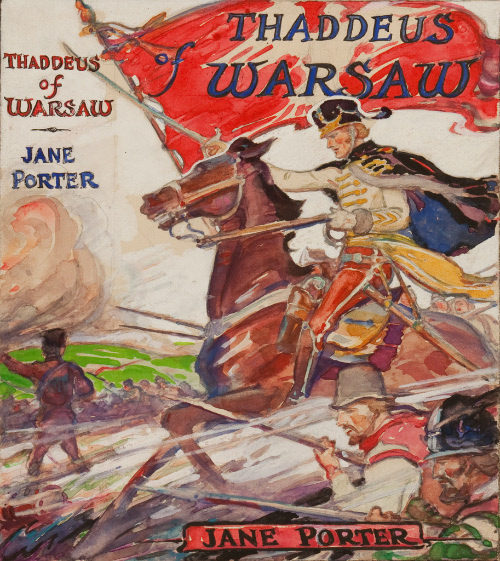
Book cover design for Thaddeus of Warsaw, by Jane PorterATTRIBUTED TO: Walter Stewart (American illustrator and painter, 1902–1981) 


Maria Porter, in her 1803 Thaddeus of Warsaw, created

... “the historical novel as we know it” in her 1803 tale of a Polish war hero who becomes a refugee in England. “What was new about ‘Thaddeus of Warsaw,’ ” Looser explains, “was its mingling of climactic historical events with the conventions of biographies, romantic tales, and probable domestic novels.” Contemporary critics dubbed it “a work of genius,” and it was a sensational bestseller. ....


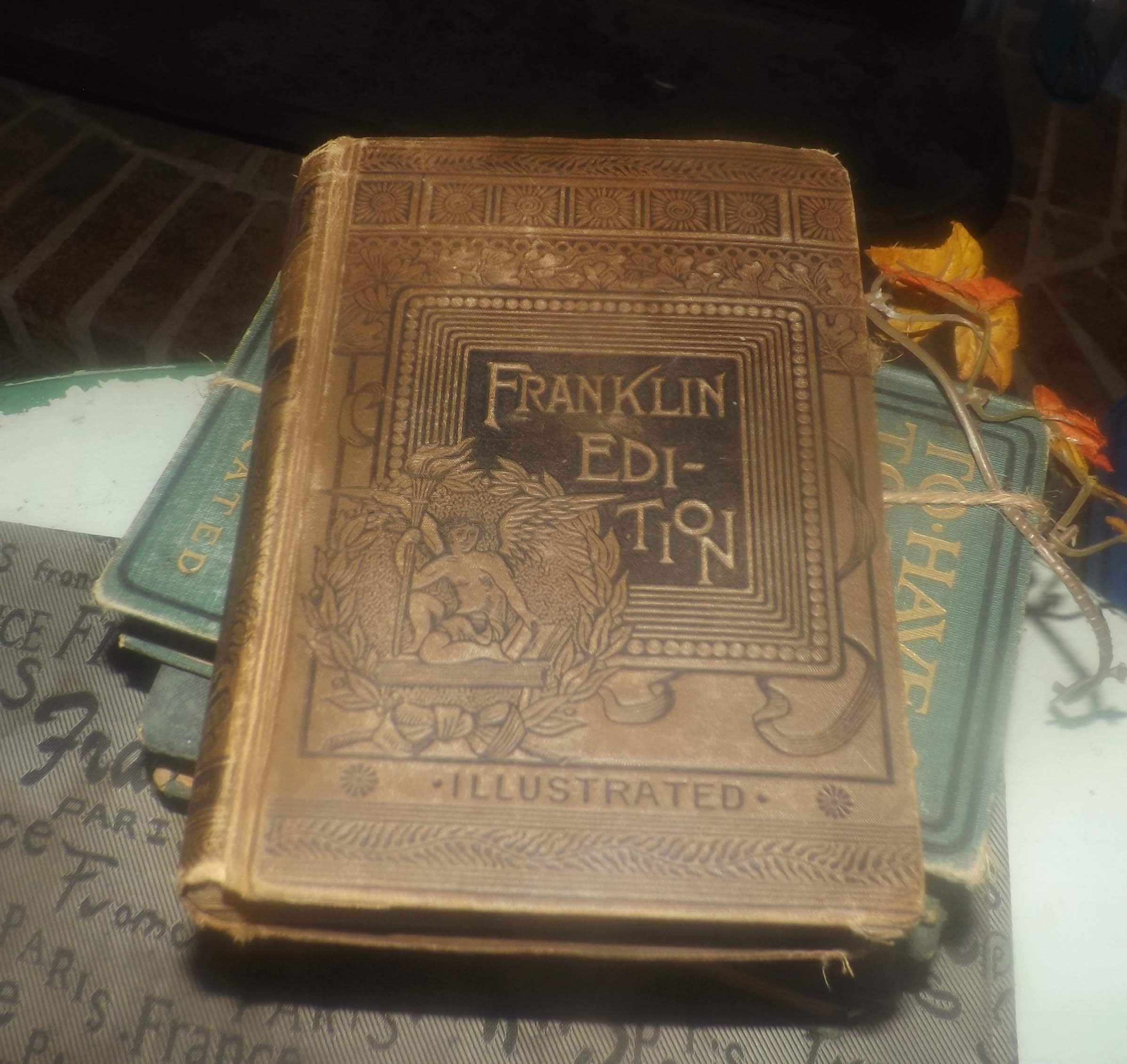
ANTIQUE (1810) FIRST-EDITION HARDCOVER BOOK THE SCOTTISH CHIEFS. JANE PORTER. FRANKLIN EDITION. PUBLISHED PRINTED ENGLAND BY WORTHINGTON


In 1810 Jane Porter published The Scottish Chiefs, telling the tale of William Wallace’s battle for Scottish independence from Britain, published quite prior to Scott’s first novel, Waverly, 1814, that told of of the 1745 Jacobite rebellion. 

These two sisters’ novels were massive hits, best sellers, out of the box. Would that have had any influence on Scott’s literary choice of form and subject?  One commentator to the review observed,

 "I find it interesting that of the twenty-six ‘Waverley novels’ written by Walter Scott not one was set during the time of William Wallace and King Robert I." 

Author Looser did address this -- how could she, how can we, not?

... [Looser] is more cogent on the question of why these popular and influential authors are virtually unknown today. The root cause of the sisters’ decline in literary reputation and, eventually, sales, Looser writes, was the phenomenal success of Walter Scott’s “Waverley” in 1814 and the author’s failure to acknowledge that the methods he employed in his historical novels were very similar to the Porters’: “Critics would increasingly claim that the Waverley novels had elevated the genre of fiction — and especially historical fiction — bringing to it a superior new (masculine) excellence, while correcting supposed previous (feminine) faults.”

Are we surprised yet?

.... Jane in particular resented this and in 1827 wrote a pointed short story, “Nobody’s Address,” that implicitly accused Scott of reducing his literary precursors to nobodies. By the time she died in 1850, having survived Maria by 18 years, Jane had been reduced to living with a brother and receiving charitable grants from the government. Her achievements deserved better recognition, and although Looser’s thickly detailed biography could stand to be a little less detailed, it pays overdue tribute to pioneering siblings unjustly neglected by literary history. ....

~~~~~~~~~~~~~~~~~

     . . . . A perfect day -- gold, red and blue -- so clear and still, low humidity for a change, and the temperature in the seasonal 50's. Receiving audio royalties for The Books, was a good start to the day. However,  packed restaurants, streets and sidewalks. The annual Village Halloween Parade cattle stanchions are unloaded and going up too, for Monday, further blocking access to sidewalks and intersections.  Getting around down here is nearly impossible; I had to fight my way through the outsiders to my polling place. This is the first day of early voting in the Midterm election.  Alas there was so little, were so few, to vote for; mostly I was voting against. 

Weep for the city, weep for the state, weep for the nation, weep for the world. 

However, after Monday's Hell Night, Tuesday night, known in some places as El dia de los muertos and others as the Day of the Dead, in Haiti is Festival of the Dead,  Postmambo's Fèt Gede*, will zoom throughout the US and Europe.  This is the third year Postmambo is hosting a Gede festival: 


Postmambo Movie Night

presents

Fèt Gede in Weimar America

Tuesday, Nov. 1, 7 pm eastern

note earlier-than-usual start time

We'll warm up with some Haitian music videos, including some of my all-time favorites, namely RAM's videos featuring Gede, lwa of the dead. Including their new one, "Gede Vim Anwo." Mr. RAM himself, Richard A. Morse, has indicated that he will be able to drop in and talk to us from his pied-a-terre in New Orleans, where RAM is presently rehearsing and gigging, about these awe-inspiring videos.

==> Our main feature will be Maya Deren's Divine Horsemen: The Living Gods of Haiti, shot between 1947 and 1954. We'll talk about it afterwards with my fave co-host, Dr. Elizabeth McAlister. (Revisit her January 2022 Postmambo Session on "Funerary Rites in Haitian Vodou" here.)

==> More guests to be announced, including an instructor in Gede dancing . . . Drop in for Fèt Gede / All Saints Day / Day of the Dead / at whatever time you can make it on Tuesday Nov. 1, starting at 7 eastern and continuing until 11 or so. More info to come.

I'll be sending the Zoom link out to this list on Tuesday at 5 p.m. eastern . . .

Get your purple, black and white, your single-lensed shades and black bowler hat, and be your own Gede self


* Fèt Gede is naturally huge in New Orleans, as well as Haiti and eastern Cuba.  The Morse and Ram's pied-à-terre there is so important, not only for the cross-aculturation going on between them and the city's indigenous vodun population and musicians and Head, but because Haiti is so very very dangerous -- no exaggeration to say Haiti is very dangerous -- for everyone, on so many fronts from the second invasion of cholera, lack of water and food, drugs, gang and 'government' violence -- climate change.  You name it, it's there in the perfect storm of calamity that has come to this nation, thanks to relentless, historical, racist politics on the part of the US and Europe.

Saturday, October 30, 2021

Oct. 31: Postmambo presents ¡Que Viva la Muerte! Gède / kalunga / Death Metal Angola

      . . . . Tomorrow!  Sunday, Oct. 31!  It begins at 3:30 pm! (Eastern Daylight Time)

We'd love to have you with us. To participate, you need to have the Zoom link, which you get from the [seminar] mailing list (because [nedslist] is too big to send Zoom links to). If you're not already on that list, write me and I'll make sure you get the link.

A special one-day virtual event celebrating All Saints' Eve / Day of the Dead / Fèt Gede / Halloween


¡QUE VIVA LA MUERTE!

Long live death!

=> 3:30 pm: Jean-Daniel Lafontant will talk with us about Gède, the lwa of death whose day is celebrated all over Haiti.


=> 5:00 pm: scholar / educator / photographer C. Daniel Dawson talks with us about kalunga and death in Kongo thought and cosmology.


=> 6:30 pm: dinner break.


=> 8 :00 pm: a special edition of Postmambo Movie Night, presenting Death Metal Angola (2014), with filmmaker Jeremy Xido in conversation.  

* * *

COMING SOON!

November 11, 8 pm Eastern: NOLA Reconnect Sessions: Erol Josué talks with Dr. Elizabeth McAlister.

November 18, 8 pm Eastern: Postmambo Movie Night: Jason Berry presents his new film City of a Million Dreams.

Wednesday, May 15, 2013

After the Quake: Music, Politics, and Spirituality in Haiti

The final program in el V's HipDeep series that investigates the historical, political, cultural and spiritual elements in Angola - old Kongo, and the diaspora into the New World has been created.

This program focues on San Domingue in the past, and Haiti, as it was called, after the slave revolution.  Though program is centered after the terrible earthquake, it is not about the quake or rebuilding, particularly.  It's a wild, high velocity, high energy, fast moving show dealing with vodou and the music and culture, and how these both bleed into the political situation and are repressed by it. Among other things you will learn what a real zombie is, what it signifies. You can hear it here.


For this exclusive Afropop Worldwide Hip Deep report, producer Ned Sublette travels to Port-au-Prince, where he checks in with bandleader Richard Morse of RAM, and with Lolo and Manzé Beaubrun of Boukman Eksperyans, both of whom produced hotly controversial carnival songs this year. In a country where the president, Michel Martelly, was formerly the Tags – 1 dance-music singer, the complexities of politics are felt in music. We'll look at how vodou and carnival interact to provide a vocabulary for political expression in the tense post-quake atmosphere. We’ll meet 95-year-old Emerante de Pradines Morse, who was the first singer to perform the songs of vodou as entertainment in Port-au-Prince; we’ll hear from historian Laurent Dubois, author of Haiti: The Aftershocks of History; and we’ll go crowd-surfing in the crush of carnival at Jakmel, the southern Haitian port city that was once a colonial cousin to New Orleans. Produced with support from a Knight Luce Fellowship for Reporting on Global Religion, a program of the University of Southern California's Knight Chair in Media and Religion.
This is long series in every way: long dreamed of;  long envisioned, long struggled to make possible; long in creation.  And here it is, fulled realized, created, and concluded!

Congratulations Mr. Sublette!