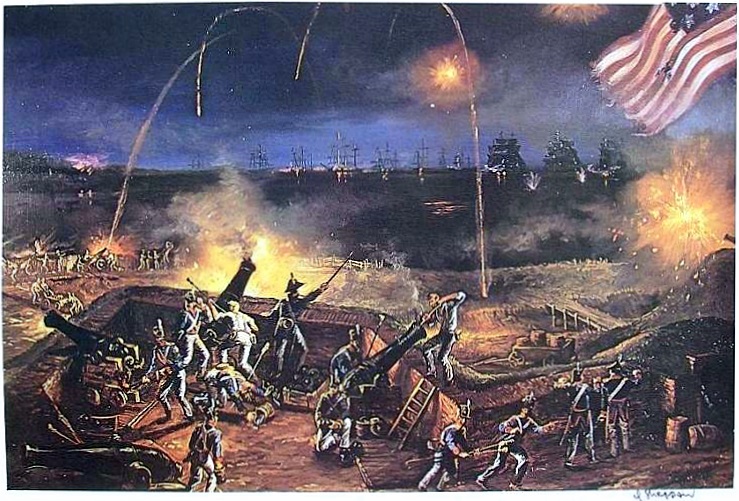
August 24, 1814, a day of national infamy.
Which blundering event on the part of the nation and its leaders was merely one more blundering failure in this war that New England merchants agitated to secede over -- which is the likely explanation that so few remember and even fewer even know about the War of 1812. This, despite it being the hinge point in the towering career of Andrew Jackson, and his shaping of our subsequent national history up to and including the Civil War. The Brits may have been having their successes against (mostly) very tiny, undefended towns and plantations along the Chesapeake in these years. But Jackson was winning one engagement after another in the south and west, against Indians, against the Brits, against whatever he set himself against, including the wilderness itself.
Again, for the best description and analysis of this "forgotten war," the best source is Henry Adams's account in the volumes that cover the Madison administrations in his History of the United States of America.
Canada remembers the War of 1812 much better -- the northern conflict that is, not the Chesapeake conflicts and those further south. This is because that war, in which they turned back the U.S. invasions has become a part of Canada's founding history as herself a nation.
Fortunately, in September came the Battle of Baltimore - Ft. McHenry, which not only stopped the Brits but redeemed American military reputation.
For a look at today's Bladensburg, go here. With about 10,000 residents, it looks a very pleasant place to live -- as do so many small communities in Maryland's counties.
Showing posts with label Maryland. Show all posts
Sunday, August 24, 2014
Saturday, August 16, 2014
The Battle Of Caulk's Field Remembered, Where It Happened - War of 1812
From the Chestertown Spy,* the local online weekly gazette, that includes articles, essays and opinion about the Kent County, Maryland community, reported on and written by the community, whether politics or dog training classes.
The local historians of this community -- which is just about everybody who lives here, and they love sharing what they know -- are as impressive as any other professional historians and scholars.
El V and I visited the site of the Battle of Caulk's Field on a Thanksgiving Day in 2010. There shall be a Bicentennial re-enactment on August 30th.
These Kent Country events are so much fun. Partly it's because of the food, partly because, while the events are executed as accurately as possible, neither the re-enactors nor the watchers take themselves too seriously.
-------------------
* The Chestertown Spy is named for The Spy, Chestertown's 18th century newspaper.
"At midnight, August 30, 1814, between Chestertown and Rock Hall, in a field of shadowy figures and muzzle flashes, a 45-minute clash between British royal marines and local militia ended 14 British lives, including that of Sir Peter Parker, captain of the Menelaus. The Kent militia suffered only wounds.
The Battle of Caulk’s Field, while no Bladensburg—a devastating strategic loss for the small American army—is, nonetheless, a unique and significant marker in the field of American History. Its memorial and past ceremonies, performed by U.S. National Guard and British Royal Marines at the battle site, have come to symbolize a mutual respect for the past and highlight a future of shared endeavors.
Here, former editor of the Kent County News Kevin Hemstock and Friends of Caulk’s Field Committee President Steve Frohock discuss the Chesapeake theatre of the War of 1812, the Battle of Caulk’s Field, Peter Parker, and the upcoming weekend of events commemorating the war’s Bicentennial.
No more a post-it note, the War of 1812 is being discovered as a full-fledged chapter in American history."The 15-minute video of the discussion is worth watching, not only for the information the two local historians provide, but also because it's delightful to see and listen to historians who know their stuff and are enthusiastic about learning ever more, whenever they can.
The local historians of this community -- which is just about everybody who lives here, and they love sharing what they know -- are as impressive as any other professional historians and scholars.
El V and I visited the site of the Battle of Caulk's Field on a Thanksgiving Day in 2010. There shall be a Bicentennial re-enactment on August 30th.
These Kent Country events are so much fun. Partly it's because of the food, partly because, while the events are executed as accurately as possible, neither the re-enactors nor the watchers take themselves too seriously.
-------------------
* The Chestertown Spy is named for The Spy, Chestertown's 18th century newspaper.
Wednesday, August 8, 2012
A Brilliant Soft Shell Blue Crab Season!
Which is good news in a way, for the ever-endangered Chesapeake Bay and the equally endangered watermen and their way of life. A bushel of the Chesapeake *Blue Crab is currently selling for $130.00, that is a bushel sold right off the boat. Even so the cost of fuel and bait are eating into the watermen's profits.At a market that bushel's going to run a lot higher than that. So, down on the Bay, it's crabbin' time! Our Shore and Baltimore friends are in a good mood. I do wonder, however, with the end of newspapers, how we're gonna eat crabs and lobsters and crawfish.The outdoor feast on newspaper covered surfaces, impromptu or planned, home or restaurant, is nearly a year-round tradition from the Bay to the Gulf.
In the meantime, I just learned noted Baltimore novelist, Laura Lippman's Baltimore PI protagonist of her Tess Monaghan series, graduated from Chestertown's Washington College. This information about Tess would have been meaningless to me only three years ago, when I knew neither Chestertown nor Baltimore, which are now permanent parts of my heart. I learned this via listening to an audio version of Charm City (1997), the second of the Tess Monaghan series. I also know how Charm City got to be used as a moniker for Baltimore, which I didn't even know was a moniker three years ago, much less why -- even though I already knew personally Madison Smartt Bell, who wrote the walking Baltimore book, titled, of course, Charm City. But I didn't read that until I'd been to Baltimore a couple of times, though I did read it before **Madison gave a personally conducted walking tour of Baltimore that following spring.
Is it not wonderful to have cities to love -- even if you may also hate them, like I love-hate New Orleans and New York? I don't know Baltimore well enough yet to have a love-hate relationship with it, but I know many Baltimore natives who do love and hate the city that they will never leave. I love Chestertown because it is so very satisfied to be what it is and has no pretensions or desires to be anything but what it has always been, except, of course, better! I also love Havana and Santiago, but these are not the cities of my own country, so I can't / don't have the hate part -- I have no personal responsibility for these cities, outside of whatever unpleasant designs my country has on them -- which isn't the fault or responsibility of the two cities in question.
So here I sit, attempting to get some energy flowing again. Therapist really wailed on me today. The glutes are gonna hurt like sin by tomorrow, I'm betting. At least I have until Monday to recover.
Hot and humid again.
We have construction of some kind or another -- or maybe only maintenance, next door. Just the building of the scaffolding that envelops the entire building top to bottom took a week of clanging and banging. What they will do once the scoffold is entirely up I have no idea. I hope it won't be water blasting to clean it .... If there is another hurricane like Irene from last year I shudder to think what will happen to our building as the steel scaffolding ribs are thrown into our walls.
There's also construction across the street, which is in reality preparation for deconstruction of the current ediface to build a newer! better! (much) taller! and MORE EXPENSIVE one.
And just to make it entirely fun, the block and the cross street are blocked off by a shoot -- whether for television or a movie, I have no idea. Floodlights burning up the night all night long, and all like that. So much fun ....
Well, at least cold penne, pestp and veggies, plus salad, for dinner to look forward to!
----------------------------------
* If you want to learn about Blue Crabs and their place in the eco and social systems of the Chesapeake, the book you want is Beautiful Swimmers: Watermen, Crabs and the Chesapeake Bay by William W. Warner, illustrated by Consuelo Hanks, which has never been out of print since publication in 1994. If you visit anyone on the Bay the book will be guaranteed to be on their shelves, and you probably will be gifted with a copy. There was a copy in the House when we arrived in C'town, and the second weekend we were given a copy of our own.
**Hey, thanks again, Madison. It is a day I still recall in detail and with great pleasure.
Monday, April 23, 2012
'tis Shakespeare's Birthday
Due to a friend from Elsewhere, here is the perfect online observance of Shakespeare's birthday.
To which I had to respond with this from a friend on the Chesapeake's Eastern Shore, which may show partly why having lived there has provoked such fascination with this part in particular of England; the 'he' referred to is the local writer, Christopher Tilghman, who has a new novel coming out set in the U.S. Civil War era:
"Pursuant (Isn't that a wonderful word?) to our earlier conversation, this is so full of the England you dream of that I had to send it to you. Enjoy."
To which I had to respond with this from a friend on the Chesapeake's Eastern Shore, which may show partly why having lived there has provoked such fascination with this part in particular of England; the 'he' referred to is the local writer, Christopher Tilghman, who has a new novel coming out set in the U.S. Civil War era:
I've met him....kind of a weedy, strange member of a HUGE clan of descendants of the doctor who fled England in the Protectorate, gaining the Hermitage, enormous land grant on lower Chester River in 1647.........the old man's daughter Rebecca married the up-and-coming SIMON WILMER, lately of Stepney Manor and about 3,000 acres on both sides of the Chester River, 100 of which he managed to sell in 1706 to the Legislature of the day for the "erection of a town...." :) Seriously, the man writes some luscious and semi-decadent prose and if you partied at the Hermitage at sundown on a summer's eve with much of the clan present and everything, EVERYTHING the tribe ever owned still present in the house, built in 1860s, and the mighty Chester slapping at the pilings while the ospreys screeched and fished and the foxes barked in the darkening fields and the mist rose over the marshes below the grass terraces you'd understand why.......BTW, that 100 acres is where the river port of C'town was built, which is now the county seat. C'town is also the county seat. As mentioned so many times, the same names of power and wealth from the founding settlements' eras are still alive and well in the ranks of power and wealth today. Another reason why Midsommer resonates so much.
Thursday, May 26, 2011
Captain John Smith by J. A. Leo Lemay &* Homicide*
The American Dream of Captain John Smith (1994 - University Press of Virginia) by Prof. Lemay is the first book written by this American scholar that we've read. This is the case despite living among his personal library collection -- the first scholars to have that privilege -- and reading many of titles, opening and dipping into many more, and yet not able to fully delve into that magnificent collection.
So, when we returned to NYC from the Fellowship we ordered several of Lemay's books. This is the first one to arrive. What a fascinating tale it is too, a tale of swashbuckling heroism of both the European Renaissance and the American frontier. Smith was a knight and he wore armor. He wore the iron collar of slavery to the Turks. He fought the Turk in the Transylvanian armies (when the Poles had an empire and fought the Turks, Mongols, Tatars and Russians in the region), slaying three of the Turks' greatest warriors in single combat, then cut off their heads so they might be impaled on poles. He went to Virginia. He was twenty-six years old. He returned to England because a careless aide blew off Smith's balls, evidently trying to light a cannon or a musket, as well as the aristocrats of the Virginia Company being dissatisfied with Smith's yeoman practicality of making things work, and making even aristocrats work, while not finding gold, and making friends with the Indians -- and playing the tribes off against each other, being the best friend of each one. Then he wrote books. He was an egalitarian and a visionary. The tales about him, for so long dismissed as tall tale telling are true. He is the first Virginian, the perfect knight, pure and true. After him Jamestown fell apart, into starvation, slavery and massacre. His was the perfect New World binary -- only White Men and Indians; he was untainted by the evil of slavery. His New World was re-created again in Owen Wister's Virginian, who like Smith, was a natural aristocrat who possessed all the needful skills to survive and thrive, particularly that of effective violence.
I am almost finished watching the first season of Homicide: Life on the Street (1993). Most appealing to this watcher is Crosetti’s conspiracy cover-up obsession with Booth’s assassination of Lincoln. In ep 7, "In the Rockets Dead Glare," he and his partner, Meldrick Lewis, go to D.C., where Crosetti insists on first stopping at a Chinese restaurant, which, it turns out, is in the building that used to be Mary Surrat's boarding house where many an anti-Union conspiracy was planned. A secret service agent takes them to Ford’s Theater and shows them around the area, points out the Doctor’s house across the street where the unconscious, bleeding Lincoln was carried. Would this have as much meaning if I hadn’t listened this winter to Manhunt, the book about Booth, the conspiracies, the assassination, Booth's escape, the aftermath, and the hunt for him? They are showing us in an entertaining and plausible way that Maryland's history is deep.
So, when we returned to NYC from the Fellowship we ordered several of Lemay's books. This is the first one to arrive. What a fascinating tale it is too, a tale of swashbuckling heroism of both the European Renaissance and the American frontier. Smith was a knight and he wore armor. He wore the iron collar of slavery to the Turks. He fought the Turk in the Transylvanian armies (when the Poles had an empire and fought the Turks, Mongols, Tatars and Russians in the region), slaying three of the Turks' greatest warriors in single combat, then cut off their heads so they might be impaled on poles. He went to Virginia. He was twenty-six years old. He returned to England because a careless aide blew off Smith's balls, evidently trying to light a cannon or a musket, as well as the aristocrats of the Virginia Company being dissatisfied with Smith's yeoman practicality of making things work, and making even aristocrats work, while not finding gold, and making friends with the Indians -- and playing the tribes off against each other, being the best friend of each one. Then he wrote books. He was an egalitarian and a visionary. The tales about him, for so long dismissed as tall tale telling are true. He is the first Virginian, the perfect knight, pure and true. After him Jamestown fell apart, into starvation, slavery and massacre. His was the perfect New World binary -- only White Men and Indians; he was untainted by the evil of slavery. His New World was re-created again in Owen Wister's Virginian, who like Smith, was a natural aristocrat who possessed all the needful skills to survive and thrive, particularly that of effective violence.
I am almost finished watching the first season of Homicide: Life on the Street (1993). Most appealing to this watcher is Crosetti’s conspiracy cover-up obsession with Booth’s assassination of Lincoln. In ep 7, "In the Rockets Dead Glare," he and his partner, Meldrick Lewis, go to D.C., where Crosetti insists on first stopping at a Chinese restaurant, which, it turns out, is in the building that used to be Mary Surrat's boarding house where many an anti-Union conspiracy was planned. A secret service agent takes them to Ford’s Theater and shows them around the area, points out the Doctor’s house across the street where the unconscious, bleeding Lincoln was carried. Would this have as much meaning if I hadn’t listened this winter to Manhunt, the book about Booth, the conspiracies, the assassination, Booth's escape, the aftermath, and the hunt for him? They are showing us in an entertaining and plausible way that Maryland's history is deep.
Homicide's Baltimore is larger and more varied than The Wire's Baltimore, less claustrophobic. It's the Baltimore which I got to know to some degree this year fairly well, thanks to local friend-guides. It's a city, not a corner, not the dead-enders, despite it being all homicide all the time, even the homicide of a police dog.
What else is particularly interesting about this series, at least its first season, is that the bond among them all as police overides everything else, whether race, gender or class. There is a single female detective, but she's the younger Melissa Leo -- 'nuff said? They all smoke, but the struggle is beginning between those who are quitting / quit and those who aren't. We are seeing demands by the non-smokers for segregated space in the office.
Rooted in a place and a job of work, even though it wasn't Simon's show in the sense that he didn't produce, direct or write ( he 'merely' wrote the book from which the show took its title -- and I read the book too around the time it came out), you can see how much this is still in place in Treme, with New Orleans and music in particular.
The photo is of the plaque on the old fire department building that stood in for the Baltimore Police headquarters in Homicide, down at the waterfront, Fells Point, across from the big park that was the site for the Broadway open markets. I took this shot at the beginning of December, 2010.
Friday, May 13, 2011
Settling In, Back Home
We forgot the eggs and the big air tight container of cheeses on the House counter. We had loaded the frozen foods and were ready to roll, just about to do the kitchen idiot check, when M showed up to say goodbye and chatchatchat -- but we had frozen foods in the cooler, and we needed to get through the Holland Tunnel and to our block by 5 or else we'd never find a parking spot by our place -- the alternate side of the street parking turns over then, and if you get a good spot it's yours through the weekend. So we lost our focus and forgot to make the idiot check of the kitchen! We e-mailed M that when he comes to put the trash barrel back in the yard tonight he’s better do something about the eggs and the cheese. Since that was the worst that happened, that ain't bad! If we were to forget something, much better the eggs and cheese, than the local Chesapeake shrimp! Gads they are superior to that farmed stuff which is what is mostly available up here, no matter how expensive the restaurant.
Ned unpacked the car and got everything up into the apartment in about 30 – 40 minutes (I stayed with the car – this is NYC – you don’t leave a car filled with stuff unattended, no matter what – and because of my back he was determined I not carry anything.) In two hours we got most things that are going to be unpacked, unpacked. We went out and ate burritos.
Now what? Little by little, continue the culling, the repairing and re-arranging. We will try and get the new online router today – ours is about 6 years old now, and needs to be upgraded. Also, one stack of boxes goes to hisw CUNY Grad Center office, and another to Storage. I pick up the books the NYPL Humanties has pulled for my solo book project -- as opposed to our co-written The American Slave Coast. So far for May, we've got three barbeque invitations (one of them in Baltimore), a friend's book publication party and another friend's reading and signing.
But, woo, it's loud here. And Young. And WEALTHY. Only the last of three has C'town, which attracts the retirees, while the C’town youth leave until middle-age, when they come back to care for their parents and the property, and then stay, but mostly people don't rock their wealth on their clothes or with their bodies. Land, and more land, and what their houses and gardens and fields show, on maintaining their political power and water power. I rather wonder what things would look like down there if all agricultural subsidies were abolished. One has suspicions that things around there would come to look much like they did after abolition, and until around WWII. So much of Maryland's prosperity these days comes from its proximity to D.C. Yes, family ‘farms,’ but these farms are enormous. The Upper Chesapeakers always did speak of their plantations as their ‘farms,’ from the mid-eighteenth century on, and these include both Washington and Jefferson.
C'town, it was like living in fairyland or Never-Never. Now it’s only in the rear-view mirror.
So far today I've done 3 1/2 hours of clearing and cleaning, organizing and re-arranging. Now I quit for the Back is screaming in agony. With days more of this to do, pacing is all.
Ned unpacked the car and got everything up into the apartment in about 30 – 40 minutes (I stayed with the car – this is NYC – you don’t leave a car filled with stuff unattended, no matter what – and because of my back he was determined I not carry anything.) In two hours we got most things that are going to be unpacked, unpacked. We went out and ate burritos.
Now what? Little by little, continue the culling, the repairing and re-arranging. We will try and get the new online router today – ours is about 6 years old now, and needs to be upgraded. Also, one stack of boxes goes to hisw CUNY Grad Center office, and another to Storage. I pick up the books the NYPL Humanties has pulled for my solo book project -- as opposed to our co-written The American Slave Coast. So far for May, we've got three barbeque invitations (one of them in Baltimore), a friend's book publication party and another friend's reading and signing.
But, woo, it's loud here. And Young. And WEALTHY. Only the last of three has C'town, which attracts the retirees, while the C’town youth leave until middle-age, when they come back to care for their parents and the property, and then stay, but mostly people don't rock their wealth on their clothes or with their bodies. Land, and more land, and what their houses and gardens and fields show, on maintaining their political power and water power. I rather wonder what things would look like down there if all agricultural subsidies were abolished. One has suspicions that things around there would come to look much like they did after abolition, and until around WWII. So much of Maryland's prosperity these days comes from its proximity to D.C. Yes, family ‘farms,’ but these farms are enormous. The Upper Chesapeakers always did speak of their plantations as their ‘farms,’ from the mid-eighteenth century on, and these include both Washington and Jefferson.
C'town, it was like living in fairyland or Never-Never. Now it’s only in the rear-view mirror.
So far today I've done 3 1/2 hours of clearing and cleaning, organizing and re-arranging. Now I quit for the Back is screaming in agony. With days more of this to do, pacing is all.
Saturday, May 7, 2011
Neither Here Nor There
An existence suspended.
Hand delivered notes, thanking me for yesterday's gathering of the Ladies.
Phone calls and e-mails from that other existence I will soon resume.
Most pressing current concern: When should I change the Netflix address?
The climbing rose outside the south kitchen door has bloomed.
Hand delivered notes, thanking me for yesterday's gathering of the Ladies.
Phone calls and e-mails from that other existence I will soon resume.
Most pressing current concern: When should I change the Netflix address?
The climbing rose outside the south kitchen door has bloomed.
Friday, May 6, 2011
Fly Like an Eagle
The rain had quit, and the sun was finally coming out of this damned cold day. I caught sight of an enormous wing span against the blueing sky, the sunlight caught in the pinions, and sure enough, there, gliding above Queen Street, a baldie. There wasn't a chance of mistaking that winged silhouette for thouse of the ubiquitous buzzards.
Early mornings are one of the times of day that the backyards are at their most lively -- not just down here, but anywhere, surely, there are backyards, or fields plus trees and all the rest of what birds like.
In my backyard the birds -- so many different kinds of birds -- are complaining at the tops of their voices, because they've spied the food I scattered around the yard about an hour ago, but they've also spied Cleo, who thinks she's invisible between two bushes, as she cleverly waits for a bird to fly down for her claws. I've seen her attempts several times, yet I've never seen her have a success. She seems remarkably slow and clumsy for a cat. Maybe she doesn't see so well? In any case, she's fed by the Ladies on the block, who have concern meetings about her when she's not been seen for a few days, who have even gone searching for her during one of her desertions of Queen Street.
I call it Kitchen Window TeeVee. I watch as I prep some ingredients for the Mediterranean Shrimp Cous-Cous I'm going to serve this afternoon.
According to the Ladies, for whom I'm preparing this shrimp, Cleo would prefer to die than enter the house of anyone. She is willing to sit on your porch in the sun and eat what you put out for her, and when it's winter, sleep in the warm shelters you provide. But that's as far as she's going, no thank you, not very much.
In a while el V's taking off for NYC with a load of what we need to take back home. He'll hang out with Los Muñequitos, who are there, as the last stop on their first U.S. tour in 9 years -- we saw them in D.C. two weekends ago. When he returns we pack up the car again, for Thursday's final run between here and home. The Eastern Shore Adventure is nearly over. I'm going to miss the backyard, with the flowers, the birds, cats, foxes, extremely.
OTOH -- New York, home, ye olde Friends, and New Ones we don't know yet! The new friends here will come and visit! No need for a car! I will be independently mobile again, yay!
Early mornings are one of the times of day that the backyards are at their most lively -- not just down here, but anywhere, surely, there are backyards, or fields plus trees and all the rest of what birds like.
In my backyard the birds -- so many different kinds of birds -- are complaining at the tops of their voices, because they've spied the food I scattered around the yard about an hour ago, but they've also spied Cleo, who thinks she's invisible between two bushes, as she cleverly waits for a bird to fly down for her claws. I've seen her attempts several times, yet I've never seen her have a success. She seems remarkably slow and clumsy for a cat. Maybe she doesn't see so well? In any case, she's fed by the Ladies on the block, who have concern meetings about her when she's not been seen for a few days, who have even gone searching for her during one of her desertions of Queen Street.
I call it Kitchen Window TeeVee. I watch as I prep some ingredients for the Mediterranean Shrimp Cous-Cous I'm going to serve this afternoon.
According to the Ladies, for whom I'm preparing this shrimp, Cleo would prefer to die than enter the house of anyone. She is willing to sit on your porch in the sun and eat what you put out for her, and when it's winter, sleep in the warm shelters you provide. But that's as far as she's going, no thank you, not very much.
In a while el V's taking off for NYC with a load of what we need to take back home. He'll hang out with Los Muñequitos, who are there, as the last stop on their first U.S. tour in 9 years -- we saw them in D.C. two weekends ago. When he returns we pack up the car again, for Thursday's final run between here and home. The Eastern Shore Adventure is nearly over. I'm going to miss the backyard, with the flowers, the birds, cats, foxes, extremely.
OTOH -- New York, home, ye olde Friends, and New Ones we don't know yet! The new friends here will come and visit! No need for a car! I will be independently mobile again, yay!
Thursday, May 5, 2011
The House in New Orlreans
Some of the people who put on Barcelona's annual Jazz Festival are in New Orleans for the first time, for New Orleans's current Jazz Fest. These are friends as well as colleagues.
Last night they called to say they were sorry they'd left TWTMNO and TYBTF back in Barcelona, but they'd run out of baggage room and weight, so they did. Now that they are on the ground and experiencing New Orleans for themselves -- loving it, hey, NO still charms, ensorcels and bespells -- they are crazy to see some of the places described in the books, particularly the house we lived in while there, which plays such a role in TYBTF. They asked for the address and directions, because, they said, "We are going there to put up a symbolic plaque honoring you for bringing such understanding to New Orleans, its culture and its music."
We said, "Um, probably not a good idea. The owner probably would shoot you."
We're starting to pack up the first load of things to take back to NYC, when el V goes tomorrow. I seem have gotten sick. I have the party for the neighbors and other of the Ladies who became friends here tomorrow to get ready for too.
Last night they called to say they were sorry they'd left TWTMNO and TYBTF back in Barcelona, but they'd run out of baggage room and weight, so they did. Now that they are on the ground and experiencing New Orleans for themselves -- loving it, hey, NO still charms, ensorcels and bespells -- they are crazy to see some of the places described in the books, particularly the house we lived in while there, which plays such a role in TYBTF. They asked for the address and directions, because, they said, "We are going there to put up a symbolic plaque honoring you for bringing such understanding to New Orleans, its culture and its music."
We said, "Um, probably not a good idea. The owner probably would shoot you."
We're starting to pack up the first load of things to take back to NYC, when el V goes tomorrow. I seem have gotten sick. I have the party for the neighbors and other of the Ladies who became friends here tomorrow to get ready for too.
Saturday, April 30, 2011
In Baltimore, Tomorrow
From el V:
Attention Baltimoreans!
Ned Sublette + Madison Smartt Bell, Sunday night (May Day! May Day!) at 7 pm, Cyclops Books + Music, 30 West North Ave. at Maryland (next to
Windup Space and catty-corner from Joe2.)
I will be reading from "The Year Before the Flood" and singing songs
from the forthcoming album "Kiss You Down South."
Wednesday, April 27, 2011
It Was Good!
Last night was about as perfect a spring evening and night as you could get. El V's performance was one of his very best, I think. OTOH, his voice and his performances do just keep improving, so this is probably merely normal musician-performance momentum.
The audience was wonderful, and as diverse as an audience can be here. The audiences down here really 'get' him in every way. Last night was about as perfect a spring evening and night as you could get. El V's performance was one of his very best, I think. OTOH, his voice and his performances do just keep improving, so this is probably merely normal musician-performance momentum.
Also, the audience was wonderful. The audiences down here really get him in every way. There's something for everybody who makes up these audiences too, in his songs and his books.
I do admit shamelessly to enjoy chatting with the people who seek me out to specifically say how much they enjoy coming to his events because of -- and I quote one woman in particular here -- "he's such a gifted, multi-talent artist and a brilliant, formidable intellect." This sort of thing said by people who hold copies of his books and cds.
Then, of course, then, I would enjoy that, wouldn’t I! Also, enjoying the praise given to my partner is part of the job description, isn't it -- otherwise, you know, why bother?
The audience was wonderful, and as diverse as an audience can be here. The audiences down here really 'get' him in every way. Last night was about as perfect a spring evening and night as you could get. El V's performance was one of his very best, I think. OTOH, his voice and his performances do just keep improving, so this is probably merely normal musician-performance momentum.
Also, the audience was wonderful. The audiences down here really get him in every way. There's something for everybody who makes up these audiences too, in his songs and his books.
I do admit shamelessly to enjoy chatting with the people who seek me out to specifically say how much they enjoy coming to his events because of -- and I quote one woman in particular here -- "he's such a gifted, multi-talent artist and a brilliant, formidable intellect." This sort of thing said by people who hold copies of his books and cds.
Then, of course, then, I would enjoy that, wouldn’t I! Also, enjoying the praise given to my partner is part of the job description, isn't it -- otherwise, you know, why bother?
Tuesday, April 26, 2011
Historical Breakfast
With Peter Wood, author of the ground-breaking, trail blazing Black Majority: Negroes in Colonial South Carolina from 1670 through the Stono Rebellion (1973).
We can't make his lecture Thursday night because we're doing the same for the county historical society and museum annual dinner and dance. So getting to hang out this morning mattered. He's coming to el V's musical performance tonight though, so we'll see him again before he leaves.
Thursday, April 21, 2011
Town O' Robins
As mentioned previously I've never seen such large robins, so many robins at one time in one place as down here in C'town on the Eastern Shore. Here is one of them, clicked two Sunday afternoons ago ~~~~~~~~~~~~~~~~~~~~~~~~
April Sunday Squirrel In the Pink `````````````````````````````````
April C'town Sunday Study in Red ............................
Early April Ivies Entwine Sunday C'town ===================
April Sunday Squirrel In the Pink `````````````````````````````````
April C'town Sunday Study in Red ............................
Early April Ivies Entwine Sunday C'town ===================
Wednesday, April 20, 2011
Evidence of Bird Brain Observed In the Field
I cut up an apple that had been sitting in the refrigerator for months and scattered the pieces in the backyard. A bird grabbed a piece of apple and instead of grabbing their own pieces of apple, the other birds chased around after the first bird.
Also, the bumbles, the biggest I've ever seen, longer than my thumb. The yard is buzzing.
Our backyard this morning ~~~~~~~~~
Also, the bumbles, the biggest I've ever seen, longer than my thumb. The yard is buzzing.
Our backyard this morning ~~~~~~~~~
Monday, April 18, 2011
It's Here Again
C'town again. It's like Neverlandia. Other than the friends here, here just goes poof when we leave it. I can't believe it exists -- it's a vaporous memory of loveliness and allergies. So many varieties of trees with pinkish, pink and fuschia colored flowers! So many trees and shrubs with flowering reds. And I do not know what they are, mostly.
Well, we are here again after the NYC weekend. A cherry tree in my backyard has blossomed. I had no idea I had a cherry tree. And tulips also. I'm not so good with trees and flowers that didn't grow in the Red River Valley. Then in New Mexico it was a desert and arid mountain environment, so that was all something else. In NYC, it's all public what we see growing in Manhattan -- in parks, pocket parks, in front of businesses and office towers, on the avenue berms, whether flowers or trees. So they are industrially familiar.
What I don't have in my backyard is lilacs, but they're breaking out where there are lilacs, and I'm so glad. Spring to me always still means Iris and Lilacs. Even though this year I got to have a spring in a place where violets grow naturally, without prodding.
4 more weeks, and it's back to NYC for good.
Well, we are here again after the NYC weekend. A cherry tree in my backyard has blossomed. I had no idea I had a cherry tree. And tulips also. I'm not so good with trees and flowers that didn't grow in the Red River Valley. Then in New Mexico it was a desert and arid mountain environment, so that was all something else. In NYC, it's all public what we see growing in Manhattan -- in parks, pocket parks, in front of businesses and office towers, on the avenue berms, whether flowers or trees. So they are industrially familiar.
What I don't have in my backyard is lilacs, but they're breaking out where there are lilacs, and I'm so glad. Spring to me always still means Iris and Lilacs. Even though this year I got to have a spring in a place where violets grow naturally, without prodding.
4 more weeks, and it's back to NYC for good.
Wednesday, April 13, 2011
Spring Signatures
The Daddy robin redbreast who has claimed my Eastern Shore backyard for himself and his nest-sitting Baby Mama can beat the Daddy robin redbreast who has conquered your backyard!
As perhaps the most unoriginal observation ever, here is a bird paradise. I see more robins here in a single day -- and they are the biggest robins I've ever seen -- than I've seen in all the years put together in NYC. Here, a backyard, overflowing with varieties of birds and flowers. Cats, squirrels and foxes also. It smells so good -- if you don't suffer from allegeries like el V, who is suffering worse than he's ever suffered, except on visits to my family farm in the Red River Valley.
Misty and damp today. Ever greener, every day, along with the brilliant flashes of yellow, fuschia, red, violets everywhere on trees, shrubs and flower beds. Just returned from a local journalist-historian's lecture on the War of 1812 in the Chesapeake. It was an excellent presentation, which he and his wife do in the summers on historic replica vessel cruises here on the Chesapeake in the summers. But ... not a word about the free people of color who were in the U.S. navy or served on other vessels, or those enslaved who assisted the British in return for their freedom. So I had to say something afterward during the q&a. He said this was very important yes, but so many were sold by the British when they took them to Jamaica. A myth that has been definitively disproved by the very laws in place by Britain at that time, as well as by primary source materials that show where these 8 - 9 thousand freedom earners ended up. But as this was in the morning, and it's only the elderly and people like us who have the leisure to sit in a library and receive a presentation there were actual gasps at this. No one here of the older generations wants to believe 1) that their ancestors' slave would be so treacherous; 2) that the Brits would have kept their promises of freedom.
Fortunately, one of my neighbors was in the audience too (she's also on the BOD of the county historical society and museum), and she jumps in and says, "O Fox, thank you for reminding us that we should stop acting as if the War of 1812 was only white people." So my bad manners squeaked out of that one. I did couch my remarks courteously. He did do a very good job of condensing a very large amount of material into the time slot. And unlike so many tour guides everything he said was correct. But it just left out the color, so to speak, and we really cannot and should not do that any more, ever, in any circumstance, and most particularly the wars of the U.S.A.
As perhaps the most unoriginal observation ever, here is a bird paradise. I see more robins here in a single day -- and they are the biggest robins I've ever seen -- than I've seen in all the years put together in NYC. Here, a backyard, overflowing with varieties of birds and flowers. Cats, squirrels and foxes also. It smells so good -- if you don't suffer from allegeries like el V, who is suffering worse than he's ever suffered, except on visits to my family farm in the Red River Valley.
Misty and damp today. Ever greener, every day, along with the brilliant flashes of yellow, fuschia, red, violets everywhere on trees, shrubs and flower beds. Just returned from a local journalist-historian's lecture on the War of 1812 in the Chesapeake. It was an excellent presentation, which he and his wife do in the summers on historic replica vessel cruises here on the Chesapeake in the summers. But ... not a word about the free people of color who were in the U.S. navy or served on other vessels, or those enslaved who assisted the British in return for their freedom. So I had to say something afterward during the q&a. He said this was very important yes, but so many were sold by the British when they took them to Jamaica. A myth that has been definitively disproved by the very laws in place by Britain at that time, as well as by primary source materials that show where these 8 - 9 thousand freedom earners ended up. But as this was in the morning, and it's only the elderly and people like us who have the leisure to sit in a library and receive a presentation there were actual gasps at this. No one here of the older generations wants to believe 1) that their ancestors' slave would be so treacherous; 2) that the Brits would have kept their promises of freedom.
Fortunately, one of my neighbors was in the audience too (she's also on the BOD of the county historical society and museum), and she jumps in and says, "O Fox, thank you for reminding us that we should stop acting as if the War of 1812 was only white people." So my bad manners squeaked out of that one. I did couch my remarks courteously. He did do a very good job of condensing a very large amount of material into the time slot. And unlike so many tour guides everything he said was correct. But it just left out the color, so to speak, and we really cannot and should not do that any more, ever, in any circumstance, and most particularly the wars of the U.S.A.
Tuesday, April 12, 2011
Upon Observance of the Sesquicentennial of the Civil War Day
Wise words arrive from the hearts, the minds and the keyboards of two of the contemporary writers of history I most admire, Edward Ball and Adam Goodheart, in the Opinion section of the NY Times. Today there are at least five columns up, reflecting on the Civil War and its aftermath. However, I particularly recommend Edward Ball's "An American Tragedy" (author of the brilliant Slaves in the Family), and Adam Goodheart's "The Defenders" (author of 1861: The Civil War's Awakening and the person responsible for granting us the Patrick Henry Writing Fellowship -- so I can and do testify at first hand to his many-headed varieties of brilliance).
Monday, April 4, 2011
Adam Goodheart: "How slavery really ended in America"
Full disclosure: the author is the director of the Starr Center for Writing the American Experience, where we've been located this academic year on fellowship working on our book, The American Slave Coast, thus, a friend. He also is involved with the NY Times daily Disunion column, as well a frequent contributor to the column himself.
This weekend, the New York Times Magazine ran what they call a preview of his book, 1861: The Civil War Awakening, from Knopf, published this month. You can see it here.
If you can get to it behind that paywall this is one I highly recommend as worth your time, if you have any interest in American history generally, or the Civil War particularly. You are allowed 20 'free' stories per month from the NY Times website. Also, if I have this correctly, you can get to stories if you plug in the title or caption in your search engine; you could try it out by typing into google this: How Slavery Really Ended in America Adam Goodheart .
An excerpt, from the narrative of how the so-called 'Beast' General Butler (a most successful lawyer before the war began) handled the first of the fugitive slaves who ran to the protection of the Union and Fort Monroe down in Virginia:
This weekend, the New York Times Magazine ran what they call a preview of his book, 1861: The Civil War Awakening, from Knopf, published this month. You can see it here.
If you can get to it behind that paywall this is one I highly recommend as worth your time, if you have any interest in American history generally, or the Civil War particularly. You are allowed 20 'free' stories per month from the NY Times website. Also, if I have this correctly, you can get to stories if you plug in the title or caption in your search engine; you could try it out by typing into google this: How Slavery Really Ended in America Adam Goodheart .
An excerpt, from the narrative of how the so-called 'Beast' General Butler (a most successful lawyer before the war began) handled the first of the fugitive slaves who ran to the protection of the Union and Fort Monroe down in Virginia:
Yet to Fort Monroe’s new commander, the fugitives who turned up at his own front gate seemed like a novel case. The enemy had been deploying them to construct a battery aimed directly at his fort — and no doubt would put them straight back to work if recaptured, with time off only for a sound beating. They had just offered him some highly useful military intelligence. And Virginia, as of 12 or so hours ago, was officially in rebellion against the federal government, having just ratified the secession ordinance passed a month before. Butler had not invited the fugitives in or engineered their escape, but here they were, literally at his doorstep: a conundrum with political and military implications, at the very least. He could not have known — not yet — that his response that day might change the course of the national drama that was then just beginning. Yet it was not the first time, nor would it be the last, that an unanticipated bureaucratic dilemma would force the hand of history.Some weeks back I read an account by a North Carolinian about 'Beast Butler' at Fort Monroe. It insisted he was making a fortune in cahoots with the U.S. Navy Secretary an a Confederate officers to smuggle Union military goods down south and sell them to the Confederacy. There wasn't a word in this account about Butler's huge role in establishing the Union response to 'contraband' negroes, the establishment very soon of schools and much else in the vicinity to handle the ever-growing influx of self-emancipators. This text was a splendid example of how we re-write history despite facts and the revisionsim becomes, alas, fact, a fact that has prolonged this national division of the Civil War to the present time.
Despite his rank, General Butler had been a professional soldier barely four weeks. In private life, back in Massachusetts, he was a lawyer, and a very successful one — although he grew up poor, the swamp Yankee son of a widow who kept a boardinghouse in Lowell, the textile-mill town. Unable to attract clients through social connections or charm, he became an expert quibbler: a man who knew every loose thread in the great tangled skein of common law and who could unravel an opponent’s entire case with the gentlest of tugs. By his early 40s, he had also built a successful career as a state legislator and harbored larger political ambitions.
A fellow officer once called Butler “less like a major general than like a politician who is coaxing for votes.” Race-baiting was red meat to many of his working-class constituents in Lowell, and he had always been glad to toss morsels in their direction. But after barely 24 hours at Fort Monroe, the new commander had already sized up his new constituency. The garrison was made up predominantly of eager volunteers from New England, many with antislavery sympathies. How was Butler to win the confidence — or even obedience — of such men if his first act as their commander was to send three poor blacks back into bondage?
Butler’s features may have been brutish and his manners coarse, but inwardly, he nursed the outsize vanity of certain physically ugly men — vanity often manifest in a craving for approval and adulation. He also possessed a sympathetic, even occasionally sentimental, heart.
Still . . . sentiment was a fine thing; so was the admiration of one’s subordinates. Ultimately, though, his duty was to his commander in chief. With a few strokes of his pen, Lincoln had made Butler a major general; the president could just as easily unmake him, sending him back to Lowell in disgrace — and with another stroke, for that matter, send the blacks back to their master as slaves.
Whatever Butler’s decision on the three fugitives’ fate, he would have to reach it quickly. He had barely picked up his pen to finally begin that report before an adjutant interrupted with another message: a rebel officer, under flag of truce, had approached the causeway of Fort Monroe. The Virginians wanted their slaves back.
Waiting before the front gate was a man on horseback: Maj. John Baytop Cary of the 115th. With his silver gray whiskers and haughtily tilted chin, he appeared every inch the Southern cavalier.
Butler, also on horseback, went out to meet him. The men rode, side by side, off federal property and into rebel Virginia. They must have seemed an odd pair: the dumpy Yankee, unaccustomed to the saddle, slouching along like a sack of potatoes; the trim, upright Virginian, in perfect control of himself and his mount.
Cary got down to business. “I am informed,” he said, “that three Negroes belonging to Colonel Mallory have escaped within your lines. I am Colonel Mallory’s agent and have charge of his property. What do you mean to do with those Negroes?”
“I intend to hold them,” Butler said.
“Do you mean, then, to set aside your constitutional obligation to return them?”
Even the dour Butler must have found it hard to suppress a smile. This was, of course, a question he had expected. And he had prepared what he thought was a fairly clever answer.
“I mean to take Virginia at her word,” he said. “I am under no constitutional obligations to a foreign country, which Virginia now claims to be.”
"But you say we cannot secede,” Cary retorted, “and so you cannot consistently detain the Negroes.”
“But you say you have seceded,” Butler said, “so you cannot consistently claim them. I shall hold these Negroes as contraband of war, since they are engaged in the construction of your battery and are claimed as your property.”
Ever the diligent litigator, Butler had been reading up on his military law. In time of war, he knew, a commander had a right to seize any enemy property that was being used for hostile purposes. The three fugitive slaves, before their escape, were helping build a Confederate gun emplacement. Very well, then — if the Southerners insisted on treating blacks as property, this Yankee lawyer would treat them as property, too. Legally speaking, he had as much justification to confiscate Baker, Mallory and Townsend as to intercept a shipment of muskets or swords.
Labels:
Civil War,
Maryland,
Slavery,
The American Slave Coast
Saturday, April 2, 2011
*Marie, or, Slavery in the United States: A Novel of Jacksonian America
This novel, published in 1835, was written by a Frenchman, Gustave De Beaumont, travel companion of Alexis De Tocqueville, author of the still essential study of American history, Democracy in America, also published in 1835. The two of them co-authored "On the Penitentiary system in the United States." Between May 11, 1831 and February 20, 1832, they covered 7,000 miles, suffering all the travel conditions of hazard and hardship of that time in all the various regions, making a complete circuit of all the former colonies and into Canada. De Beaumont focused his work on the manners and mores and cultural life of the new nation, while de Tocqueville focused on the political institutions. Both men remained political progressives and reformers, fast friends throughout their shared journeys, and for the rest of their lives.
Maria begins in Baltimore. It is framed conventionally with a French narrator who then meets the pov narrator of the events of the novel, who also is French. It is conventionally sentimental in style and sensibility -- which was not exactly the same attitude of style and sensibility that we think of them now: back in the nineteenth century these traits in a novel exhibited the characters' level of education and understanding, whether attained by formal education or by native capacity. and even both.
For contemporary readers this reads hardly as a novel at all, but more like a work of sociology, with copious notes amplifying the statements of behaviors of the various characters as types of contemporary actors on the stage of that brave new world, the United States. Most of all, it is an investigation into the entwined tragedies of the native peoples and the descendants of the slaves brought here from Africa. For me the interest in the book is centered in that, as seen and interpreted by a well-educated (both he and his companion spoke excellent English English -- they had even lived in England for some years), well-informed, European outsider, who very much hopes that the United States is a wholly new and good thing to come into the historically evil world of power, rank and wealth exploiting all others.
The other center of interest is that they traveled the U.S. at the very start of the Jacksonian Triumph of Democracy, and tell us what they see. Outside of the sublime vistas of the still surviving wildernesses, what they see is pretty unattractive. It is energetic beyond comprehension in the getting of and making of wealth. Many are achieving prosperity such as never known by so many, but even more are being crushed by this achievement. Most of all, it is the Native Peoples and the slaves who suffer and are crushed by this accelerated pace of wealth getting, the very peoples -- via the theft of their lands, and in the case of the slaves the very theft of every part of their selves and labor. For women, particularly after their marriages, which are the point of their earlier years, they are immured in home, hardly less imprisoned (prison reform, as noticed above, is of large concern to them) than members of a harem, but unlike in the harem, they have no companions other than their children and their servants -- or as in Baltimore, their slaves. Education and the refinements of life are left to them, whereas their husbands are uneducated bores who can think or speak of nothing but business. However, what good are the education and refinements to these wives who are domestic prisoners?
Worst of all is the condition of the white women who are legally slaves for they have a black/slave ancestor who was raped by her white owner, and her progeny then are generationally raped by their white owners ... thus, Maria, in which we travel from the South to the wilderness of northern Michigan. Though a sentimental novel, this is not a melodrama, nor is it a sensational novel. It is a sober and somber examination of how slavery and theft of lands is the terrible stain upon the grand experiment in perfect liberty and democracy that the men of the country thunder at all times and all places into the ears of everyone that the United States is. In other words, here already we have in a novel of 1835, a distillation of what were the Jacksonian principles of the U.S. -- particularly its exceptionalism in the world. In contrast it shows us as well the blinkers and blinders worn by those who are running the great machinery of that Jacksonian democracy the refusal to see the miseries of inquality they've already enshrined as as the doctrine of the country.
The greatest lesson we are taking away from this academic year of intensive study is how early, how deeply, how extensively the non-progressive ideals of the extreme right got rooted in the the national philosophy.
Maria begins in Baltimore. It is framed conventionally with a French narrator who then meets the pov narrator of the events of the novel, who also is French. It is conventionally sentimental in style and sensibility -- which was not exactly the same attitude of style and sensibility that we think of them now: back in the nineteenth century these traits in a novel exhibited the characters' level of education and understanding, whether attained by formal education or by native capacity. and even both.
For contemporary readers this reads hardly as a novel at all, but more like a work of sociology, with copious notes amplifying the statements of behaviors of the various characters as types of contemporary actors on the stage of that brave new world, the United States. Most of all, it is an investigation into the entwined tragedies of the native peoples and the descendants of the slaves brought here from Africa. For me the interest in the book is centered in that, as seen and interpreted by a well-educated (both he and his companion spoke excellent English English -- they had even lived in England for some years), well-informed, European outsider, who very much hopes that the United States is a wholly new and good thing to come into the historically evil world of power, rank and wealth exploiting all others.
The other center of interest is that they traveled the U.S. at the very start of the Jacksonian Triumph of Democracy, and tell us what they see. Outside of the sublime vistas of the still surviving wildernesses, what they see is pretty unattractive. It is energetic beyond comprehension in the getting of and making of wealth. Many are achieving prosperity such as never known by so many, but even more are being crushed by this achievement. Most of all, it is the Native Peoples and the slaves who suffer and are crushed by this accelerated pace of wealth getting, the very peoples -- via the theft of their lands, and in the case of the slaves the very theft of every part of their selves and labor. For women, particularly after their marriages, which are the point of their earlier years, they are immured in home, hardly less imprisoned (prison reform, as noticed above, is of large concern to them) than members of a harem, but unlike in the harem, they have no companions other than their children and their servants -- or as in Baltimore, their slaves. Education and the refinements of life are left to them, whereas their husbands are uneducated bores who can think or speak of nothing but business. However, what good are the education and refinements to these wives who are domestic prisoners?
Worst of all is the condition of the white women who are legally slaves for they have a black/slave ancestor who was raped by her white owner, and her progeny then are generationally raped by their white owners ... thus, Maria, in which we travel from the South to the wilderness of northern Michigan. Though a sentimental novel, this is not a melodrama, nor is it a sensational novel. It is a sober and somber examination of how slavery and theft of lands is the terrible stain upon the grand experiment in perfect liberty and democracy that the men of the country thunder at all times and all places into the ears of everyone that the United States is. In other words, here already we have in a novel of 1835, a distillation of what were the Jacksonian principles of the U.S. -- particularly its exceptionalism in the world. In contrast it shows us as well the blinkers and blinders worn by those who are running the great machinery of that Jacksonian democracy the refusal to see the miseries of inquality they've already enshrined as as the doctrine of the country.
The greatest lesson we are taking away from this academic year of intensive study is how early, how deeply, how extensively the non-progressive ideals of the extreme right got rooted in the the national philosophy.
Saturday, March 26, 2011
History Nerds! An Example of What Excites Us!
"Carpentry in the Southern Colonies during the Eighteenth Century with Emphasis on Maryland and Virginia"
Peter C. Marzio
Winterthur Portfolio
Vol. 7, (1972), pp. 229-250
Published by: The University of Chicago Press on behalf of the Henry Francis du Pont Winterthur Museum, Inc.
There were no architects in the colonies at this time, the first decades of the 18th c. Yet Annapolis has these exquisite edifices of classic Georgian architecture. How did this happen? A very old book which is a paeon to the old city (1937) and serves as a popular history and guide to historic Annapolis states that several Annapolis men hied themselves to England around 1730, subjected themselves to the most strenuous training in drafting and all the other associated crafts and skills of building, from assessing the quality of sand and paint, to wood working. Then they came back and built historic Annapolis.
Well, yes, I believed what he said was true. But this long ago author provides no references or citations -- this was a book for the popular market. I also know like anybody else that most crafts were performed by slaves -- the more skilled your slave, the higher the fee for which you could hire him or her out for. So obviously slaves had to be trained by these architects when they returned, for otherwise there would have been only one or two of these precious Georgian buildings in Annapolis built between the 1730's and 1775, where there are in fact dozens. These buildings were fashioned perfectly from design, to framing, to those finishing touches that take the longest, which means ornamental plastering, woodworking and carving of all kinds. No one man, not even 30 men working alone could do that. You need a crew. You probably had to train your crew of slaves in these skills.
Now I have citation documention that proves this was so. Ha!
How we spend our days, combing indices.
Peter C. Marzio
Winterthur Portfolio
Vol. 7, (1972), pp. 229-250
Published by: The University of Chicago Press on behalf of the Henry Francis du Pont Winterthur Museum, Inc.
There were no architects in the colonies at this time, the first decades of the 18th c. Yet Annapolis has these exquisite edifices of classic Georgian architecture. How did this happen? A very old book which is a paeon to the old city (1937) and serves as a popular history and guide to historic Annapolis states that several Annapolis men hied themselves to England around 1730, subjected themselves to the most strenuous training in drafting and all the other associated crafts and skills of building, from assessing the quality of sand and paint, to wood working. Then they came back and built historic Annapolis.
Well, yes, I believed what he said was true. But this long ago author provides no references or citations -- this was a book for the popular market. I also know like anybody else that most crafts were performed by slaves -- the more skilled your slave, the higher the fee for which you could hire him or her out for. So obviously slaves had to be trained by these architects when they returned, for otherwise there would have been only one or two of these precious Georgian buildings in Annapolis built between the 1730's and 1775, where there are in fact dozens. These buildings were fashioned perfectly from design, to framing, to those finishing touches that take the longest, which means ornamental plastering, woodworking and carving of all kinds. No one man, not even 30 men working alone could do that. You need a crew. You probably had to train your crew of slaves in these skills.
Now I have citation documention that proves this was so. Ha!
How we spend our days, combing indices.
Subscribe to:
Posts (Atom)