LINES OF THE DAY

". . . But the past does not exist independently from the present. Indeed, the past is only past because there is a present, just as I can point to something over there only because I am here. But nothing is inherently over there or here. In that sense, the past has no content. The past -- or more accurately, pastness -- is a position. Thus, in no way can we identify the past as past." p. 15

". . . But we may want to keep in mind that deeds and words are not as distinguishable as often we presume. History does not belong only to its narrators, professional or amateur. While some of us debate what history is or was, others take it into their own hands." p. 153

Silencing the Past: Power and the Production of History (1995) by Michel-Rolph Trouillot

Showing posts with label southwest. Show all posts

Thursday, July 17, 2014

Marfa - Ft. Davis - The Buffalo Soldiers

By coincidence, the latest NY Times Disunion, the column that is tracking the Civil War years chronologically since 2011, concerns Kentucky's tidal waveof enlistment by, now former, slaves, the moment in 1864 the U.S. government declared it legal for them to join the military.  See: "A 'Stampede' for Freedom" by Aaron Astor here.

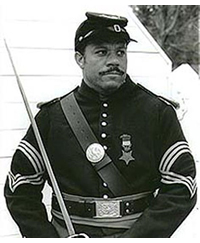
A Union soldier, an escaped slave from Kentucky, verified Douglass' statement when he said, “When I donned my Union blues, I felt freedom in my bones” ....

Camp Nelson, the largest recruitment center in Kentucky for the recruitment of black soldiers in 1864. Information about Camp Nelson and its black regiments here.


There are many black Kentuckian Civil War reenactors.
What unfolded over the next 10 months was one of the most extraordinary events of the entire Civil War. As many as 57 percent of all military-age black men in Kentucky joined the Army; nearly all of them had been slaves right up to the moment they enlisted. No other slave state witnessed such a staggering enlistment rate. Closest were Tennessee and Missouri, where 39 percent of eligible black soldiers joined. And just as white Kentuckians became increasingly disaffected with the emancipationist turn in the Civil War, black Kentuckians filled the state’s draft quota. ...

As all Kentuckians understood, black enlistment meant more than filling out the ranks of the Union Army in the war’s final, deadly months. In no other state was black enlistment more directly tied to emancipation than in Kentucky. Even as other Union slave states – Missouri, Tennessee, Arkansas and Maryland – moved to eliminate slavery in the war’s final months, Kentucky’s Unionist leaders stood firm in favor of the peculiar institution. As a result, joining the Union Army proved to be the only path to freedom for black men and for their families. More than offering mere numbers in the ranks, these black Kentucky soldiers helped transform a conservative war for the old pro-slavery Union into a revolution in behalf of a Union based on a “new birth of freedom. 
As we know, full emancipation did not arrive until quite some time after Lee's surrender at Appomattox.  For black men, remaining in the military was the best way of ensuring their freedom would c

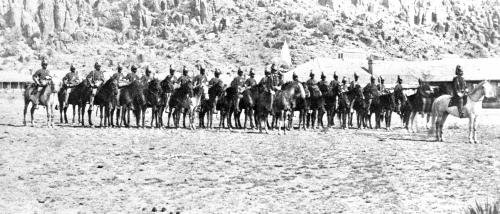
Though this Disunion column doesn't mention them, as outside the chronological purview, the Buffalo Soldiers come to mind, particularly this week, since after the war some of the most well-known black regiments were stationed at Fort Davis.


This map shows Fort Davis and the associated Davis Mountains State Park* location in northern Presidio County (the Davis Mountains are referred to, probably most often in Texas, as the Alps of Texas).

Life for African Americans remained difficult after Emancipation.  Among the many towering obstacles put in the way of African Americans claiming their rightful participation in society, by the various systems, north and south, African Americans were denied employment in almost any work that would allow for, either or both, accumulation of capital and the opportunity of social and political position.  The objective was to keep African Americans in the south, laboring in what became the neo-slavery of Jim Crow.
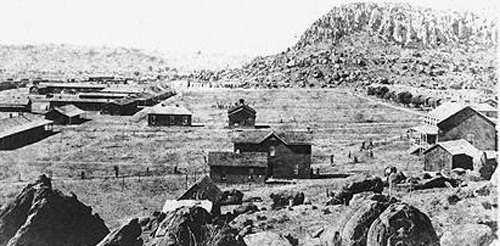
Fort Davis 1885


Fort Davis Buffalo Soldiers 1875

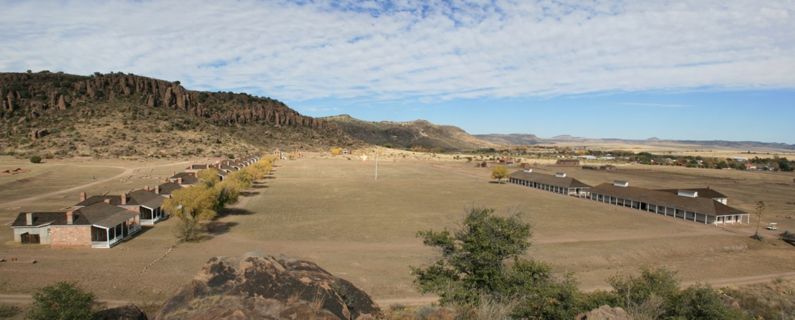
Fort Davis restoration


Fort Davis National historic site

An exception, to degree, to this system, was the military.  Many African Americans preferred to stay within the army than go back to work as, say, a sharecropper.  With the Civil War finished, the U.S. army could now give its attention to "subduing" the western tribes.  The postings in the Southwest were fairly miserable, far from even towns, much less urban centers.  The conditions were monotonous and frequently dangerous.  African Americans filled the need for troops.  The military provided a stable paycheck, and security from the violence of northern white supremacists, and labor coercion from southerners outraged at the idea of 'free" black men.

An account of the history of the Buffalo Soldiers at Fort Davis is here.

It also provided an opportunity to put two colonized groups of people at war with each other for the benefit of the white supremacist establishment.  But yet, yes, a man has got to do what he's got to do, to support his life and his family.  Most of all, it's not for someone like me to criticize such choices.

-----------------------

*  Birders' Alert:  The Davis Mountains State Park does weekly birding hikes in the primitive area of the park.

Tuesday, July 15, 2014

Cuidad Juárez - Sunday, July 13

A dear Albuquerque friend drove in to see Las Vidas Perfectas this evening at the Museo de la Revolutión en la Frontera in Juárez.  He and his girlfriend


stayed overnight in the Camino Real. So I got to drive over the bridge to Mexico with L.  -- and did not have to hang out all day while tech went on.  The LVP people took off for Juárez early in the AM.  My back couldn't have taken that kind of all day hang, even with breaks for the mercados. On the other hand, I'm not able to buy anything because getting it home -- American Airlines! and I am also getting cowboy boots this week and they sure do eat space and poundage -- and that would be frustrating. I do love exploring markets like this, whether or not I buy anything. There is always jewelry ....

Going across the border to Juárez was quick and easy.  Coming back was something else.  You can feel the vibration change in the middle of the bridge approaching the admittance gates to the U.S.  For one thing, at some point a U.S. border cop, on foot, appears, nonchalantly strolling across the lanes, for no particular reason at all. The peddlers attempting to sell mops, kitty art, bottles of water, popcorn etc., the people determined to wash your windshield, have gone poof into thin air. Traffic crawls to a halt.  It can easily take 5 more hours now to cross those -- what? 1500 feet to the gates.  We were lucky.  It took us about 35 minutes, but very stressful minutes.  Imagine the New Jersey Turnpike and the turn offs to the Holland Tunnel, but with armed military everywhere you look.  One strolls over and peers for a long time into the backseat where H and I are sitting.  We don't bother to interrupt our conversation to look back at him.

Yet it is a very distressing, particularly for H, who was born in Hidalgo Mexico, but has been a U.S. citizen for years and years, and lives in Albuquerque. One gets a much deeper sense of how truly awful all this is when traveling with U.S. citizen who is of Mexican descent.*

We have our "documents" at the ready as ordered. The guard who takes our passports asks "What were you doing in Mexico?" The implication is only creeps, criminals and other undesirables bother with Mexico. He  doesn't  attempt even the rudiments of politeness.  L is pumping George Jones on his car speakers. El V and L had been singing along.  As el V's the one at the window on the guard's side, he answers, "Attending the opera.  At the museum." The guard snickers, "Was it any good?" El V smarts back, "It was very good.  I was the star."  L groans.  The guard laughs, takes away our passports to run them through the scanners and databases. He quickly returns them.  Now we're allowed to return to the U.S. It takes three minutes to get back to the hotel and have dinner.  Except for el V, none of us have eaten since breakfast and now it's nearly 10 PM.

I did get to spend time in the Museum of the Revolution on the Border itself. Juárez had a huge role in the Mexican Revolution (the Revolution's armed conflict began in 1910 and lasted roughly through 1920).  Morever, like so many museums everywhere, part of the institution is located in the old Mexican Customs House (see: el paso del norte -- trade route!). As much a role as they play in history, I've come to collect visits to customs houses like I've been doing visits to castles.

Among the many interesting things observed about the audience in Juárez is -- it was entirely "Mexican," with the exception of the couple from Ft Worth - Dallas, who scheduled their vacation in order to attend every performance of Las Vidas (they are coming to the Marfa performances as well). However, the earnest, attentive, pretty and very young Japanese women, ubiquitous at anything like this anywhere I've been, in Europe, the U.S. and the Caribbean, particularly Cuba -- they were conspicuous by their absence today. There were three present at Saturday night's El Paso gig, but none at all at el Museo de la Revolutión.

52 women were killed here back in October, 2013, when a bomb was thrown into their place of work.

An image for Majorie Agosin’s book of poetry, “Secrets in the Sand: The Young Women of Juarez.”
The buildings all around us in Juárez were so interesting, so attractive, despite many of them being so run down.  Street signs are not generally in evidence though.  All this the consequences of so many tens of thousands killed there in the drug gang wars, the exploitation of the maquilidoras and the violence there, particularly against women.

I would liked to have explored more, but L, who has spent quite a bit of time in Juárez due to his activist work, says it's really too dangerous.  If L thinks it's too dangerous, then it is.  L goes everywhere, anywhere.

--------------------

*The Mexican born member of the Las Vidas Company had a nasty return as well.  He walked back with several of the other performers because it is so much quicker than driving.  You still have to show your passports and prove you are who you are.  The border patrol guard who took R's passport snickered about his hair -- it's very long, very beautiful and he had braided it into one his lovely signature braid designs.  Yeah, yeah, yeah, you creeps.


Sunday, July 13, 2014

El Paso 3 - Saturday

It wasn't predicted at 8 AM when I looked at the forecast.  Nevertheless, I am having a fine view of a spectacular thunderstorm rolling in fast over the mountains now at 3 PM MST.  Thunder cracking, and lightning, lightning whips reflected in the windows of the hotel's wings on either side of our room.

And now it's over. So fast, it's as if the storm never happened.  The pavement didn't even look wet.  As hot as the pavement is, the rain must have turned to evaporation upon impact.  The temperature was 96º, with a 'real feel' of 101º when the front rolled over us.  The southwest!

Among the events hosted by the hotel today is a bachlorette party. Evidently Mexican culture does these parties very differently than we see in the movies? Because there wasn't a cocktail in sight -- but the desserts were so luscious one gained ten pounds simply by looking at them.

The bride must have hundreds of female friends and relatives, as the dining room was entirely given over to the party and every chair was occupied.  The guests celebrating the bride were of all ages, from very elderly women to tiny girls in the cutest clothes and hairstyles, who behaved even more cutely (can one use that usage?

 Those little girls -- there were some who were maybe three years older than the littlest ones, and like -- I assume cousins everywhere, the older girls are adored by the younger ones, who follow them everywhere, and hug them every chance they get.  The older girls are careful and tender with the littler ones. Latin culture does inculcate that sort of attitude of children to each other.

Turned on the tv for the first time, to see what is up in that.  It maybe because this is a hotel, but the screen resolution was poor, particularly as used to high def and so on as I am from watching solely online. Commercial breaks as ubiquitous as ever.  But imagine the shock when thinking I'm settling in on a PBS overview of the Presidents of the U.S., from Washington to Lincoln.  Narrated by Newt Gingrich, co-written with his wife Calista, Rediscovering Religion in America (2007) proved how fundamentally religious each of the presidents was, and how they believed religion was more important than government to government. Religion here means protestant christianity only, and specifically evangelical protestant christianity.  The program was interrupted with endless, lengthy commercial breaks to sell many kinds of insurance from many insurers to senior citizens.  This is not a PBS as I have ever seen it.  This must be PBS in Texas ....


Gotta say: the women of El Paso are poised and stylish, with that extra elegance and bounce that is part of a latina woman's culture, from whichever hispanic background she hails.  A woman seated at my table at the theater tonight, now retired, used to own her own clothing design business.  She told me that fashion was really big business in El Paso, meaning designers as well as fabricators and manufacturers, though in the last ten years it went pfffffftttt, which is why she's now retired.  But the influence of it once being a big part of the city's economy and cultural life is still evident whenever you see a young or youngish woman, or a little girl.

However, there is still El Paso Fashion Week. I've met many women who worked in fashion in NYC, or whose daughters are now working in fashion in NYC, or who are going to NYC this fall, to study fashion or design at Pratt, FIT, NYU, and so on.

Most of the oxygen today was taken up by preparations for tonight's performance. Which paid off.  It was revelatory.  Las Vidas Perfectas continues to evolve, and shall for as long as it is performed.  The amount of talent assembled on that stage was breathtaking.  The amount of work, perseverance, faith and skill -- as well as the creative and artistic talent -- by so many individuals, to make this so successful can't be measured.

Super Moon, El Paso, Saturday, July 12, 2014
The first performance was a spectacular one, though the performers are all complaining about what was poor, what went wrong, how they effed up, etc. Artists are never satisfied with themselves.  It was spectacularly received too, and I know so, because I heard what audience members said.  For example: a young man, dressed in universal young hipster style, after the first section's applause died down, sighed to his companions, "O, I feel I've gone to New York.  It must be like this all the time there!"  (Ha!  It sure as heck is not, at least not anymore. But I remember what it is was like when I lived in Albuquerque, and artists from Europe or the coasts came in.)

In other words, it was an event worthy of an El Paso super moon!

Tomorrow night, Sunday, with the performance in Mexico, in the Museo de la Revolutión, will surely be even more so, as Ciudad Juárez is entirely Spanish-speaking.  As well, in the latino world, the arts and intellectual pursuits are far more respected than in the U.S.  Artists and intellectuals are part of the political discourse -- the entire spectrum is far more lively than anything you find in the U.S.  Print magazines remain important and vital in the nations south of us, whereas here, it's all gone online, whatever is left, and it's all about entertainment. If something takes longer than 164 characters to look at, make fun of it and dismiss it.  Unless it's filled with non-stop mindless violent action.  Then we can stare at it for days at a time, and so we do, getting to ever higher levels of The Game, whatever The Game may be.

However, in so many parts of some of these countries, violence is a way of life and politics that artists, intellectuals and the people themselves are desperate to change, particularly since so many of them are specific targets of the violence.  It's not a Game.

Saturday, July 12, 2014

El Paso 2 - Friday

Needing a break from the room, and el V's constant Las Vidas' practice, we went walking in what had been El Paso's city center, back when el V was a tad and his father was teaching biology at what then was Texas Western College, now, folded into the UT system, is the UTEP -- University of Texas at El Paso.  El V, back then, knew and loved this downtown - central business district of El Paso, filled with record stores and movie theaters as it was,

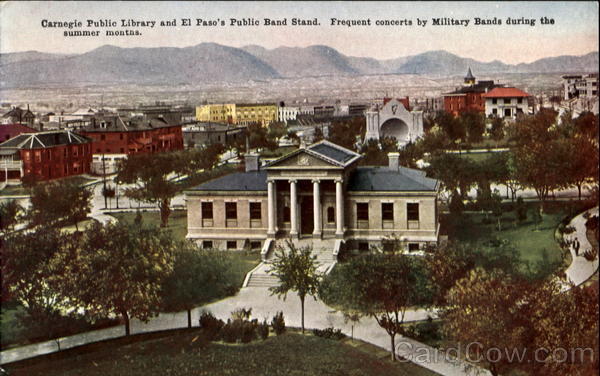
This is the El Paso Main Public Library when el V was a little kid.

The El Paso History Museum is in the foreground; the Main Public Library is in the background.

The museum's ground installations are a fringe benefit for the library.
and the public library.

Like so many cities, El Paso destroyed its downtown by tearing down much of the historic, attractive part, driving away the thriving smaller businesses, in order to build a sterile convention center, sports stadium, etc. The city also employed the Great Terminator upon the very neighborhoods and communites, that give a city a soul, the soul that make cities attractive and liveable:  El Paso drove a damned interstate through the rooted neighborhoods and mercantile centers, killing them dead under concrete, killing the soul.

So, with its downtown  deader 'n a doornail, like so many other cities, El Paso's revitalization wish fullfillment is to upscale the attraction of what remains in the old city downtown center, renting the spaces out to young(ish) entrepreneurs in the, usually vain, expectation these expensive camera cuisine restaurants, and the high fat food plus expensive imported beer sports bars will attract local business and tourism. Throw in the inevitable crafts mall, art galleries, a farmer's market once a week for part of the year, and First Friday Nights special offers, etc. How many small cities and towns have we seen doing this since the 1980's?

The real kicker is how the wealthy corps and politicians count on artists to fix the urban blight that they created themselves, and, then, if by chance the plan actually works -- as in NYC -- grab the real estate back and dump the creatives into the street -- but not these streets. The creatives fixed 'em so they're no longer welcome. Then begins the sterilization process all over again as the prices rise higher and higher and higher, with nothing inhabiting the real estate again except that from which anybody looking for any real fun and surprise will run from at 100 MPH.

There is construction everywhere, just like in every city that anyone wants to live in everywhere in the world, covering ever more open space under asphalt and cement, pretending to be public gardens and recreational territory.

Hotels abound throughout this area, as there are regional headquarters for every national / international bank, mortgage company, real estate moghul, and every kind financial and insurance corporation here -- not to mention those of such light "industry" as textiles and light furnishing finishing, that employ international cheap labor and ship internationally. The busy execs flying in and out, making deals, arming drug dealers, smashing progressive governments and labor movements need places to stay.

But where do they eat?  Probably in the strip clubs, which are further away? they aren't in these restaurants.

Then there is the tourism.  Where do they eat? Well, tourist college kids, think going to Juárez will give them better deals on getting so drunk they must crawl and more exotic and cheaper sex workers.  So there isn't enough enough clientele to make these places profitable 7 nights a week.  Partly, too, it's because they don't really want Spanish speaking clientele.

(It's más pleasant that our hotel's staff is bi-lingual, and so are the guests.  The staff were puzzled by el V and EVF's Spanish though -- they had to tell them it was Cuban.  Then there's E's Spanish-Spanish, pure Castillian -- she's from Madrid.)

What is great here though is the El Paso Historical Museum -- there is a lot of history -- the El Paso Art Museum -- and the El Paso Public Library.  The library is still where it was when el V was a little kid, though the building is not the same. It's open 7 days a week!  You see all kinds of people in it.  It reminds me of Greenville, Mississippi's public library. What else does this library do beyond all the things public libraries are providing these days, including wi-fi connection, computers and a/c?  It is showing the World Cup games for all those who can't watch at home, can't afford to be or don't want to be in a sports bar.  Is that public service or what?

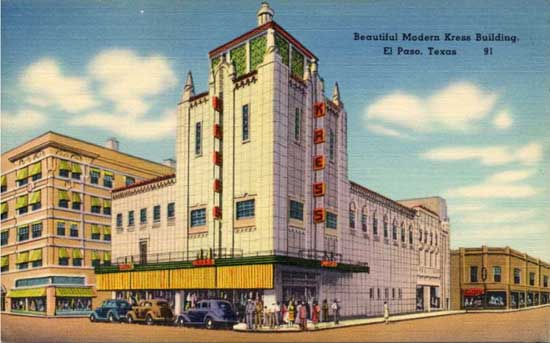
The Kress Building has survived, but everything around it has been torn down, so it sits within a construction site; the streets around it are closed.  This historic post card doesn't show what a glorious jewel of a building it is.

It's nearly impossible to photograph the Kress Building now.
There are some buildings that didn't get torn down during their urban renewal, and I love those. So many Spanish-Moorish styled buildings, that are beautiful.  So we were out photographing madly early this AM while the sun was in the right place to have shadows and not glare.

It's such a pleasure to have all these recognizable bits come together that have not changed about being in the southwest: the clatter of cicadas, big sky, the dry heat, hearing "Mexican" Spanish, local tribes people, the Moorish-Spanish influenced design of buildings, fountains, patios, plazas and courtyards, the food (which though el V can't eat it, isn't stopping me from eating Mexican dishes every chance I get -- the hotel has some of the best red and green chili sauces for breakfast ever) -- and, this is SO TEXAN! Shiner Bock, my beer of choice for this trip.


Or so it felt as the sun rolled down, while the super moon rolled up,  turned yellow, big as a super-large cotton ball, over the mountains, then turned red in the smog for awhile.


El V had hired a car to drive us along the scenic route, as well as look for spots from his childhood days here. The driver was a self-educated tour guide, from India, who has lived in El Paso for 30 years. He was filled with information about everything to do with El Paso and Juárez, and enjoyed sharing.  He seized the opportunity to fact-check various things from the 1960's downtown and campus against el V's memories of the time.

These days though, West Texas is about to go into recycling toilet water, so depleted is the water table from irrigation, and how arid it is, now that the grasslands have been taken out for over a century.  Recycled toilet water won't preserve this profligate water way of life in a region that has always been arid.

Chihuahua grasslands now.

How all the Chihuahua grasslands used to be, only a century plus about twenty years ago.

It's painful to have those instinctive reactions to flying over the Franklin's flatlands, seeing it as ancient, primeval desert monster -- while the facts are that a century ago -- or perhaps a decade or so before that -- those flatlands, mesas and plateaus were grass tall as your knees and the clutching spread of claws on the twisted limbs sand channels were streams and rivers of flowing water. Cattle and cotton and oil .... (In the Sahara it was goats, among other things.)  How quickly we destroy the environment, yet insist we have no responsibility for that or any obligation to it.

This is what is keeping us from ever returning to the southwest -- water. The northeast we are water rich. Doubtless other regions will be going to war with us about this most precious resource of all, in the fairly close future.  Hey -- I've lived to see the return of the wars of religion -- it's not that unlikely I shall see water wars too. If I live, that is.

Dune feels more prescient all the time.


Friday, July 11, 2014

El Paso 1 - Thursday

The flight from Dallas-Ft. Worth to El Paso is over  some of the most desolate arid landscape on the planet.  You see dried to the bone river bed after river bed. twisting and twining like bizarre, ancient reptiles.  It is said, or it used to be said, "The West begins at Fort Worth."  Maybe what was meant that this is where the water ended.


However the last 35 minutes of the flight, when you begin to hit the mountain landscape of the Chihuahuan Desert, is a spectacular sight.  Bluffs, cliffs, passes, an occasional peak thrusting far above the surrounding bedrock, sand and river beds, which here though dry now, still have greenery running along them, This is particularly so along the Rio Grande, which still has some water down here.

There used to be grass on the flats and mesas in season between the mountains, canyons and cliffs. Now the flatlands are bare,


covered with creosote bushes a/k/a greasewood in English, and chaparral and gobernadora in Mexican Spanish,


or  mesquite.

These days the Otero Mesa Grassland of the Chihuahuan Desert, straddling both Texas and New Mexico's border (which is why El Paso, TX and Las Cruces, NM, are considering themselves part of "the larger El Paso-Las Cruces metropolitan region), remains as the largest grassland left on American public land (though the cattlemen have done a damned good job of about finishing it off -- their cattle eating your grass for a nominal fee, which they don't bother much paying).

Easy walking distance from the hotel (wearing sunscreen and a broad-brimmed hat) is Mexico, over the bridge and through the pass to Ciuadad Juárez, which gives El Paso its name: the pass through the Franklin Mountains into el norte, through which, when it was all still part of the Spanish Imperium, and Mexico, traders, military and migrants traveled what was named the camino real -- the royal road to New Mexico, Colorado and California.  Los Indios were using it long before the Spanish arrived.

Historic view of the bar-lobby from ye grand olden days.

Our hotel, on the registry of historic hotels, is thus named el Camino Real, and has been around in one form or another since the Mexican Revolution.  It's gorgeous in that late nineteenth century way of opulence (like the Hotel Nacional in Havana, where the bullet holes in the walls are preserved from the days of the Cuban war of Independence -- mine and many others' favorite Havana hotel). The pool is beautiful, the breakfast is anything you want, literally from fruit to nuts to oatmeal to yogurt, to toast-eggs-bacon, to refried beans-sausage-red or green chili salsa, etc.

Our company of traveling players is made-up of superb professionals, all of whom are more than socially competent and have good personalities. Everyone already knows each other well already from previous Las Vidas Perfectas gigs.  We even have the requisite child who is experiencing all this for the first time with a child's sense of wonder and excitement, the five-year-old son of one of the producers and his performer-costumer wife.  He has his nanny too, so when E has to work she's free to do so.  The Son flew for the first time yesterday, got his photo taken with the plane's captain, got to go swimming and play monsters with one of his favorite playmates (el V).  Glory be though, he slept through almost all of both flights, waking up for bathroom visits and orange juice only.  In other words the Son is a really good kid, and, as per usual for me these days, seems far more mature in his use of language and in social interaction than kids used to be.  That includes me when five, that's for sure.

The producers are immensely pleased with the performance spaces, the tech crew, the sponsors and the way both cities are supporting the performances of Las Vidas Perfectas. They are proud to have this program in their cities, and show it in every way they can.  The producers -- who arrived some days earlier to organize matters for set-up and rehearsals in El Paso and Juarez -- told us last night that the professional theater tech crew are more professional and do things better than in NYC -- and they care more. This all bodes well.

Last night when we gave up walking around due to exhaustion and altitude, it was still 90º.  The moon was hanging over the southern tip of the Rockies, the Franklin Mountains, which cut El Paso in two (el paso del norte), and surround El Paso and Ciudad Juárez on three sides.  Huge, white and nearly at the full, July 12th's full moon is the third of 2014's five super moons.


Today, people are, working on their parts for Las Vidas Perfectas, getting haircuts, depositing their per diem checks into their accounts, resting, perhaps exploring a bit, shopping.* Tomorrow it's rehearsal, spot, sound check and so on at the historic Tricky Falls theater.

I'm working on The American Slave Coast, re-reading again and making editorial comments, even though it's with TW.  Besides Las Vidas, el V's also working on Afropop Worldwide HipDeep proposals.  Hopefully, by tomorrow morning, we'll be acclimated enough to get up early while the sun's in the right part of the sky to do some photography.

 -------------------------
* el V got himself a dashing pair of spectators, black and white, at one of the Mexican tiendas along what used to be the main street, and now is a zócolo.  And pairs of superfine sox!

Friday, June 27, 2014

Next Month

From the El Paso Opera website:

El Paso Opera and Ballroom Marfa are proud to announce the Texas premiere of “Vidas Perfectas,” the Spanish-language production of the avant-garde American composer Robert Ashley’s (1930-2014) groundbreaking work “Perfect Lives” (1983), which concerns a bungled bank robbery in the American Midwest. Originally commissioned by The Kitchen in New York City and subsequently produced for the BBC as a seven-episode television opera called “Perfect Lives,” “Vidas Perfectas” switches the locale to the U.S-Mexico border, the landscape inspired by Marfa, TX, and the language to Spanish. The opera tells its untraditional story through an innovative combination of video and live performance. An opera that incorporates chanting, storytelling, meditation and ecstatic revelation, “Vidas Perfectas” challenges the way we think about language, opera, television, and performance.
The Protagonist - Lead
 David Grabarkewitz, El Paso Opera’s general and artistic director, calls the production “fun, funky and weird. It’s not traditional opera storytelling; expect to see an edgy performance.” He says experiencing “Vidas Perfectas” will be like stepping into a modern art installation.
“Vidas Perfectas” comes to El Paso, Ciudad Juárez and Marfa after a successful debut at The 2014 Whitney Biennial at the Whitney Museum of American Art in New York City. All seven episodes are being recorded and edited for television and will be released on CD and DVD;  “Vidas Perfectas” will continue to tour internationally as a live performance.
It's going to be an interesting experience, stepping back into the Southwest, to which, other than Texas -- meaning Dallas-Ft. Worth, Houston and Austin -- I've not been in years.