LINES OF THE DAY

". . . But the past does not exist independently from the present. Indeed, the past is only past because there is a present, just as I can point to something over there only because I am here. But nothing is inherently over there or here. In that sense, the past has no content. The past -- or more accurately, pastness -- is a position. Thus, in no way can we identify the past as past." p. 15

". . . But we may want to keep in mind that deeds and words are not as distinguishable as often we presume. History does not belong only to its narrators, professional or amateur. While some of us debate what history is or was, others take it into their own hands." p. 153

Silencing the Past: Power and the Production of History (1995) by Michel-Rolph Trouillot

Showing posts with label disaster capitalism. Show all posts

Sunday, December 8, 2013

David Simon: 'There are now two Americas. My country is a horror show'

An edited extract from:
... the creator of The Wire, David Simon, delivered an impromptu speech about the divide between rich and poor in America at the Festival of Dangerous Ideas in Sydney, and how capitalism has lost sight of its social compact.
in the UK Guardian / Observer. It's very strong meat, which will send the usual sorts into frothing vituperation, but hey, Mr. Simon calls 'em as he sees 'em, and he sees via many more perspectives and experiences than the usual frothing vituperators.  For instance, there's this:
You know if you've read Capital or if you've got the Cliff Notes, you know that his imaginings of how classical Marxism – of how his logic would work when applied – kind of devolve into such nonsense as the withering away of the state and platitudes like that. But he was really sharp about what goes wrong when capital wins unequivocally, when it gets everything it asks for.
That may be the ultimate tragedy of capitalism in our time, that it has achieved its dominance without regard to a social compact, without being connected to any other metric for human progress.
We understand profit. In my country we measure things by profit. We listen to the Wall Street analysts. They tell us what we're supposed to do every quarter. The quarterly report is God. Turn to face God. Turn to face Mecca, you know. Did you make your number? Did you not make your number? Do you want your bonus? Do you not want your bonus?
And that notion that capital is the metric, that profit is the metric by which we're going to measure the health of our society is one of the fundamental mistakes of the last 30 years. I would date it in my country to about 1980 exactly, and it has triumphed.
And it's a disaster.


Unless we are among that ever shrinking minority of the global plutocratic oligarchs and their servants,


we are all living Disaster Capitalism now -- combined with the neo-police state of 24/7 surveillance of everyone and everything. Ain't the future grand?

Wednesday, August 21, 2013

Low Winter Sun 2

I called this one right. Doesn't this look bleak, depressing and boring as heck?


At least with The Sopranos you get beautiful tables of food the viewer wants to dive into, glass after glass of damned good wine. Nobody whacked or got whacked, without a satisfying meal (unless she was an anorexic girlfriend who didn't deserve it, but whatya gonna do?).


The Bad Cop Who Wants to Be Good in Detroit series, Low Winter Sun, has failed already, after two episodes, according to the reports.  The commentators bring up some of the reasons they believe the viewers rejected the series out of hand, including:
The problem is that there has been too much of this "anti hero cop drama set in a bleak environment" that by now I'm pretty sure everyone is tired of. Three recent examples being Top of the Lake, Broadchurch, and the Bridge, This type of tv show is saturated.
Though no one mentioned the title -- a very bad title for a television series.  Maybe it would be OK for a play, but not for tv.

Friday, August 2, 2013

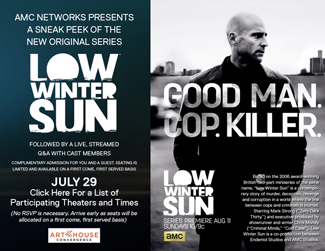
Low Winter Sun -- Another Form of Disaster Capitalism Looting Our Cities

What David Simon wrought -- not that he is to be blamed, for he burned with the holy fire of first-hand, personal outrage. With The Wire and Treme  He cared, he cares passionately, he cared, some might say too much. His templates have been taken over by others, who are not interested in the horror of corrupted morality but in all the sensationalism they can squeeze out of it, the cheap thrill of seeing people behave really badly without consequences -- the expected privilege of  ever-growing numbers -- because, why not?
A dark story in a city falling in on itself might present some audience problems, but Mr. Stillerman noted that the show was opening immediately following the final season premiere of “Breaking Bad,” which has thrived on exploring human pathology.
But now our cities destroyed by neglect and design are golden opportunities for looting and pillaging via showrunner career-building opportunism on all fronts, as this New York Times article on the AMC premiere of Low Winter Sun  * tell us, though perhaps not by design. In order that we don't miss the opportunism here, one of the characters is played by David Costabile, who was in the cast of both The Wire and Breaking Bad.  Additionally, a thug is played by Jay Ransone from The Wire's second season, and who also appeared in a season of Treme ( and Simon's Generation Kill too; at least the actors are getting work, even if the residents of the cities where the series are shot aren't. That's something.) This is about men doing bad things to each other. Surely they do bad things to women, children, animals and plants as well, but women and how they hold things together as best they can when the men don't bother will not be the focus. The focus is Men, choking within their claustrophobic manufactured atmosphere of testosterone poison.

The show is closely focused on Agnew and his partner, Joe Geddes (Lennie James), two homicide cops who commit that signature crime on a deeply crooked fellow detective and then spend time trying to unsolve the crime.
To be sure we don't miss this is about the baddest, meanest, ugliest men in a city, the article is titled "Broken Men, Broken Place."  Besides the adored Albuquerque's Breaking Bad, another recent television series example of this relentless miserable, masculine grey  bleakness of corruption which so often is mistaken for depth and gravity, was Chicago's Boss. One feels confident of what to expect without seeing it first. This isn't a comment on whether the series will be good bad or indifferent, just what the series is planned to be. 

There's no mistaking the relationship between what has happened in New Orleans, and continues to happen, with what is going on with Detroit, as this same New Orleans blogger describes here.  The 'best' of New Orleans is Disney World tacky faux -- the rest can go to hell until they get out and leave it all safe and easy for the corporate looters.  Even the schools and hospitals, ever our first targets in dismantling a decent culture and economy that serves the whole community, not merely the oligarchy of plutocrats.

But it's all service economy now: all the rest of us live to serve the rich, and are to be grated for it.  Mayor Billionaire didn't even bother to disguise telling us so.
"You know, the yelling and screaming about the rich - we want rich from around this country to move here. We love the rich people," he said on his WOR-AM radio show.
"People say, 'Oh, well, you know, if the income were redistributed throughout the system more fairly,' " Bloomberg continued.
"I don't know what fair means. You can argue that if you make more money, you deserve more money."
Rich people generate jobs and taxes with the expensive things they buy and the fancy restaurants where they eat, Bloomberg said - but they aren't making much money as the stock market collapses, and raising taxes on them will just drive them away.
The stock market is having record profits, Mayor Mikey, and we all know it. But that's how much contempt you have for us: you lie to our faces and tell us to suck up your lies. You can't even quite control the laughing in our faces as you pronounced that the only jobs the rest of us can ever expect is servicing the wealthy for less than a living wage, while be taxed at a vastly higher rate, while receiving nothing in return in terms of education, health care or food and home.

Recall, how it was in the glorious days of the ancíen régime, when in France all work was in service to the wealthy, such as lace making (which was one of the businesses controlled by the king)?  You ruined your eyes and your general health, while malnourished and ill-housed, making the rivers of lace that festooned the aristocracy, lace you never wore for you could not afford decent food, much less the luxury product you created, and when you couldn't make it any longer, you were out of a job, left to your own devices to die hopefully sooner and quietly, rather than later, making another burden on the overburdened  malnourished country to dispose of a diseased stinking body.

This, folks, is the economy to which we are returning, at ever accelerating pace, as the global plutocratic oligarchy gobbles everything that generates value.

But in the meantime we have the bread-and-circuses thrill of progressive degradation to make up the loss of our future, all while expressing ourselves in baby talk, pretending to be other creatures, anything other than adult human beings confronting our too terrible to admit realities.

-----------------------
* One does rather expect, that with such a stupid, impossible to remember title, Low Dark Sun  -- ooops! Low -- what it is it? look it up again --  Winter -- Winter! Sun will not go on for long.

Sunday, September 16, 2007

Disaster Capitalism

Disaster Capitalism: The new economy of catastrophe
by Naomi Klein
PUBLISHED September 8, 2007

This article is a preprint for subscribers. Itwill appear in the October 2007 Harper's Magazine.

This is astounding information and observation, though, when we think about it, not in the least surprising, confirming what we already know, have witnessed, and tragically, some of us have already experienced personally.

It goes along with the current loud touting of climate change capitalism, and how the market is going to deal with it. Yay! for the ice caps melting and the new sea passages! So good for the economy.

Ms. Klein's article, based on her book, is far too long to post all of it here, even though it's not yet available for online reading. But here are a few pulled paragraphs (if one would like to see the entire article, let me know via e-mail):

[ Everywhere in Iraq, the wildly divergent values assigned to different categories of people are on crude display. Westerners and their Iraqi colleagues have checkpoints at the entrances to their streets, blast walls in front of their houses, body armor, and private security guards on call at all hours. They travel the country in menacing armored convoys, with mercenaries pointing guns out the windows as they follow their prime directive to "protect the principal." With every move they broadcast the same unapologetic message: We are the chosen, our lives are infinitely more precious than yours. Middle-class Iraqis, meanwhile, cling to the next rung down the ladder: they can afford to buy protection from local militias, they are able to ransom a family member held by kidnappers, they may ultimately escape to a life of poverty in Jordan. But the vast majority of Iraqis have no protection at all. They walk the streets exposed to any possible ravaging, with nothing between them and the next car bomb but a thin layer of fabric. In Iraq, the lucky get Kevlar; the rest get prayer beads.

Like most people, I saw the divide between Baghdad's Green and Red zones as a simple by-product of the war: This is what happens when the richestcountry in the world sets up camp in one of the poorest. But now, after years spent visiting other disaster zones, from post-tsunami Sri Lanka to post-Katrina New Orleans, I've come to think of these Green Zone/Red Zone worlds as something else: fast-forward versions of what "free market" forces are doing to our societies even in the absence of war. In Iraq the phones, pipes, and roads had been destroyed by weapons and trade embargoes. In many other parts of the world, including the United States, they have been demolished by ideology, the war on "big government," the religion of tax cuts, the fetish for privatization. When that crumbling infrastructure is blasted with increasingly intense weather, the effects can be as devastating as war. ]

[ "Neglected Defense: Mobilizing the Private Sector to Support HomelandSecurity," a 2006 report whose advisory committee included some of thelargest corporations in the sector, warned that "the compassionate federalimpulse to provide emergency assistance to the victims of disasters affectsthe market's approach to managing its exposure to risk." Published by theCouncil on Foreign Relations, the report argued that if people know the government will come to the rescue, they have no incentive to pay forprotection. In a similar vein, a year after Katrina, CEOs from thirty of thelargest corporations in the United States joined together under the umbrellaof the Business Roundtable, which includes in its membership Fluor, Bechtel,and Chevron. The group, calling itself Partnership for Disaster Response,complained of "mission creep" by the nonprofit sector in the aftermath ofdisasters. The mercenary firms, meanwhile, have been loudly claiming that they are better equipped than the U.N. to engage in peacekeeping in Darfur.

Much of this new aggressiveness flows from suspicion that the golden era of bottomless federal contracts might not last much longer. The U.S. governmentis barreling toward an economic crisis, thanks in no small part to thedeficit spending that has bankrolled the privatized disaster economy. Sooner rather than later, the contracts are likely to dip significantly. In late 2006 defense analysts began predicting that the Pentagon's acquisitionsbudget could shrink by as much as 25 percent in the coming decade.

When the disaster bubble bursts, firms such as Bechtel, Fluor, andBlackwater will lose much of their primary revenue streams. They will still have all the high-tech equipment bought at taxpayer expense, but they will need to find a new business model, a new way to cover their high costs. The next phase of the disaster-capitalism complex is all too clear: with emergencies on the rise, government no longer able to foot the bill, and citizens stranded by their hollow state, the parallel corporate state will rent back its disaster infrastructure to whoever can afford it, at whatever price the market will bear. For sale will be everything from helicopter rides off rooftops to drinking water to beds in shelters.

Wealth already provides an escape hatch from most disasters-it buysearly-warning systems for tsunami-prone regions and stockpiles of Tamiflu for the next outbreak. It buys bottled water, generators, satellite phones,and rent-a-cops. During the Israeli attack on Lebanon in 2006, the U.S. government initially tried to charge American citizens for the cost of their own evacuation, though it was eventually forced to back down. If we continuein this direction, the images of people stranded on New Orleans rooftops will not only have been a glimpse of America's unresolved past of racia linequality but will also have foreshadowed a collective future of disaster apartheid, in which survival is determined primarily by one's ability to pay.

Perhaps part of the reason so many of our elites, both political and corporate, are so sanguine about climate change is that they are confident they will be able to buy their way out of the worst of it. This may alsopartially explain why so many Bush supporters are Christian end-timers. It's not just that they need to believe there is an escape hatch from the worldthey are creating. It's that the Rapture is a parable for what they arebuilding down here on Earth-a system that invites destruction and disaster,then swoops in with private helicopters and airlifts them and their friendsto divine safety. ]

There is much, much, much more. She's speaking at the NYPL Humanties Research Library next week; it's already sold out.