LINES OF THE DAY

". . . But the past does not exist independently from the present. Indeed, the past is only past because there is a present, just as I can point to something over there only because I am here. But nothing is inherently over there or here. In that sense, the past has no content. The past -- or more accurately, pastness -- is a position. Thus, in no way can we identify the past as past." p. 15

". . . But we may want to keep in mind that deeds and words are not as distinguishable as often we presume. History does not belong only to its narrators, professional or amateur. While some of us debate what history is or was, others take it into their own hands." p. 153

Silencing the Past: Power and the Production of History (1995) by Michel-Rolph Trouillot

Friday, October 22, 2010

Loudoun schools remove textbook that claims black soldiers fought for South

Breaking news.

Presumably, she says cautiously, this is just the first of many Virginia school districts to do so.
Evidently the embarrassment of national front page and cable talk shows was too much even for those true born sons of the Commonwealth of Virginia.

However, as the story points out, many districts say they are unaware there's been 'controversy.'  This is also stated:

A state official said yesterday that the book was approved by the Department of Education without the input of a single historian or content specialist.

Wednesday, October 20, 2010

Virginia 4th Grade History Textbook Criticized

We read a 1957 Virginia history textbook last night, mandatory for all the Virginia grade schools. Guess what? West Virginia is an unfit subject for 4th grades -- nary a mention of it in its history of the Civil War. Nor a mention of the 200,000 + African Americans who fought in various capacities for the Union -- however, almost all slaves happily stayed on the plantation, or fought the Union. How about that? Also, the history of the United States? It's only Virginia history. We also have the 7th and 11th grade texts that are part of that series for Virginia public education, that we got on Inter Library Loan from the U of VA. They are equal to the 4th grade text.


So if you wonder how we get the o'donnells here you go. War on history taught with facts and real information, which has been going on by the right since at least 1950 -- when all those uppity black men came back from fighting in WWII and Korea. If you couldn't get rid of public education all together, then teach lies. They've taught the lies so well that even the people telling the lies don't know they are lies.

Here's the WaPo story on the contemporary version of this kind of so-called history taughtg in the public schools.
 
This is the conclusion of the article, about the person who wrote this so-called history book, who, by her own admission, is no historian:
 
The book also survived the Education Department's vetting and was ruled "accurate and unbiased" by a committee of content specialists and teachers. Five Ponds Press has published 14 books that are used in the Virginia public school system, all of them written by Masoff.
 
Masoff also wrote "Oh Yuck! The Encyclopedia of Everything Nasty" and "Oh Yikes! History's Grossest Moments."


Monday, October 18, 2010

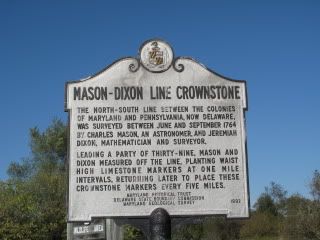
Historic Marker of the Mason-Dixon Line

Marker stones, called Crown stones, carved with the Baltimore coat of arms on side, and the Penn coat of arms on the other, were set up every 500 feet to mark the dividing line. This project kept surveyers rich for a long time.  I got some photos of a Crown stone, but because of the age, and all the vegetation around it, including poison ivy, not much can be seen from it.


Centerville Community of Free Blacks: With more contemporary siding now, and it had been linked to the electrcity grid, the house is deserted. C O'D says that this was typical design for these houses in Kent County's free black communities, both before and after the Civil War. The family slept in the loft right up under the roof. One room, plus what as used as a kitchen under the lower part.

You can see more of these in the Kent County Historical Museum publication, Historic Houses of Kent County: An Architectural history, 1642-1860 (1996).


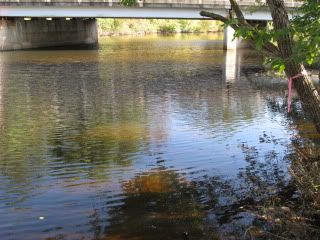
Upper Chester River: Clear, clean, a wonderful place to canoe or kyack. Also a good place for fisherman. I took this photo from the spot where anglers exercise their skills.


So, that's a bit from my Delmarva Sunday Excursion yesterday. couldn't have had a nicer day for this. I couldn't have been provided with better guidance. I also got taken into all these rooms that the general public doesn't get to enter. This is the nicest Sunday afternoon I've had in years. My only regret is that I didn't take more photos. But I was so busy listening and looking. There was much more to the day, that was seen and experienced, than can be blogged.

Maybe the best part were the rural drives to Odessa and then the one back to Chestertown. There are a variety of rural landscapes in just this small area. Horses! Bald Eagles (there's also a wildlife reserve within this little area). I had such a good time.

I watched the end of season one of A Good Wife. V made me dinner -- well warmed up leftovers. Then we went to make fun of the ducks, er widgeon, and have a good night glass of wine at the Fish Whistle. I retired to bed with computer to finish transcribing my notes on William Claiborn.

Odessa underlines yet again, that those who could own slaves and have indentured servants, tended to stay wealthy, influential and powerful generation after generation, as they intermarried. These people still help run Delaware with the Duponts.

Corbit-Sharp House (1774): Odessa, Del. Continued

This stone building is behind the Corbit-Sharp House, looking from the river and the gardens. Perhaps this is where the to-become-very-wealthy Quaker, Corbit, lived after he got his tannery on its feet, but before he built the Philadelphia-style Georgian mansion.

He had four wives, with children by them all. At one time there were 13 children in all living in the house from early 20's to infant. His fourth wife, 16 years younger than he, outlived him for 20 years. Mary was a wealthy heiress from the sophisticated, cosmopolitan Philadelphia, very well educated, and au courant with all the modes. So William improved and expanded the original mansion and grounds according to her wishes. This included moving the kitchen from the basement to the ground floor, with windows.


All Purpose Room, Including Office, Corbit-Sharpe House: This is a true mansion (makes our house look puny), owned by Quakers or not, and it is huge. It hosted many large parties, as well as long-staying relatives from Pennsylvania and Virginia.

In those days people hadn't yet separated certain functions into separate rooms. This one seems to have been a room in which the family ate, but where the Master also conducted business. That desk-bookcase, was made locally, and is a museum-quality piece. I lust-yearn to possess it myself.

The wall paper is not period.

Upstairs there is the 'entertaining room" with chandeliers, mirrors, much satin brocade and a spinnet. Except for the instrument, all of that is the restorer Sharp's idea, and is not right for a Quaker's home of that period, no matter how wealthy.


Hiding Runaway Slave Sam in the Corbit-Sharp House: 1830's. Era of the Fugitive Slave Laws.


Sam had run away from his owner in Maryland, evidently for harsh treatment. Mary Wilson-Corbit was home alone with her daughter Molly, who was about 8 - 9. Sam, who had been chased over the Eastern Shore of Maryland by the slave catchers, came to the House's door, begging for help. The slave catchers were right on his heels. Mary was liable for all kinds of punishment for helping him. She had to make her decisions very quickly. She decided to hide him.

Fortunately the slavecatchers didn't have dogs.
From the Corbit-Sharp House Sam was smuggled to Philadelphia, and from there up to Canada. He got word back to Philadelphia that he had made it --Illiterate, he couldn't write the message; the message of his safety was then sent back to Mrs. Corbit . No one knew about this except Molly, until she told the story to organization of Colonial Dames after the Civil War. Her account is recorded in the group's Minutes.

17th C Appoquinimink, 18th C Cantwell's Bridge, 19th C Odessa

Appoquinimink was named for the Appoquinimink River; it became Cantwell's Corners; in the 19th C, as Cantwell's Corners's economy declined, was re-branded / re-named Odessa, after the great Ukraine grain growing, grain market, grain distribution center that provided for so much of Europe.  (This didn't help.)
This, perhaps the smallest Quaker meeting house in the U.S., the Appoquinimink Friends Meeting House (1785) Odessa, Delaware -- was a stop on the Harriet Tubman Underground Railroad Line. Runaway slaves would hide in the Meeting House loft.
This Meeting House is still in use, with a meeting every second Tuesday. Typical of the Quakers, my guide K O'D, says, is how well kept up everything is. The gates and paling fences in the brick had just been repainted. The cemeteries had just been re-mowed.

Most of the buildings that make up the Historic Preservation district of Odessa, Delaware, were put up when it was still called Cantwell's Bridge (on the Appoquinimink River), growing up around a tavern, that currently is not open as it is being re-fitted to be an historic foods restaurant. From what I was told by the staff it sounds as though this will be worth visiting all on its own, in order to eat. I felt as though I knew what I needed to know about the Cantwell Tavern though, from my time at the Fraunces Tavern Museum.


Collins-Sharp House (1700): One of Delaware’s oldest residences. It is two separate log and frame houses, joined, one older than the other, a common practice in the Delmarva region up to the Civil War. This is the color it was painted, according to the professionals who determine such things, many of them at the University of Delaware.

Garden for the Collins-Sharp House: The cold frames are out of period, according to the historic gardeners. Glass was too rare and expensive in the 17th c - early 18th c to use this way.  There are hanging bee hives on the porch columns from where the photo was shot. There are traditional standing 'hive' hives scattered about also, made of plaited straw.


Friday, October 15, 2010

The War of 1812, Sometimes called the Privateers' War

This is why.

I'm absurdly excited about going on a sail down the Chester into the Chesapeake on the Lynx, part of the College's participation in the long "Downrigging Weekend," a week from Saturday afternoon. It's a 'private' sail, meaning the Board of Trustees, staff, patrons, benefactors etc. and their families from the Starr Center and selected Washington College people. I have never done anything remotely like this before -- and this is a replica of a period 1812 U.S. privateer out of a Maryland boatyard.  This week I've been reading period accounts published in the local paper about the local burnings, pillagings, killings by the British navy in our area -- and the death of British Captain Parker.  This war, which when taught at all, is taught faintly as a joke in U.S. History, feels personal and terrible.

It's as if I'm ten or 11 again; it's the kind of thing that you dream about and anticipate for weeks when that age, and this is what I've been like  ever since we got the invitation last month.


Our passenger experience will probably be a little different, as we disembark for a reception, followed by a sit-down dinner at the Customs House.

This happens right after el V does The Year Before the Flood and Fats Domino at the Rock 'n Roll Hall of Fame in Cleveland.*  I flat out told him that I wouldn't miss this even for Fats Domino.

How 'bout us and American history, huh?

* The organizer of these events is so knocked out by The Year Before the Flood in general, and the R&B chapters, that's why they determined El V was the right person for this.  That has made him so very happy!

Wednesday, October 13, 2010

Song of the Wild Goose

Now I've heard the music of geese. They are migrating down here to their traditional Chesapeak winter grounds. The sky is constantly cut by the wavered edge lines of flock flight, day and night. Particularly at dusk, as they wing over the marshes and creeks and fields -- fields let me haste to point out of harvested and yet-to-be harvested corn and grains -- they are a dramatic silhouette against the mauve horizons. They honk. They honk while flying. They honk-chatter constantly on the ground -and water, to and with each other.

Last night we were driven out into the country to have dinner in the home of a couple who live in the historic Kent County village of Still Pond. The village is mostly 18th century, with a scattering of 19th edifaces -- even a couple from the 17th.
Ribbons of geese furled and unfurled as we drove. We could hear them though inside the car.

We sat in the screened in porch before dinner. Still Pond is located among grain fields and a web of creeks feeding into the Chester River. Oh did the geese vocalize, in steps, in harmony, and sometimes out of tune and with dissonance. I wish I could understand what they were saying.

Funny how the Chester River year-round geese's constant blather sounds different from these Canadian geese.

BTW, dinner was 'merely' a plain supper, of entirely local ingredients of course, from the pork roast to the corn out of which the fritters were made. The wine was local, and so was the beer. Even the spice cookies were local, that show up only at this time of year. Merely a plain supper? It was one of the best meals I've ever eaten. I'd put it up there with the best of meals I've had in Spain, Italy, New Mexico and New York.

Well, the after-supper Jameson's wasn't local, I suppose, though our hosts are of Irish descent.

We were driven back to C'town through drifts of fog.
I thought, even now, tonight, geese are flying and honking above the Towers of Manhattan, where I'd hear them if I were there.  They are coming here.  I love it here.