LINES OF THE DAY

". . . But the past does not exist independently from the present. Indeed, the past is only past because there is a present, just as I can point to something over there only because I am here. But nothing is inherently over there or here. In that sense, the past has no content. The past -- or more accurately, pastness -- is a position. Thus, in no way can we identify the past as past." p. 15

". . . But we may want to keep in mind that deeds and words are not as distinguishable as often we presume. History does not belong only to its narrators, professional or amateur. While some of us debate what history is or was, others take it into their own hands." p. 153

Silencing the Past: Power and the Production of History (1995) by Michel-Rolph Trouillot

Showing posts with label politica. Show all posts

Monday, February 15, 2021

Weather, Inclement and Cold, Over-Busy Days, Ill Friends, Getting Through With History and Historical Fiction

      . . . . Subject line says it all, and I'd make book this subject line applies to a vast swathe of us across the globe.  The big difference between and much of the vast swathe, is that, tiny, cramped as it is, is snug, and filled with comforts. 

I don't know about others, but the relentless, graphic violence and jeopardy of children, women, and all others who are regarded as the rightful prey offering of the entertainment industries, as well as the entertainment industries' relentless offering of file criminals as identification protagonists has flattened my brain into idiocy, when not rousing me to desire to commit violence on them. 

Happily, there is an antidote that brings us heroism and the projection of loyalty, sacrifice, true friendship and virtues to the fore, while providing good escape action adventure into the past.  The Overdrive- Libby historical fiction series, Duke Classics, has put these novels up on the public libraries that subscribe to Overdrive - Libbey.  These a novels that our great-grandparents and grandparents likely were familiar with, and maybe, like me, stumbled into on their shelves, in their basements and attics, but are hard to find these days, particularly in the libraries.

But one day, titles I've always wanted to try but never came across, such as Joan of Naples by Alexander Dumas, jumped out at me.  This is the 14th Century Queen of Naples (at the top of my list of favorite queens), who was a patron of Boccaccio, a good friend with Pope Clement -- during the Black Death, no less -- and who managed to keep her throne for decades despite so many trying to take it from her (ultimately they were successful, but it took them until she was old).   One can always count on Dumas to have written at some point (or had his factory do it) a novel dealing with a figure of French history about which one is curious.  As you can see from a Dumas era illustration the story of Joan of Naples is filled with action:


This is how one of her husbands met his end, supposedly.

One can access a medieval Romance, such as The Young Lovell, by Ford Maddox Ford. 
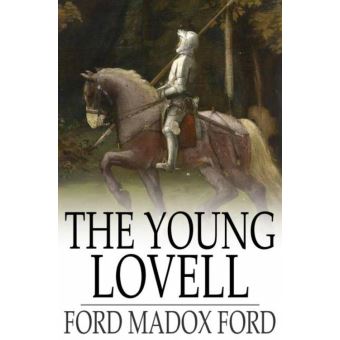


 Ford's Parade's End which might familiar from the BBC-PBS 2012 tv series featuring Benedict Cumberbatch)  and some of his other fiction are considered ground-breaking, like Henry James works, as moving the novel into the modern age.  But Ford wrote for nearly 40 years, and most of his work was not that.


As this particular Overdrive program was developed for university libraries, so today's few brave lit students could find such works for their research, classic authors such as an Elizabeth Gaskell, who usually only have a couple of titles available to a general audience, have their full bibliographies accessible.  Mary Gaskell wrote for money, so she wrote a lot of books, not just her hagiography of Charlotte Bronte,  North and South, Wives and Daughters and Cranford -- the last three BBC productions too.

The works of authors truly obscure authors these days, even to literature students perhaps, such as George Payne Rainsford James are also here.


 I have taken additional cheer from the vivid red and white of roses, the gold-trimmed champagne glasses, and bouffants of chocolate ads running on every online site for Valentine's Days.


We're playing lots of Mardi Gras music in the apartment, not only because our first events of NOLA Reconnect 2: Continuing Stories are coming right up, but because -- hey, Mardi Gras is comin' babee, and is nearly here, as of tomorrow.  This too has been cheery, and does wonderful work taking us out of the mundanity of the ice, illness (some with covid-19, some with other issues, and some with both).  

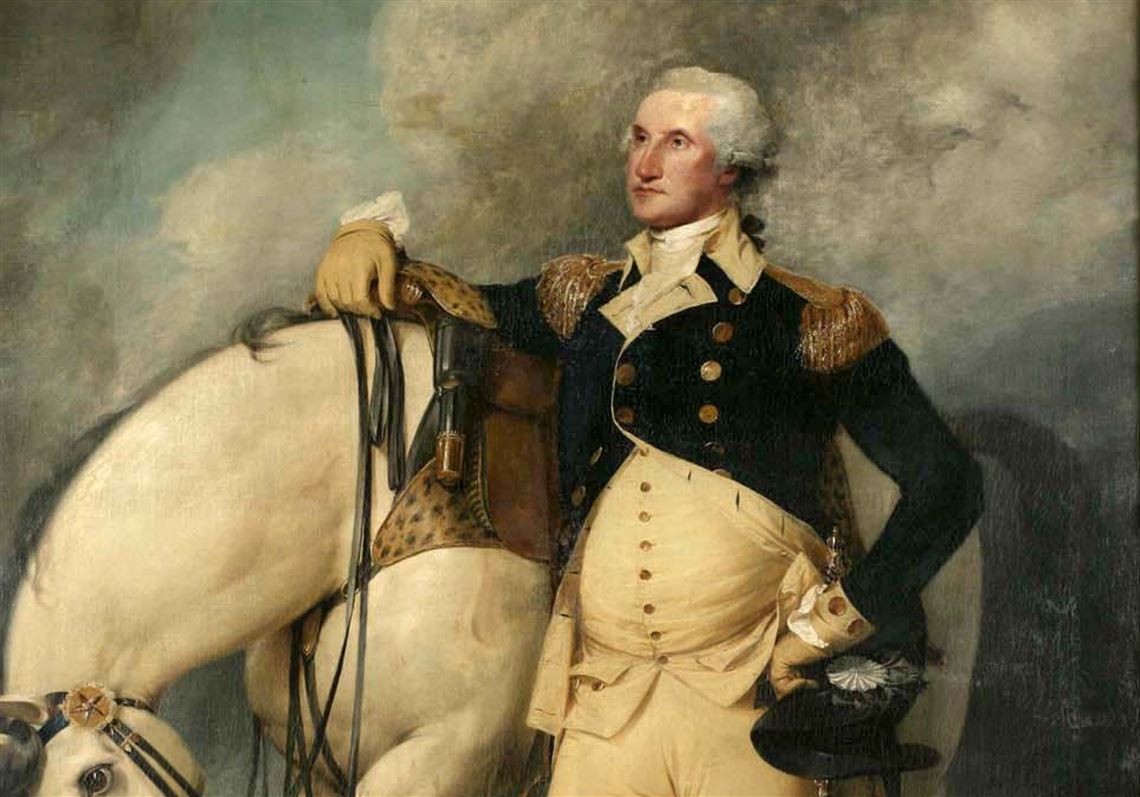
In between, hey I think a lot about George Washington -- Presidents Day -- that figure who remains an historic enigma. Was he really a terrible battle commander but a brilliantly astute political operator?  Was he real a dull mind that never read a book but possessed an intellectual organ that recognized what matters mattered when others couldn't even read the room?


So, among the museum presentation (Black History Month you know), other engagements, NOLA Reconnect, cooking cooking cooking and all that entails, etc. the hour of 8 PM is so welcome.  A couple of hours for tv and books! 

A storm, mostly freezing rain, rolling in.  Another storm Thursday, though this one is mostly snow, They say.  We've already had about three storms I think, in the last 8 days or so -- my sense of time is fairly weird these frigid days and nights, w/o any above freezing temperatures to punctuate.

I tell myself, "Get through this week, and things will get better, at least weather wise!" It's easier to keep that thought in mind because on Saturday, in France, two very elegant, lovely friends got married.  We couldn't be there, but they sent us photos.  O they are beautiful people inside, and so they are beautiful outside too.

 As for last week's tv, it was compelling, with some brilliant, brilliant characters -- particularly female characters -- and presentation.  However, I will confess that, while it was expected, the final episode was, honestly, disappointing.  It seems over 60% of we US voters feel the same about it.  Maybe next season we'll get our druthers?


Wednesday, February 3, 2021

Walking Under, On and In February

     . . . . Confucius: A Biography (2004) by Jonathan Clements got retrieved from the library today, thereby getting me out walking, which it is always essential to do, no matter how regularly one works out.  Jeosophat! the auto temperature reading machine worked on me -- though I had to remove my fur hat first.  But it meant in-and-out within 90 seconds or so.


It's a small book, but tries to locate Confucian thought within the man's life (551–479 BCE) and place, as well as traditions and culture within which he grew up. I wanted a book that speaks to the recent history his time and location had experienced, but I don't think this book does that. I shall have to be content with the map and google.

The book's from a British house, Sutton Publishing,  previously unknown to me -- which doesn't mean much. What matters is, despite its relatively recent publication, the paper has already turned yellow and brittle.  

As I know nothing about Confucius or his thought, I can't help but know more when I finish reading it.


~~~~~~~~~~~

Walking in February, on top of February snow, and slop all that particular February day-after storm color,  under a grey February sky, I  spotted this street graffito, written in a neat long hand, no dabs, blots or runs, in silver paint – "*rump lost. The South did not win.An efficient summation of too many's state of denial about history, present and past.

Which could be the title for why The New Republic currently is running this piece on American historiography and its own hisytory:

"Against the Consensus Approach to History

How not to learn about the American past"

It says a great deal about the why of the sheer horror of the Woods and Wilentzes at the premises of the 1619 Project.  It's interesting to see it running in The New Republic.   It also applies to the way the ^rump's 'legal' team is couching their argument against impeachment for inciting the 1/6 armed attack on the Capitol, as well as to the deniers of the lost election.

This fits within the spate of studies, reports and articles coming through in many places everyday as to who are the armed attackers, how did they get this way -- and also who they are not -- as well as closer scrutiny of how have so many USians become proselytists for the bottomless cray-cray of q***n, the denial of covid-19, haters of those who wear masks to protect themselves and others from getting sick.

There continues to be this weird impression that the base that is driving this movement for armed authoritarian, white supremacy, nationalist take-over of nearly the first nation to establish itself as a democracy for rights to all of liberty and equality, are not the poor and dispossessed, as some of us have been saying since long before the 2016 election. Quite the contrary. Though it is sobering to recollect how equally true this was of the driving insurrectionists of the war of independence (which again, was why the secession CSAers really believed they'd win: it would be just the same except instead of having only France helping them, they'd have Britain recognizing them as a nation in submission to their King Cotton).  So this piece in the Atlantic Monthly is very interesting too. Considering our history, particularly the determination by the rich to break from England, and the rich to break with the United States, I'm not sure I agree with the AM's piece's premise here, particularly considered side-by-side with the history of  "Consensus History" history piece in the NR.

"We analyzed 193 people arrested in connection with the January 6 riot—and found a new kind of American radicalism."

A graphic - data breakdown of who was part of the Capitol 01/06 armed attack, helping to organize, plan and direct, as well as being cannon fodder.

~~~~~~~~~~~~~~

In the meantime many musicians, including the one in our household who says he's retired from personally making music himself, have learned there is a pile of "unclaimed" residual money in the Hollywood Screen Actors Guild, and the other aspects of Hollywood business as composers, players, vocalists etc. for a lot of them.  Unclaimed because nobody bothered to contact them there were earnings from various aspects of what they did, if they were union members.  So those who have found out, and see the names of people they know, they are having the fun of contacting the musicians/composers and telling them, "There is money for you!"

~~~~~~~~~~~~~~

Began watching the third season of Gommorah on HBO last night.  The first episode felt flat, perhaps due to the endless acres of truly hideous wall paper no matter how wealthy the home or how humble. Some of the sizzle began to return in the second one. It feels different though, from the first two seasons. Is it because so much time has gone by since the second one, plus the world plunged into covid-19 -- which really would make no difference one thinks to these vile criminals -- or because I'm seeing it on an HBO screen, not a netflix screen -- both via streaming though, so that shouldn't matter.


What is the same, if even, perhaps more so: the suburb photography, the depth of the color, which does seem southern Italy, not even, Rome, much less anywhere else.  It's lushly gorgeous. 

Thursday, February 8, 2018

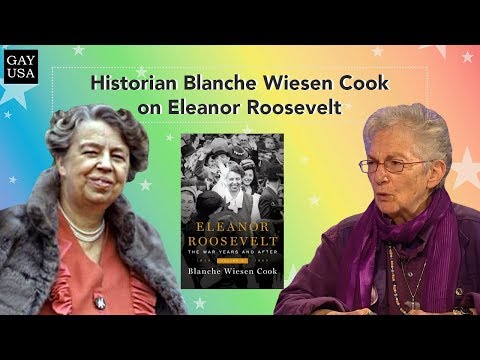
Reading Blanche Wiesen Cook's 3 volume Biography of Eleanor Roosevelt

     . . . .  I began, naturally at the beginning with Vol. I The Early Years, 1884-1933  (1992).


Blanche Wiesen Cook


I had read this volume around the time it was published as I was working at its publisher, Viking - Penguin, at the time.  

This is pure Gilded Age era material, and Eleanor Roosevelt was as at the center of the Gilded Age as one could be as a member of the ruling, affluent class of old Dutch New York families. Recall Eleanor's uncle was Theodore Roosevelt, so like Henry Adams, Roosevelts could fairly believe the White House was part of their natural heritage.  But unlike the bitter and disappointed New England aristocrat, Henry Adams, Franklin and Eleanor actually did do politics, and hold political offices -- even if Eleanor, despite her many breakthroughs, could only do so through her husband, so to speak. 


This re-reading, in the depths of our own Gilded Age, while like the previous one should also be more aptly named the Age of Miseries, has me noticing things that must have just slipped by back at the start of the 1990's. Back then I  knew much less of our history than I do now, and truly far less of this period of bottomless corruption and cruelty, ushered in by end to the War of the Rebellion, than I do now. 


ER in Inaugural Ball Gown
Which is why I shudder at the preening announcements of shallow Julian Fellows and his joy in 'the 400' of New York where and when he's locating his new television series, title, of course, The Gilded Age, which was not in use until much later, taken from the title dreamed up by Mark Twain and Charles Dudley Warner for The Gilded Age: A Tale of Today 1873),  their still famous satire of the era's idiocies and excesses.

As Theodore Roosevelt was Eleanor's uncle -- brother to her alcoholic father -- Cook gives us a great deal of background to his family.  What I didn't recall on the first reading was that David McCullough's Mornings on Horseback (1981) contained all this material too (I re-read this one too, rather recently, back in 2015).  As mentioned that the first time I read Vol I. I didn't know all the history I now do -- and I sure didn't know it when reading Mornings on Horseback on the subway to work, morning and night, and at lunch, These two works make good introductions to the residents of their class, for good and a whole lot for ill, who lived at the apex of the age's vaunted opulence, snobbery, bigotry, exploitation and racism.


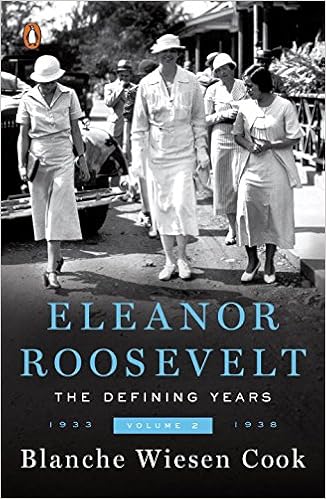
Having finished Vol I over the weekend I immediately started Vol. II The  Defining Years, 1933-1938 (2000). In the later chapters of Vol I., when Franklin goes through his first campaigns and other election experiences, and takes full advantage of everything Eleanor can and does contribute -- without even acknowledging to anyone else much less ER (throughout the work Cook refers to Eleanor Roosevelt as ER) that she's contributing anything.  It was just what he was entitled to, and many women held him up at all times, beginning with his mother and her money.  The portrait of FDR in these books isn't flattering.  Cook gives him credit when credit is due, but in many ways and far too often FDR shows himself a selfish sob, and even just plain mean, and certainly ready to descend into political skullduggery against other politicians -- but then, he was a consummate politician and that's how they roll.

When ER begins to think politically and of politics and of unfathomable obstacles to women emerging in this sphere, I thought constantly of Hillary Clinton's What Happened (2017). I was certain, of course, that Clinton has read these books, and many more about Eleanor Roosevelt. With what knowing bitterness she has had to recognize ER's conclusions.  So it was exciting then, when the Acknowledgments and Introduction to Vol. II, Cook names First Lady, Mrs. Clinton, who gave her personally a guided tour of the White House in preparation for ER's own White House years.

As ER, with the help of an ever growing circle of brilliant and close friends, began her education in feminism and then became one herself, FDR was already deeply in politics.  ER found everything about politics exciting and felt right at home in all the phases of campaign, and particularly policy, but didn't allow herself to say so, either to herself or the public. She wrote and spoke constantly of the dislike of women by the political patriarchy, and their loathing and disdain at the very idea that a woman could be one of them, either as a designer of policy and strategy or as a candidate herself.  Among her many articles on these subjects in these years she shared with other women in the 'ladies' magazines that when a woman was allowed to run, it would be in elections for seats in which there was no chance of the party winning. This way the party men could say they lost the election because "the candidate was a woman."  ER wrote and spoke of these matters openly and often.


Kirkus review here; NY Times review here.
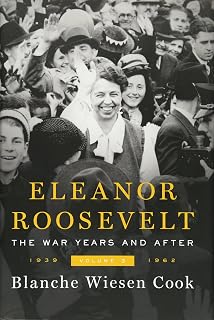
This project took Cook's adult life, as we see since the concluding  Vol. III The War Years And After, 1939-1962  didn't find publication until two years ago, year of That Election, 2016.   Nothing she learned about the reception of an effective and influential woman at the higher levels of politics either for policy or as a candidate seems to have changed, not even a bit.  Clinton isn't the only one who reads these texts with bitter familiarity.

Wednesday, July 21, 2010

Recording Studio ChitChat

Incarcerate in the same cell without a single call to their attorneys, no digital devices, no microphones, no reporters:

Camille Paglia, Ann Coulter, Mary Matelin, Michelle Bachman, Sarah Palin and Michelle Malkin.

Take odds on whether they play Survivor or activate the cooperation gene -- lots of betting permutations to delight the audience.

Who would you add to the mix?

I still wouldn't pay to watch. Too, too dirty.