LINES OF THE DAY

". . . But the past does not exist independently from the present. Indeed, the past is only past because there is a present, just as I can point to something over there only because I am here. But nothing is inherently over there or here. In that sense, the past has no content. The past -- or more accurately, pastness -- is a position. Thus, in no way can we identify the past as past." p. 15

". . . But we may want to keep in mind that deeds and words are not as distinguishable as often we presume. History does not belong only to its narrators, professional or amateur. While some of us debate what history is or was, others take it into their own hands." p. 153

Silencing the Past: Power and the Production of History (1995) by Michel-Rolph Trouillot

Showing posts with label indian history. Show all posts

Thursday, March 26, 2020

Panipat (2019) -- Maratha Empire

     . . . . Last evening the school in which the course is situated had its usual faculty Wine Wednesday, but via Zoom. That was cheerful. 

Then it was dinner time. After clean-up I watched for a while an historical action film set in the 18th C Maratha Empire Hindustan, Panipat -- Great Betrayal (2019). Recall at the same time (1751) the East India Company is warring to take out the Mughal Empire on the other side of the subcontinent. That the Marathas took out the Nizam helped the Brits do that.  Around 1805, the EIC begins its war upon the Maratha and other Hindu kingdoms. We see some spectacular recreations of the famous Red Fort, among other striking visuals.

https://timesofindia.indiatimes.com/entertainment/hindi/movie-reviews/panipat/movie-review/72375755.cms
Ashutosh Gowariker’s magnum opus ‘Panipat’ is based on historical facts, taking some creative liberties along the way. Shadashivrao Bhau (Arjun Kapoor), is an able commander in his cousin Nanasaheb Peshwa’s (Mohnish Bahl) army. After a victorious battle against the Nizam of Udgir, Shadashivrao Bhau is chosen by the Maratha Peshwa to lead their army to Delhi. Ahmad Shah Abdali (Sanjay Dutt), the king of Afghanistan, has set his inroads into India after forming an alliance with Najib-Ud-Daula (Mantra) with the intention to defeat the Marathas and curb their expanding power....
.... ‘Panipat’ packs in a layered narrative that delves into the complex politics of the period, the intricate workings of war strategies versus might, negotiation dynamics and the importance of forming alliances. And it also weaves in the love story between Shadashivrao Bhau and Parvati Bai. In fact, the chemistry between Kriti Sanon and Arjun Kapoor as their love story develops, is one of the high points of the film. But with a run-time of close to three hours and the many characters and plot points the film touches upon it becomes a lengthy and at times, tedious watch...[but worth it, particularly for the spectacular final battle sequence]
There are spectacular dance numbers, and singing interludes, which these I don't care for generally and don't here either, though they too are spectacular. What I love are the dancing, the brilliant colors, that eye-popping palette, all that gold and truck loads of pearls, rubies and emeralds. So I watched that for a bit, before retiring, reading aloud, and not sleeping most of the night, filled with the stress of getting up at 6 AM for a supermarket shopping trip, without real gloves and mask.  But I do have my own Italian granny era wheeled shopping cart that has been leaning against a wall here unused for umpity years!

Friday, March 2, 2018

The Fishing Fleet: Husband-Hunting in the Raj

     . . . . A while back an amiga mentioned she was reading Anne De Coucey's 2012 The Fishing Fleet: Husband-Hunting in the Raj. 


I'd wanted to read this book when hearing about its publication, but it wasn't possible at that time.  However, this last week I've been seriously sidelined from almost all real life due to a very bad pinched nerve condition that has made sitting at desk and many other things impossible.  So this was a good time for books I don't always have room for during real life.

It's a good enough book.  The research is extensive and broad.  De Coucey is a good writer, and with this name, presumably is part of the class out of which the Fishers who could presume alliances with the Heaven Born came.

Also, I love these sorts of histories, and I particularly enjoy books from the era of John Company -- the East India Trading Company from before the Mutiny and the imposition of the Raj by the British imperial govenment, and after, once it was imposed.  Much changes between those two eras of the British dominance of India, from when the Company imposed its will unimpeded and when the English began governing as opposed to 'only' extracting India's resources.

The first Fishers of men, English women looking for decent marriages, were coming out before the Raj.  The Company paid young women who qualified a fee as well as their carriage costs, and provided various goods and services.  All through these decades there were more women of marriageable age in England due to Napoleon first, and after WWI and the Influenza.  There were all these white British  men in India with no white English women to marry. Early in the history of the Company it didn't matter, and British men from the army and the Company married into Indian families.

But after Cornwallis came out as governor general -- post surrendering to the French and Washington at Yorktown -- that changed.  Laws of all sorts were passed that kept the children of anglo-Indian marriages from any significant post in the companies or in government.  With the Raj this was already hard social and economic reality -- no posts were open to anyone Indian or of Indian background.  This was equally true of the government as of the military and of business -- which continued even though the Company no longer ran things.

Along with these conditions things changed a great deal for the Fishing Fleet ladies as well.  Now they had to pay the equivalent of $30,000 to go out to India as a license to travel there as an unmarried woman without family waiting for them, they needed to supply all their own needs and they need to pay their own way.

Now these are the times that would have been really interesting to read about -- who were these women, how did it work out for them, all sorts of things.  However, the author isn't interested in these women, and authors get to write about what they want.

The author is interested in the young women of her own class, who don't have to pay to come out, and who are related or connected in some way with those running India.  So we're in the early 1900's and mostly in the 1920's and 1930's.  These are the people she knows . . . .

So the book, interesting enough in its own way, is also quite disappointing in my way.

Thursday, December 8, 2016

Dariba Diaries

   . . . . Dariba Diaries,  as far as I can determine,


 was a single season series from Epic, a newish Indian television channel that debuted in 2014. Epic's mission is to air
"action, drama, comedy and narrative non-fiction programming with a focus on Indian history, folklore and mythology genre".  

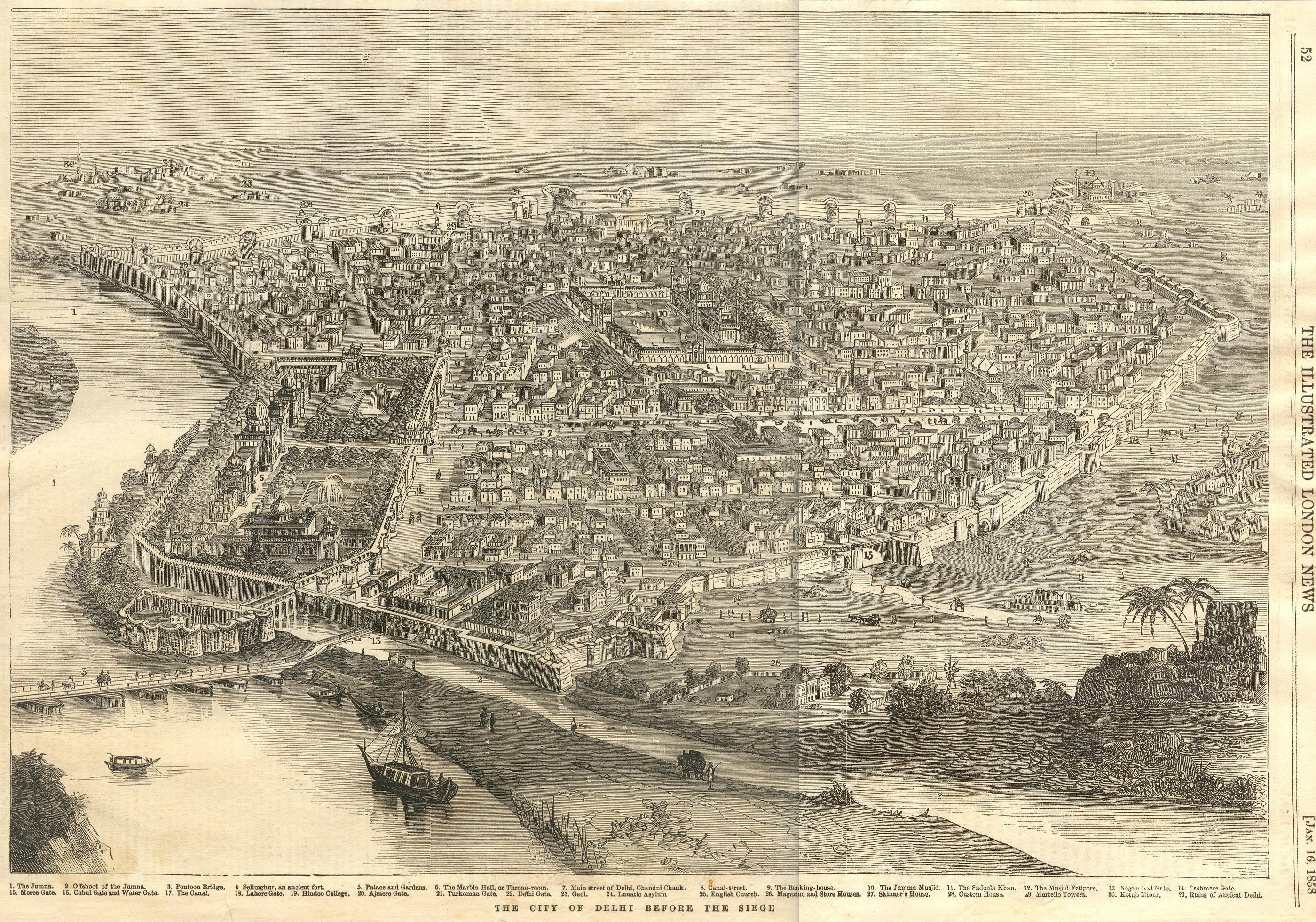
Delhi 1858 before the siege that was part of the 1857 Rebellion against the British


     . . . . Dariba Diaries is an episodic mystery series, set in a vaguely -- extremely so --  Delhi of the 19th century, when the era of the Mughals in Delhi under  Bahadur Shah Zafa is rapidly being replaced by the British. The British presence is a social as well as political destablizing force, thus a rise in crime. Within the series Dariba is a street or area -- I'm not clear about this -- within the walls of old Delhi.

Fortress of Selim Ghur and Imperial Palace, Delhi, 19th century.
"Dariba Kalan (Hindi: दरीबा कलान, English: Street of the Incomparable Pearl), is a 17th-century street in Chandni Chowk area of Old Delhi or Shahjahanbad.[1][2] It lies within the walled city of Delhi, and connects the Chandni Chowk area with Jama Masjid."
It was there the bazaar was located that bought and sold the luxury goods such as silk and jewels for the inhabitants of the palace and other of the fabulously wealthy Mughal administrators and favorites. Today it's internationally known throughout India and the diaspora as the place to buy the expensive gifts and adornments for Indian weddings.

However, what we see on screen doesn’t seem very like anything of the sort beyond the facade of an occasional building. Nor have I yet seen a Brit, which is just fine, of course.  IOW, the show doesn't seem to live up to its billing as an historical drama to my eyes at least.  I took the advice of Indian diapora members in my acquaintance and skipped the first two episodes.  The talking heads were unbearable, they said. So sloooooooooooow.

The highest value element of Dariba Diaries -- and it is very high -- is the Intro / Credit animation – gorgeous and purely Northeastern Indian (Delhi).  The creator, Mahesh Sama, evidently used to work at Disney, which would explain that excellence perhaps, when the rest of the production is pretty low by western standards. The subtitles fly by so swiftly that even very fast readers can't finish reading the 6 - 8 words translating the action (never more).

Dariba Diaries' protagonist, Mirza Jaan Nawaz, old Delhi's own Sherlock Holmes,  played by Sid Makkar, who is well known for other roles such as in the Best Exotic Marigold Hotel films.
Well, besides the Credit / Intro sequence, there is another exception to the generally low standard production values -- the cast.  Even those who are not lovely always hold the viewer's eyes whenever they are on screen. That is no small thing indeed.

Not to mention how refreshing it always is to see television set entirely outside of the USian mindset and vision, that has emerged from its own culture and history.

Additionally it's a nice, non-intellectual engagement for my currently sick brain.  I can't think anyway so Dariba Diaries and I are perfectly matched.  Also, temps plunging and next week we are under a polar vortex.  We've already been groaning under the yoke of the orange chaos demon, and it will only get worse, far worse.  I feel pretty rotten all together.

Youtube promos for the episodes can be watched here.

Dariba Diaries season 1 is streaming currently on Netflix. And I applaud them for providing it -- and The Magnificent Century.  More, please.


Friday, March 6, 2015

Corporate Pillage and Power Supported By the State: The East India Company

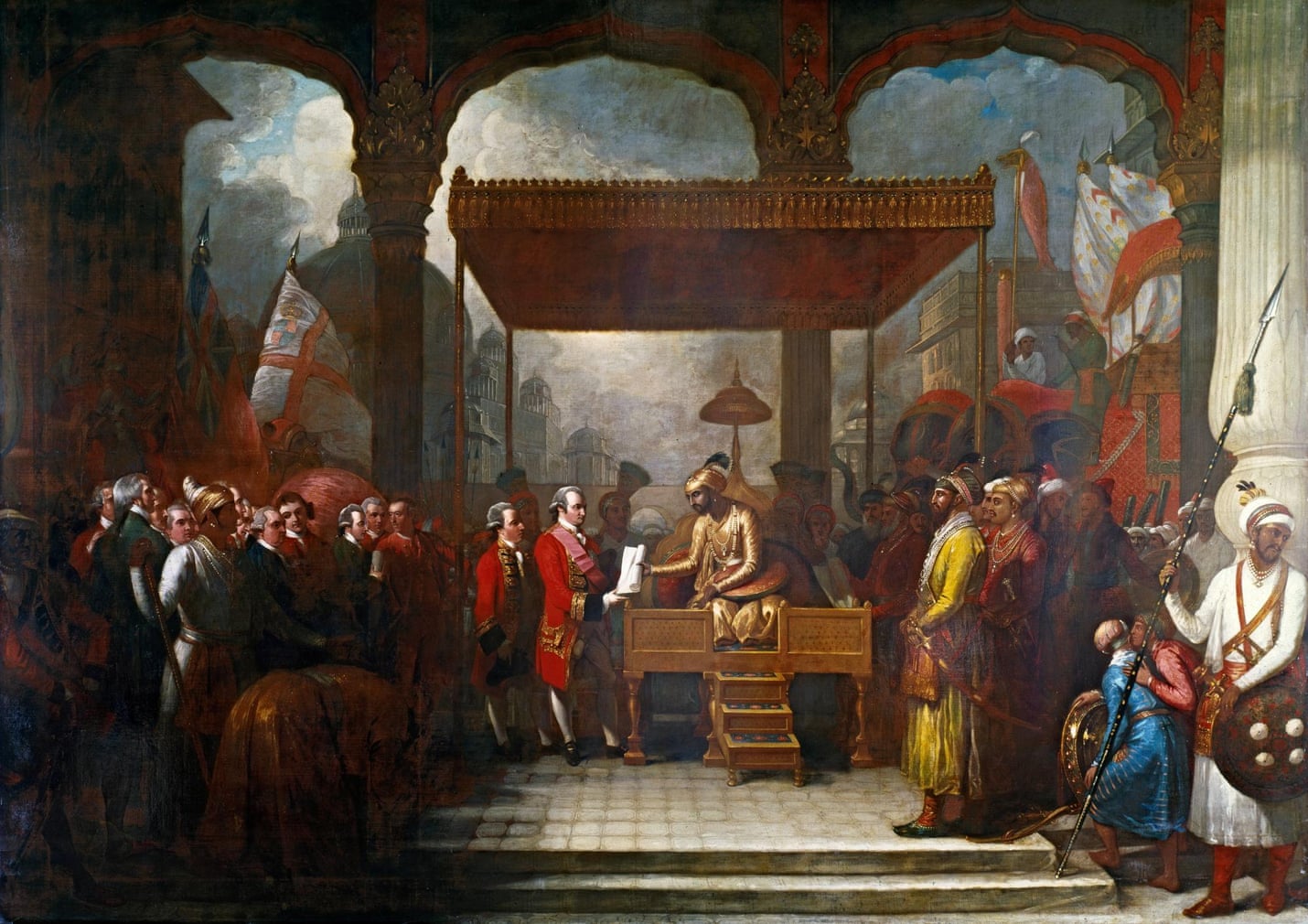
In the Guardian's Long Read series, "The East India Company: The original corporate raiders," is excerpted from William Dalrymple's forthcoming book, The Anarchy: How a Corporation Replaced the Mughal Empire, 1756-1803, to be published next year.


One cannot but help recalling the English government, its enthusiasm to help fill the East India Company's empty coffers from the glut of India tea on the market, gave some big pushes to the North American colonies' rebellion and secession. (For a good description of this series of unfortunate events, particularly for New England, and especially Boston - Massachusetts, see Nick Bunker's An Empire on the Edge (2014).*

The pull from Dalrymple's The Anarchy concludes:
The 300-year-old question of how to cope with the power and perils of large multinational corporations remains today without a clear answer: it is not clear how a nation state can adequately protect itself and its citizens from corporate excess. As the international subprime bubble and bank collapses of 2007-2009 have so recently demonstrated, just as corporations can shape the destiny of nations, they can also drag down their economies. In all, US and European banks lost more than $1tn on toxic assets from January 2007 to September 2009. What Burke feared the East India Company would do to England in 1772 actually happened to Iceland in 2008-11, when the systemic collapse of all three of the country’s major privately owned commercial banks brought the country to the brink of complete bankruptcy. A powerful corporation can still overwhelm or subvert a state every bit as effectively as the East India Company did in Bengal in 1765. 
Corporate influence, with its fatal mix of power, money and unaccountability, is particularly potent and dangerous in frail states where corporations are insufficiently or ineffectually regulated, and where the purchasing power of a large company can outbid or overwhelm an underfunded government. This would seem to have been the case under the Congress government that ruled India until last year. Yet as we have seen in London, media organisations can still bend under the influence of corporations such as HSBC – while Sir Malcolm Rifkind’s boast about opening British embassies for the benefit of Chinese firms shows that the nexus between business and politics is as tight as it has ever been. 
The East India Company no longer exists, and it has, thankfully, no exact modern equivalent. Walmart, which is the world’s largest corporation in revenue terms, does not number among its assets a fleet of nuclear submarines; neither Facebook nor Shell possesses regiments of infantry. Yet the East India Company – the first great multinational corporation, and the first to run amok – was the ultimate model for many of today’s joint-stock corporations. The most powerful among them do not need their own armies: they can rely on governments to protect their interests and bail them out. The East India Company remains history’s most terrifying warning about the potential for the abuse of corporate power – and the insidious means by which the interests of shareholders become those of the state. Three hundred and fifteen years after its founding, its story has never been more current. 
I'm guessing (i.e.I do not know!) this first serial from Dalrymple's book was run so far ahead of publication due to the Guardian centering for weeks the HSBC scandal. It's also not a chunk just pulled from the book; it was edited and revised,


as the pulls in various publications from Kim Gordon's Girl in a Band: A Memoir aren't chunks of self-enclosed text, but revised as well.  First Serial excerpts often need a revision specifically for the specific publication in play, as most books aren't composed as stand-alone sections, and the length and focus for each publication is different.

----------------------------------

*  William Dalrymple  and Nick Bunker are two of my most admired and favorite independent scholar-writers -- meaning they both do splendid research, but they are also good writers as writers, which makes all the difference.