LINES OF THE DAY

". . . But the past does not exist independently from the present. Indeed, the past is only past because there is a present, just as I can point to something over there only because I am here. But nothing is inherently over there or here. In that sense, the past has no content. The past -- or more accurately, pastness -- is a position. Thus, in no way can we identify the past as past." p. 15

". . . But we may want to keep in mind that deeds and words are not as distinguishable as often we presume. History does not belong only to its narrators, professional or amateur. While some of us debate what history is or was, others take it into their own hands." p. 153

Silencing the Past: Power and the Production of History (1995) by Michel-Rolph Trouillot

Showing posts with label corporate. Show all posts

Friday, March 6, 2015

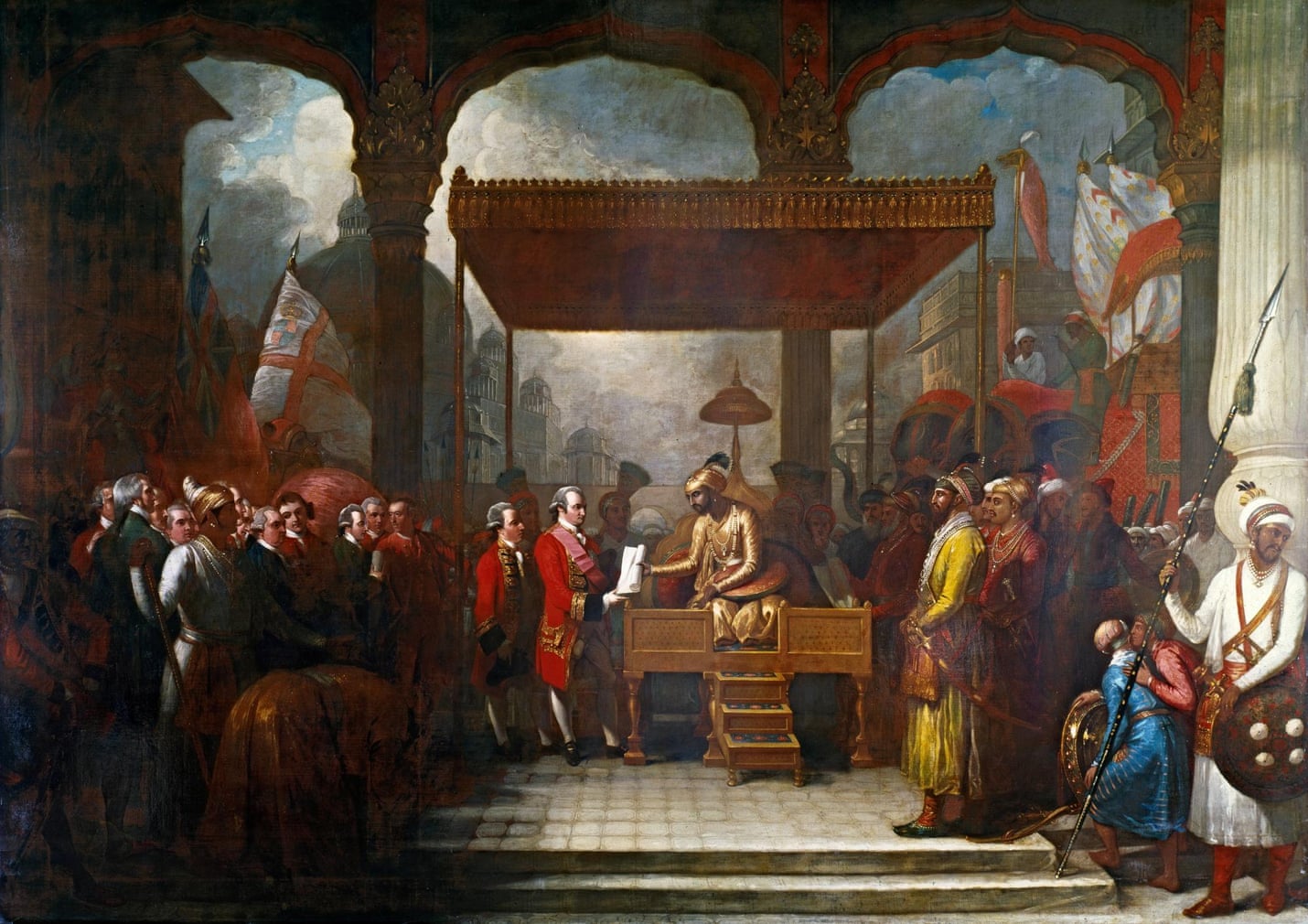
Corporate Pillage and Power Supported By the State: The East India Company

In the Guardian's Long Read series, "The East India Company: The original corporate raiders," is excerpted from William Dalrymple's forthcoming book, The Anarchy: How a Corporation Replaced the Mughal Empire, 1756-1803, to be published next year.


One cannot but help recalling the English government, its enthusiasm to help fill the East India Company's empty coffers from the glut of India tea on the market, gave some big pushes to the North American colonies' rebellion and secession. (For a good description of this series of unfortunate events, particularly for New England, and especially Boston - Massachusetts, see Nick Bunker's An Empire on the Edge (2014).*

The pull from Dalrymple's The Anarchy concludes:
The 300-year-old question of how to cope with the power and perils of large multinational corporations remains today without a clear answer: it is not clear how a nation state can adequately protect itself and its citizens from corporate excess. As the international subprime bubble and bank collapses of 2007-2009 have so recently demonstrated, just as corporations can shape the destiny of nations, they can also drag down their economies. In all, US and European banks lost more than $1tn on toxic assets from January 2007 to September 2009. What Burke feared the East India Company would do to England in 1772 actually happened to Iceland in 2008-11, when the systemic collapse of all three of the country’s major privately owned commercial banks brought the country to the brink of complete bankruptcy. A powerful corporation can still overwhelm or subvert a state every bit as effectively as the East India Company did in Bengal in 1765. 
Corporate influence, with its fatal mix of power, money and unaccountability, is particularly potent and dangerous in frail states where corporations are insufficiently or ineffectually regulated, and where the purchasing power of a large company can outbid or overwhelm an underfunded government. This would seem to have been the case under the Congress government that ruled India until last year. Yet as we have seen in London, media organisations can still bend under the influence of corporations such as HSBC – while Sir Malcolm Rifkind’s boast about opening British embassies for the benefit of Chinese firms shows that the nexus between business and politics is as tight as it has ever been. 
The East India Company no longer exists, and it has, thankfully, no exact modern equivalent. Walmart, which is the world’s largest corporation in revenue terms, does not number among its assets a fleet of nuclear submarines; neither Facebook nor Shell possesses regiments of infantry. Yet the East India Company – the first great multinational corporation, and the first to run amok – was the ultimate model for many of today’s joint-stock corporations. The most powerful among them do not need their own armies: they can rely on governments to protect their interests and bail them out. The East India Company remains history’s most terrifying warning about the potential for the abuse of corporate power – and the insidious means by which the interests of shareholders become those of the state. Three hundred and fifteen years after its founding, its story has never been more current. 
I'm guessing (i.e.I do not know!) this first serial from Dalrymple's book was run so far ahead of publication due to the Guardian centering for weeks the HSBC scandal. It's also not a chunk just pulled from the book; it was edited and revised,


as the pulls in various publications from Kim Gordon's Girl in a Band: A Memoir aren't chunks of self-enclosed text, but revised as well.  First Serial excerpts often need a revision specifically for the specific publication in play, as most books aren't composed as stand-alone sections, and the length and focus for each publication is different.

----------------------------------

*  William Dalrymple  and Nick Bunker are two of my most admired and favorite independent scholar-writers -- meaning they both do splendid research, but they are also good writers as writers, which makes all the difference. 

Wednesday, August 14, 2013

Meet the Clintons: Card-Carrying Members of the Plutocratic Global Corporate Oligarchy

The Clinton Foundation has been renamed as the Bill, Hilary and Chelsea Clinton Foundation, in preparation for being the organization center of Hilary Clinton's run (again!) to be POTUS in 2016.
For all of its successes, the Clinton Foundation had become a sprawling concern, supervised by a rotating board of old Clinton hands, vulnerable to distraction and threatened by conflicts of interest. It ran multimillion-dollar deficits for several years, despite vast amounts of money flowing in. ....
... efforts to insulate the foundation from potential conflicts have highlighted just how difficult it can be to disentangle the Clintons’ charity work from Mr. Clinton’s moneymaking ventures and Mrs. Clinton’s political future, according to interviews with more than two dozen former and current foundation employees, donors and advisers to the family. Nearly all of them declined to speak for attribution, citing their unwillingness to alienate the Clinton family. ....
Today, big-name companies vie to buy sponsorships at prices of $250,000 and up, money that has helped subsidize the foundation’s annual operating costs. Last year, the foundation and two subsidiaries had revenues of more than $214 million. ....
Yet the foundation’s expansion has also been accompanied by financial problems. In 2007 and 2008, the foundation also found itself competing against Mrs. Clinton’s presidential campaign for donors amid a recession. Millions of dollars in contributions intended to seed an endowment were diverted to other programs, creating tension between Mr. Magaziner and Mr. Band. The foundation piled up a $40 million deficit during those two years, according to tax returns. Last year, it ran more than $8 million in the red.
Amid those shortfalls, the foundation has sometimes catered to donors and celebrities who gave money in ways that raised eyebrows in the low-key nonprofit world. In 2009, during a Clinton Global Initiative gathering at the University of Texas at Austin, the foundation purchased a first-class ticket for the actress Natalie Portman, a special guest, who brought her beloved Yorkie, according to two former foundation employees. ....
Far more here.  The link is to the single page view.


Having seen and heard first hand what the Clinton Global Initiative -- partnered with many corporate oligarchs such as Coca Cola to has done to Haiti -- all of which keep the their wages the established wage floor as the bench for labor not only throughout the hemisphere but the globally --  the planet cannot survive such aid and assistance.

The Atlantic also weighs in on the Clintons' Foundation here.