
The second novel wasn't as well-written as the first one though. It's flatly written in a self-conscious attempt to ape what the author believes is a Victorian lady's style of writing. The narrative is a dull mash-up of African cultures rendered in the single-dimension cliches of Africa and Africans, despite the author's claiming to having qualified as an anthropologist.
Despite what the author seems to think, what she mashed up are not dead museum cultures and places, nor are they quaint museum spiritual practices. These are people, families and communities who still have their cultures and languages, and still believe in their spiritual practices, despite the very well-funded fundies of several outside religions actively demonizing them.
Then the actively missing music .... When reading anything that is taking place in Africa, whether fiction or non, and there is no music, that is a sure sign the author never got a toehold into what was / is going on. O wait -- this is fantasy, so how do I know this is Africa? After all, the word is never used. But a whole of words that come from some particular African languages are used -- though not always correctly.
For a novel, though, worse than mashed up geographies and vocabulary challenges, is that the narrative is static and the plot is unsurprising from start to finish. The characters, including the narrator and first person point of view, are equally flat and predictable.
With no reason to finish this book, I did not do so.
Think the Temeraire series by Naomi Novik; however, instead of a Napoleonic era secondary world, this is Victorian. There is authentic passion contained the early Temeraire volumes, as the dragon Temeraire and his beloved Captain William Laurence discover each other, and, together, the Whole Wide World. With Temeraire, Lawrence, other dragons and characters, the readers feel how enormous are the stakes of their choices: personal, military, political and social. Perhaps this is a large part of the problem with the Victorian series, that it is too much an imitation -- and an imitation of materials that the author doesn't understand herself well enough to spark and fizz a reader's sense of shock and awe?
This one follows the well-patented arc of feisty lady against her social strictures, presented in a single voice flat as the notes in a creaky piano whose strings have been tuned one too many times. The perils are expected perils while the reader knows, via the First Person Herself that more books are coming, thus Our Heroine is not in peril. Then there is the problem that despite what we expect, Our Heroine is dull, or at least her voice is.
Perhaps the ur fault is Author's choice to
The opening paragraph to Kingsley's
PREFACE TO THE ABRIDGED EDITION OF TRAVELS IN WEST AFRICA.Almost word-for-word ....
When on my return to England from my second sojourn in West Africa, I discovered, to my alarm, that I was, by a freak of fate, the sea-serpent of the season, I published, in order to escape from this reputation, a very condensed, much abridged version of my experiences in Lower Guinea; and I thought that I need never explain about myself or Lower Guinea again. This was one of my errors. I have been explaining ever since; and, though not reconciled to so doing, I am more or less resigned to it, because it gives me pleasure to see that English people can take an interest in that land they have neglected. Nevertheless, it was a shock to me when the publishers said more explanation was required. I am thankful to say the explanation they required was merely on what plan the abridgment of my first account had been made. I can manage that explanation easily. It has been done by removing from it certain sections whole, and leaving the rest very much as it first stood. Of course it would have been better if I had totally reformed and rewritten the book in pellucid English; but that is beyond me, and I feel at any rate this book must be better than it was, for there is less of it; and I dimly hope critics will now see that there is a saving grace in disconnectedness, for owing to that disconnectedness whole chapters have come out without leaving holes.

Think the Temeraire series by Naomi Novik; however, instead of a Napoleonic era secondary world, this is Victorian. There is authentic passion contained the early Temeraire volumes, as the dragon Temeraire and his beloved Captain William Laurence discover each other, and, together, the Whole Wide World. With Temeraire, Lawrence, other dragons and characters, the readers feel how enormous are the stakes of their choices: personal, military, political and social.
This other series follows the well-patented arc of feisty lady against her social strictures, presented in a single voice flat as the notes in a creaky piano whose strings have been tuned one too many times. The perils are expected perils while the reader knows, via the First Person Herself that more books are coming, thus Our Heroine is not in peril. Then there is the problem that despite what we expect, Our Heroine is dull, or at least her voice is.
Perhaps this is a large part of the problem with the Victorian series, that it is too much an imitation -- and partly an imitation of materials that the author doesn't understand herself well enough to spark and fizz a reader's sense of shock and awe?
The Temeraire series itself is a secondary world fantasy inspired by Patrick O'Brien's Captain Aubrey - Stephen Maturin novels of the Napoleonic era -- Maturin a noted biologist. It has been much commented upon that the O'Brian series was an inspired Napoleonic era modeled upon the Jane Austen regency mode.
Perhaps there are so many layers of inspirations and influences upon this Author's mashup that the consequence is by the second volume already her literary efforts have been mashed flatter than an alluvial plain?
Instead, I picked up a collection of papers from 1978 by and also edited by Brit historians, P. Hair and Anthony J. Barker on the African slave trade, when all the scholarship in the field was starting new approaches, partially sparked by what had been going on in the USA with the Civil Rights Movement. It was an exciting collection of papers; the historians' excitement came through their academic structures, and that they were aware they were just crossing a threshold not previously gone over.
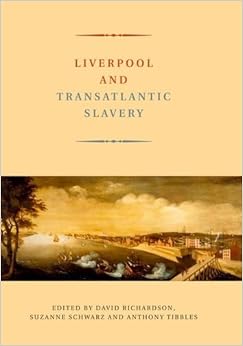
Additionally, it was exciting to compare and contrast that collection of papers with another collection on the same subject: Liverpool and Transatlantic Slavery (2010) a collection of papers presented at a recent conference in Liverpool. How far we've come since 1976!
-------------------
* Title / author deliberately omitted because my response to the work is negative and thus, for Author's sake, do not wish it to influence others doing a casual web search.

