LINES OF THE DAY

". . . But the past does not exist independently from the present. Indeed, the past is only past because there is a present, just as I can point to something over there only because I am here. But nothing is inherently over there or here. In that sense, the past has no content. The past -- or more accurately, pastness -- is a position. Thus, in no way can we identify the past as past." p. 15

". . . But we may want to keep in mind that deeds and words are not as distinguishable as often we presume. History does not belong only to its narrators, professional or amateur. While some of us debate what history is or was, others take it into their own hands." p. 153

Silencing the Past: Power and the Production of History (1995) by Michel-Rolph Trouillot

Tuesday, July 2, 2013

Battle of Getttysburg: The Impact of the Weather

Meteorology of the Battle by Rev. Dr. Michael Jacobs.

A Gettysburg man by the name of Rev. Dr. Michael Jacobs, a math professor at what was then called Pennsylvania College, had a strong interest in weather and recorded his observations three times a day, every day, even during the battle. As a result, the "Meteorology of the Battle", was published, and it gives very specific details on the weather at the Battle of Gettysburg and the role it may have played in battle.
The bad weather came after the battle, on July 4th -- though some of the surviving soldiers may have found the rain's coolness a welcome relief after the battle heat of the previous days and nights. But --
Some wounded soldiers had still not been moved from low-lying areas by the Plum Run Creek, however, which overflowed its banks. Those stranded near the flood waters, reportedly all Confederates, drowned.
According to AccuWeather's Vice President of Marketing and Civil War historian Dr. Lee Rainey, an even larger issue that was faced as a result of the rain was the retreat attempts made by the Confederate Army on July 4. 
"They had to move a 17-mile-long train of wagons filled with wounded soldiers over the dissolving dirt roads back to Virginia," he said. "And the rains caused the Potomac River--easily fordable on the march north--to flow so high that the army was trapped on the north side with the Union forces in pursuit. The Confederates dug in for a desperate battle, but in the end were able to escape across the river on the 13th, the day before Meade's planned attack."
Full story here, on the AccuWeather site, with a link to the Rev.'s report.

This being a weather report the Rev. leaves out the 1000 or so free Pennsylvania blacks -- men, women and children -- the army had kidnapped to return to former owners, put in prison or auction off.  The consequences of those few contrabands who were brought back to Virginia and returned to their 'owners' was terrible.

Sunday, June 30, 2013

150 Years Ago: The Battle of Gettysburg July 1-3, 1863

As of tomorrow it's the 150th anniversary of the bloodiest single battle of the Civil War, the Battle of Gettysburg. There are many observances of this anniversary this week, as well as the rest of the year, particularly at the Gettysburg National Military Park. Perhaps more books, articles, movies, television programs have been written and created about this battle of the U.S. Civil War than any other.  Even I feel a special connection to this battle, because I have friends who live very close by, and one of them is as knowledgeable about the grounds and the battle as any professional military historian of the Civil War. As we're currently observing the 150th anniversary of the Civil War (2011 - 2015), the usual tidal influx of  books dealing with the war and various battles is at tsunami volume.  In time for the 150th date specific anniversary of Gettyburg, here is this:

Allen C. Guelzo’s Gettysburg: The Last Invasion

The great Civil War historian, David Blight, reviews the book for the NY Times.

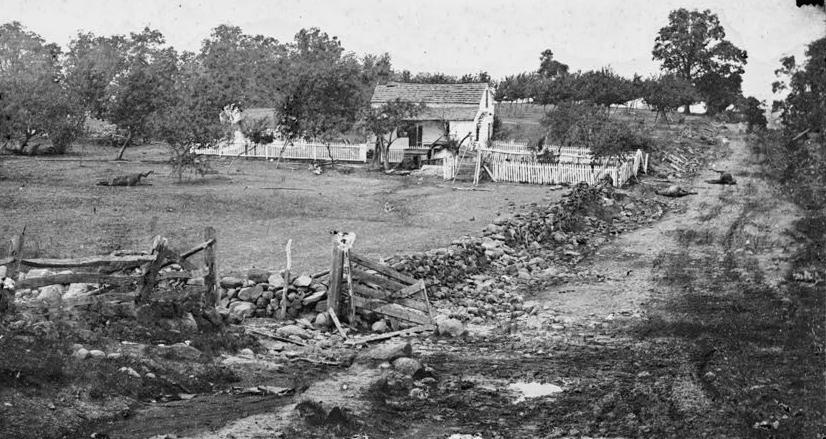
General Meade's Headquarters, Gettysburg

Guelzo tells us these German-Pennsylvanian solid rail fences and rock walls baffled Lee and his men - so unlike the zig-zag worm fences and drystone walls of Virginia

Blight praises the book, including the following, which was also emphasized by Ernest B. Furgurson in his Washington Post review. Their shared emphasis on the divisions among the Army of Northern Virginia was of particular interest to me, as one of the themes of The American Slave Coast is Virginia's sense of its pre-eminence, not just among the southern states, or the CSA, but from the colonial era and into the national eras (five of the first presidents were Virginians), its rivalry with South Carolina, its sense of "we haz been robbed!" that endures into this very day, if it isn't given pride of first place:
Amid the numbing detail about generals’ personalities, Guelzo provides some beguiling accounts of the political divisions and rivalries between the officers of the two armies. Both staffs were divided houses, with Lee’s corps commanders as well as line officers largely split between Virginians and non-Virginians and between those who had embraced secession and those who had not. The Union Army’s officer corps exhibited even more conflict between the “McClellanites,” Democrats devoted to the discredited and fired George B. McClellan, who sought a limited war that would never threaten the racial order, and those Republicans of a New England antislavery stripe who really did believe the war must destroy slavery.
Blight however, finds faults with other matters in Guelzo's book, that were not mentioned in the Washington Post's review.  Such as:
This book’s considerable achievements, though, are marred by Guelzo’s literary style, as well as by his apparently irresistible romantic urge to add one more panegyric to the epic of Gettysburg. His claim that military historians have to struggle for respect among the “Civil War’s cultured despisers,” that a book like his violates “fashion” because it is not about the “agency” of black emancipation, seems unnecessary at best. (He and I have differed on this point before.) And the gems of detail from Guelzo’s keen researcher’s eye (he tells, for example, of a Roman Catholic priest standing on a rock offering absolution to the silent soldiers as they file into battle, bands playing to raise morale during combat, a Confederate general desperately breaking his sword on the ground as he surrenders) often pale next to the array of recorded descriptions of how soldiers were shot, where bullets penetrated their bodies or those of their horses — “through the left lung,” “entered the left side of the stomach, perforating his sword belt and lodging in the spine” and the like. Such passages seem awkwardly clinical when overused, even if garnered from a soldier’s remembrance.
There are other problems with Guelzo’s language as well. What does it mean for a full division of infantry to get a “collective bloody nose,” or a brigade to have its flank “slapped.” After portraying such “sheer carnage,” why term this deadly affair a “gigantic boxing tournament gone wildly into three-digit extra rounds?” The historian John Keegan* calls this kind of rhetoric the “Zap-Blatt-Banzai-Gott im Himmel-Bayonet in the Guts” style of military history." ....
In the meantime I'm reading a biography of John Hay, Lincoln's younger private secretary (he was historian Henry Adams's best friend, as well as holding among other posts, that of Secretary of State for Theodore Roosevelt, about whom, as with Lincoln, Hay wrote first hand accounts).  I've reached the point where Hay's at Gettysburg with Lincoln, on the occasion of the Address. Hay's personal experience of that Gettysburg occasion is interesting, because it's unlike others I've read. He was a (very) young man then, with a young man's sensibilities. He got whisky drunk with chums, played poker until the wee hours the night before, was sleep deprived and hungover when Lincoln spoke. Nevertheless he did witness and remember Lincoln working up the Address.

-------

* John Keegan revealed himself sorely lacking in knowledge of our Civil War's history in his own The American Civil War: A Military History. I haven't read an English historian or historical novelist who has truly understood our Civil War. (This isn't to say there are none, but that I haven't encountered them.) The studies tend to focus on the battles, and ignore the process of the long run-up to the war -- even the most foundational, which is why this war happened, and why the Union went to war, which was not only to preserve the nation, but preserve itself from having slavery forced upon it. The Slave Power's entire objective for the war was to expand its dominance throughout the continent and the hemisphere.

IOW, the Slave Power could not be contained, for it would not be contained. Capitalist to its core, its entire economy surviving within the bubble and burst of the ever more manic interstate slave trade, it had to forever expand territory -- or pop forever. Which, with Emancipation, the Slave Power's economy did burst, never to return to the base of that economy, the enslaved womb, whose increase was their interest, which allowed for slavery and that economy into perpetuity.

The Slave Power's economy was a credit economy, based on the ownership and trade in slaves. They were its credit and payment. Working them out at hire, and selling them for a trader's promised cash, provided many a southerner with the only cash they ever handled. The South had no specie, not even a currency, beyond the credit that owning a slave provided. It didn't even have the greatly lucrative Cotton Kingdom carrying trade to England's textile industry, for it didn't bother to build or support any kind of merchant marine.  That carrying trade was New York's -- as were the granters of credit, etc.  For all the supplies and goods of anything the South might want, or need -- including the food and clothing, such as they were, for the slaves, was manufactured by, and bought from, the north.

Saturday, June 29, 2013

Juanita Jeans': Texas's -- and all Women's -- Reproductive Freedom

Huge Women's Reproductive Rights Rally at the Texas capitol in Austen on July 1st.

High Noon, Monday, July 1st, on the south steps of the Texas capitol. Be there or don’t make history.
It will be hot.  Bring water for yourself, and a fan and a chair for me.  Wear orange.
You can sign up right here on Facebook. Or put it in the comments and I will pass it along.
Wonder what to wear?
These super cool tee-shirt will be for sale for $25.  The profit goes to Planned Parenthood, Battleground Texas, and – my personal favorite – the Texas Democratic Party.  Hey, we’ve got a new address –You can order one right here!


How I love Texas women -- let me count the ways I love you!  Starting with you are never afraid to be loud when it is called for.

Thursday, June 27, 2013

A Modest Proposal For Graduate Level Early Americanist Studies

This proposal, by a an early American - Independence era grad student, is going to be very popular in this country, don't you think?


Third—and I expect this might be met with less enthusiasm—make Spanish a required language. Colonial North Americanists have a great deal to gain from our Latin American colleagues, scholars grappling with many of the same issues of colonialism, cross-cultural interaction, imperial governance, and social development. So long as much of their literature remains without translations, Spanish will be necessary to prop open the historiographical window.
He goes further than this:
Bear with me. No one wants to make graduate school, particularly the coursework years, even longer. But if Europeanists, Medievalists, Africanists, Asianists, and Latin Americanists can master languages, so can we. Moreover, increased language skills may not only be advantageous, but necessary to maintain an edge in the current academic climate.
The popularity of global and imperial histories has brought more early modern Europeanists to North American shores. What once may have distinguished a colonial American PhD student from a British imperial PhD student, for example, is suddenly harder to define when they’re both working on New York political culture in the 1730s. And if our Europeanist colleagues have the upper hand in languages, they’re going to have a far easier time reading the non-English historiography, engaging in comparative research, and utilizing non-English-language sources. And the imperial turn pulls us too. Early Americanists are more likely to end up in European archives than graduate students of the couple decades past. Even the most eager reader of French is going to struggle in the Archives nationales if the language ability stops there. (Also: if imperial history is here to stay, at least for the foreseeable future, then so too is comparative or entangled history—making languages all the more valuable.)
Languages are not only for those “out-there” historians, the ones working on non-English spaces like the pays d’en haut, Louisiana, or Spanish Florida. Too often we gloss over the multiplicity of tongues within the British Empire and its colonies. Shouldn’t students working on, say, mid-eighteenth-century Pennsylvania have at least rudimentary German? We need to consider: does language ability (or lack thereof) preordain how we approach a topic? Did some earlier historians previously look to Philadelphia rather than to Lancaster or the western frontier because of language limitations rather than the realities of historical action? Foreign languages allow early Americanists to not only look more carefully at frontier, borderland, and “peripheral” histories, but to gain a more holistic view of the early American experience.
The writer has little hope that his proposals will be adopted.  Has there ever been a country that owns a greater horror and rage at learning another language?

Monday, June 24, 2013

Gee-tar Hound!

My kinda dawg ....


Sunday, June 23, 2013

Questions Regarding Liberal Outrage about Slavery, By An Academic of Color

These questions come at the end of an early paragraph of a review in the Los Angeles Review of Books of two recent admirable works.

Lawrence P. Jackson on Master of the Mountain: Thomas Jefferson and His Slaves, and River of Dark Dreams: Slavery and Empire in the Cotton Kingdom
"Pictures from a Peculiar Institution: Writing American Slavery"

The steady stream of cynical liberal outrage is an important context to two recent books about slavery by white men: Henry Wiencek’s Master of the Mountain and Walter Johnson’s River of Dark Dreams. Both books are, in their own ways, commanding studies of a central area of American history, and pioneering works in an ongoing battle for justice. Wiencek provides more detail about Thomas Jefferson’s history of slaveholding than has ever existed in one place before, making an important adjustment to a bowdlerized historical record; and Johnson reimagines the era that transformed the geospatial reality of the Mississippi River cotton corridor, in the process providing the fuel for the industrial and financial transformation of the western world. But in both cases, I wonder, to what avail? What does it mean to have an agile, ready intellectual force prepared to do this kind of work, on this kind of subject, at this time? How are the appearances of Wiencek and Johnson’s books connected to the phenomenon of the first black president, on one hand, and the probable end of protective voting rights acts and affirmative action, on the other? In other words — to put it rather bluntly — have we reached a moment when the white liberal’s comfort zone is firmly in the archival dust of the 18th and 19th centuries, while they explicitly avoid the jagged edges of the 21st century.
It's important that we hear such questions from the perspective a black man. A well-placed, respected academic, nonetheless a black man, Jackson is subject to racial profiling (recall Henry Louis Gates was arrested for 'breaking into' his own house in Massachusetts), that sends a disproportionate number of young African Americans to fill the prison industrial complexes. These men face the sort of potential homicide and wreckage of reputation that Treyvon Martin and others have suffered in Florida and elsewhere. In view of these legal steps into re-establishing a neo-slavery,  neo-Jim Crow, Jackson has to ask himself and all of us, how, or even if, our studies, and our outrage that the studies we publish provoke, connect in a useful way with the accelerating destruction of Civil Rights.

This is increasingly a matter for all of us (for the sake of privacy and likely retaliation upon the victim I will not tell what happened two nights ago to a close friend on the streets of NO, when the cops thought he was a black man).  However, people of color, particularly men of color, are the first and most obvious targets.  And do I ever share the outrage over slavery and the ever-widening circles of destruction into the present day that fuels the work of Walter Johnson, the New Orleanian native author of the second work reviewed, River of Dark Dreams. 

So Jackson's questions are not only excellent questions, but necessary ones.

I have some answers for myself, as we travel the world, meeting with friends old and new, in a broad range of communities in the arts, journalism, history, music, even in Harlem among some of the most articulate and intellectually / historically aware friends we have. When asked, I give a brief rundown of the subject matter of  The American Slave Coast, the most succinct of which is, "The book is a study of slave breeding industry in the United States before the Civil War."  The inevitable response is, "I didn't know that! I never knew! I can't wait to read your book. It explains so much about why things are the way they are now."


What we mean by the way things are now, besides Stand Your Ground and other laws and statutes, includes the military-surveillance complex. The slave breeding industry + slavery explains "the well-regulated militia" beloved of gun-owners, tea partiers and libertarians: those militias, formed long before the Declaration of Independence, weren't about an external threat, not even about Indian attack. Those well armed night patrols were about keeping the slaves down on their plantations and incapable of planning and making rebellion. It was about regulating the 'enemy' among us, the enemy that we depended upon absolutely for our wealth and well-being, to plan rebellions of our own.

This nation went right to post grad studies on how to keep people from rebelling with the legal system, surveillance and punishment since the 17th century, long before we were a nation. It also received an intensive in how to get rich and powerful from it.  These lessons learned out of our slave system were never forgotten.


Friday, June 21, 2013

Thomas Jefferson, Slave Owner, In the News Again

In the Los Angeles Review of Books: Lawrence P. Jackson on Master of the Mountain: Thomas Jefferson and His Slaves and River of Dark Dreams: Slavery and Empire in the Cotton Kingdom.

Jackson begins with Henry's Master of the Mountain.  For him, that on Jefferson's Monticello  ..."the fact of the “small ones” being beaten meant something to me personally, because my own father’s grandfather was not freed until the Civil War ended, when he was 10."

He includes this family information following a long paragraph about his own experience with the suppression, elisions and white washing by generations of historians about Jefferson the slaveholder:

As a graduate student reading the work of Jefferson, chiefly the Declaration of Independence and Notes on the State of Virginia, I was unaware that the edited materials I had at my disposal in the library contained anything less than the complete historical record. I was still rather naïve, and expected the evidence of brutality to lie easily on the surface; I did not yet have a sophisticated sense of the kind of digging necessary to obtain an alternative perspective on enslavement from the documentary evidence left by slaveholders. This is not to say that my own mother wit had left me. I suspected that any number of accredited history books were based on lies constructed to justify genocide. I simply couldn’t prove it. My professor, a renowned Jefferson scholar who appeared on national news programs during the Fourth of July, emphasized (I assumed for my benefit) that Jefferson was a kind master. Thus, I was quite surprised to learn of the suppression, in Edwin M. Betts’s 1953 edition of Jefferson’s Farm Book, of a line from the president’s correspondence about the routine of brutalization meted out to enslaved children. Jefferson’s overseer regularly whipped “the small ones […] for truancy.” It was partial scholars like Betts, and not merely Jefferson’s own descendants, who created a record of piety and purity for Jefferson that he did not deserve. It’s important to understand this: that the attempt to paint a portrait of Jefferson that tolerant liberals could stomach is what produced the whitewash. The more we seek to make slavery better, the worse we make it.
Jackson continues with a rundown of Jefferson's cruelties of commission as a slave owner.  He follows up with two cruelties of ommision, including his infamous behavior with the slaves gifted to Thaddeus Kosciuszko by a grateful Republic for the Polish freedom fighter's heroic actions in the War of Independence:
.... Edward Coles, a prominent Virginian who served in James Madison’s White House, regularly wrote to Jefferson, begging him to lend his national stature to the emancipation cause. “Liberate one-half of our fellow beings” from “ignominious bondage,” the young man requested. In response, Jefferson told him that enslaved Africans “are pests in society by their idleness.” In 1819, Coles undertook something he had “long been anxious to do,” and which required courage: he took the people he owned, traveled to Illinois, purchased land, and “made up my mind to restore to them their immediate & unconditional freedom.” The young squire went to his patron for guidance and gave better than he got. A second example proves that Jefferson had opportunities to end the bondage of at least some of the people that he owned, but preferred not to set them free. In 1817, Polish Revolutionary War hero Thaddeus Kosciuszko desired to have Jefferson execute a trust of $20,000 and purchase freedom and land for as many black people as the number might have freed. Jefferson decided to ignore his friend’s request.*

The slaves and land were eventually sold;  the proceeds went to Kosciuzko's nearest living relative, who owned serfs in what was now part of one of the three empires that had divided Poland among themselves: Prussia, Russia and Austria, all three of which found the very idea of liberty for anyone not of royal and noble family anathema.

Jackson concludes sadly, despite the careful work that historians like himself and Wiencek do, that by now no one can put right the history of Jefferson and slavery.  There has been too much dedicated whitewash of Jefferson, starting with Jefferson's own organized, assiduous efforts. Or, as Henry himself concludes: “Jefferson’s unchangeable symbolic role is to make slavery safe."

-----------------
 In Jefferson's time there were accusations that Jefferson had appropriated the $20,000 Kosciuszko had given him in trust to buy the slaves' freedom.  So far this has not been definitively proven. As it took some time to prove to contemporary historians what was known in Jefferson's time, that he had a slave mistress and fathered children with her, the documentation for this act may also be found, under the whitewashing, elisions and suppression earlier historians have worked on the Jefferson papers.  There are many volumes yet to be published of Jefferson's papers.