LINES OF THE DAY

". . . But the past does not exist independently from the present. Indeed, the past is only past because there is a present, just as I can point to something over there only because I am here. But nothing is inherently over there or here. In that sense, the past has no content. The past -- or more accurately, pastness -- is a position. Thus, in no way can we identify the past as past." p. 15

". . . But we may want to keep in mind that deeds and words are not as distinguishable as often we presume. History does not belong only to its narrators, professional or amateur. While some of us debate what history is or was, others take it into their own hands." p. 153

Silencing the Past: Power and the Production of History (1995) by Michel-Rolph Trouillot

Showing posts with label Turkish History. Show all posts

Wednesday, November 11, 2020

Watching In Our Days of Darkness + Reading Wednesday

     . . . Last week we got tipped to a Korean streaming site that allows free access to Nirvana in Fire (2015), the Chinese series with which so many viewers in the US and Asia have passionately fallen in love. There are many fan sites and fan writing so the title may be a familiar one.  One does not need to sign-up for the paid service without commercial interruptions. As I haven't interest in the full service, I'll put up with the short commercials.

The English subtitles are good, the viewing quality is outstanding. Evidently the showrunners had an unlimited budget for production, locations and wardrobe, cameras and editing. The capital city is a huge, lavish set, which is shared with other productions. What we get on the screen is beautiful as well as graceful, so much so, it hovers at Too Much, at any moment about to fall into an overly styled realm of rococo preciosity -- at least to my USian eyes. 


However, the actors save the screen every time. They are not mannered or styled, or precious.  At least so far. Their screen presence is like to that of the most centered characters in Marco Polo, which Netflix lamentably canceled in 2016 after only two seasons.

Nirvana in Fire's first season has 54 episodes; The sequel season has 50 episodes, but I don't know if that's included on this service with the first.


Like the Turkish 13th-14th C epic series, Ertugrul: Resurrection (2014 >>>), with which I fell in love around the same time West Coasties were falling for Nirvana in Fire, two eps per day were broadcast. Like Ertugrul, extremely popular also outside of Turkey, Nirvana in Fire (extraordinarily poor title in English -- what it would be in Chinese?) this 6th Century Chinese epic, is extremely popular outside China too. Ertugrul also shares all the themes and concerns that Nirvana In Fire dramatizes, as did the real Turkish tv equivalent to Nirvana In Fire, set as it is primarily within the claustrophobic, toxic atmosphere of an imperial palace, The Magnificent Century (2011 >>>), also passionately popular outside of Turkey. What Nirvana in Fire doesn't share with Ertugrul, is the splendid horses and the relationships the riders, particularly the protagonist, Ertugrul, have with their steeds.

Back in 2018, Strange Horizons provided the best description of Nirvana in Fire that I, at least, know of in English, written by Erin Horáková.

Nirvana in Fire participates in several generic categories, aligning itself with historical fiction, fantasy, political fiction, family sagas, romance, the cop show, drama, and comedy. I get a strong sense that it’s positioning itself largely against Asian genres I’m not very familiar with: the umbrella categories of C-drama, most obviously, but as SF, Nirvana in Fire works something like a super-heroic wuxia. I saw a weakly translated fanfic reimagining the story as shenmo, which is both a fascinating idea and an illustration of how various international definitions of the fantastic may not neatly map onto one another.

I finally settled into watching two nights ago. (For some reasons it takes some energy to fulling commit to watching a new series.)  Having now viewed 4 episodes, I think Nirvana in Fire may well be my always dependable Watching through the end of the year. Thank goodness for that, since we have dark days ahead.

~~~~~~~~~~

O ya, Reading Wednesday: This Vast Southern Empire: Slaveholders At the Helm of American Foreign Policy (2016)  by Matthew Karp. 
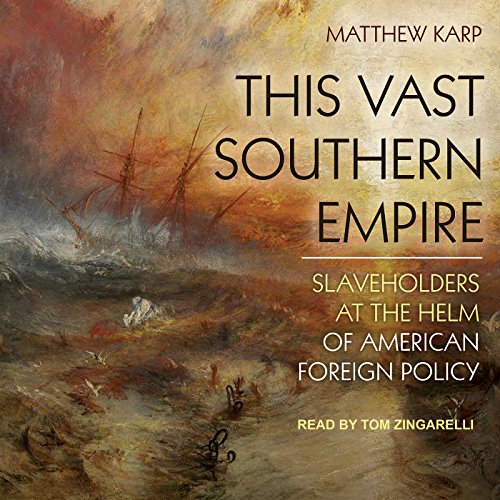

Which they were, the slaveholders, running US foreign policy to protect slavery everywhere in view of protecting their own economy, for most our nation's history until the election of Abraham Lincoln.  And then, they really cranked up the steam engines for protection of slavery and a slavery system.  By then of course, despite Britain having freed the West Indian colonies' slaves, Britain was fully operational with other forms of slavery, in the West Indies and their other colonies in Asia.  In many places such as the opium plantations and factories in India, it was plain, out-and-out slavery.  Other European nations with colonies were doing the same.  This is an informative account of how then how the US's southern slaveowners and their counterparts in Europe worked in other parts of the world to prohibit abolition in Cuba and Brazil.  Protecting these two hemispheric slave systems meant protection for their own.


Sunday, June 28, 2020

Gay Pride Weekend, Weather, Refugees and Immigrants, & History

     . . . . Hot, very. Not so sunny though, and the predicted t-storm has arrived, thank goodness.  We've had no rain for all of June.  Drought has arrived I think.

~~~~~~~~~

Nothing can stop LGBTQ from Priding the last weekend of June in NYC. Big gathering going on at Washington Square Park, in concert with a BLM protest as well. Funny.  All was peaceful.  Then cops arrived.  Squadrons of cops.

~~~~~~~~~

It has been commented at Charlie Stross's place, where many commentators are hooked into EU news far more widely and closely than I am, that the EU policy of excluding entry of US tourists isn't so much about the plague as it is to keep US refugees from coming to Europe. Which ends up being quite a lot the same thing, as NYers ran dragging the virus with them to Florida, etc., and now are running back to NY dragging covid-19 with them this direction.  But the EU certainly don't want the MAGA mad cohort coming in to swell their own numbers of crazy.  But more than that, the way the US has just stopped even trying to deal with the pandemic, and that this huge number of deathcultists are screaming that mask-wearing is satan's signature, things are going to be so insane here by January -- not to mention shortages and all the rest -- that again, merkins will want to hide from it in Europe.  Not having that! the EU says.

~~~~~~~~~

Finished Alaric the Goth: An Outsider’s History of the Fall of Rome (2020) by Douglas Boin. Maybe I have a handle finally on what the differences are between a hun, a goth and a vandal. The book's structure and organization was confusing and the content felt very thin, despite the author's hitting the keys relentlessly on his theme, that Alaric's ultimate reason for bringing and army into Rome for 3 days was that Rome was disdainful of outsiders and immigrants, denying advancement and acceptance of him even in the army to which he'd given so much. The reviews made the book sound better and more important than it was. But then what do we know about either Alaric or the era that begins toward the close of the 4th C A.D. opening into the 5th and 6th centuries? My real take-away is that the initiation of what we call(ed) the Dark Ages comes when the Christians in the west are dominating Western Rome and tolerance of any kind they WILL NOT TOLERATE! To be sure the author didn't say that, that is what I am taking away.


Now I've begun another history (besides the ongoing ones that are huge and that I don't read in every day): Charles King's 2014 work, Midnight at the Pera Palace: The Birth of Modern Istanbul. This is another of Constantinople-Istanbul's many eras of many diverse immigrants renewing the city.  It's also Jazz Age Istanbul, which Istanbul had enthusiastically, complete with myriads of jazz bands.  Agatha Christie saw it all, visiting Istanbul several times in this era. She did ride the Orient Express, inspiring one of her most famous works, Murder on the Orient Express, among other works of hers that are set at least partly in Istanbul. This is the era in which the Orient Express is created, the surprise and awe of all of Europe.  As per usual, I am struck hard all over again by the mirroring of Venice and Constantinople-Istanbul, not only in their architecture, but their trajectories as trading empires and their intimately shared past.