LINES OF THE DAY

". . . But the past does not exist independently from the present. Indeed, the past is only past because there is a present, just as I can point to something over there only because I am here. But nothing is inherently over there or here. In that sense, the past has no content. The past -- or more accurately, pastness -- is a position. Thus, in no way can we identify the past as past." p. 15

". . . But we may want to keep in mind that deeds and words are not as distinguishable as often we presume. History does not belong only to its narrators, professional or amateur. While some of us debate what history is or was, others take it into their own hands." p. 153

Silencing the Past: Power and the Production of History (1995) by Michel-Rolph Trouillot

Showing posts with label Chinese history. Show all posts

Wednesday, September 15, 2021

Warm and Woolly September

      . . . . Ay-up, in the 80's, fuerza sunshine.  Of course this is the day to trek to REI and buy serious wool sox, and hit the shops on Broadway for cashmere sweaters. To balance this out, my personal air conditioning unit is arriving tomorrow.  I'll continue to have use for this for at least another three weeks, I suppose.

     . . . . .Other significant news: CNN reports that as of today, 1 in 500 people in the US have died of Covid.

~~~~~~~~~ Books

Some serious reading has arrived in la casa, because people send us books. 



Just today we received Libros Y Grabaos De Artistas Cubanas: 1985-2008, the catalog for the exhibit held in a different world, held at the Museum of Modern Art, and funded by the Grolier Club of Manhattan. It's a beautiful volume, splendidly fabricated, with equally beautiful content.


Illuminating antiquity, somebody I don't even know -- though I do know his name, I've never met the person -- sent me a copy of the massive, annotated, mapped, appendiced and encyclopedic indexed The Landmark Herodotus: The Histories (2007), edited by Robert B. Strassler.  It's so big it's too heavy to hold. It has to rest on a lap desk or some other support. A reference resource. I have read Herodotus's Histories -- or at least read widely in them. The Polish journalist, Ryszard Kapuściński has read them all, many times.  He annotates Herodotus with his own book, Travels with Herodotus (2004) which focuses on a lifetime of reading Herodotus on the road, studying and reporting. He never traveled without the Histories. Even if one isn't familiar with or care about Herodotus, as with all of Kapuściński's writing it well worth reading, because so goo.

Now for the busy, busy 19th Century.
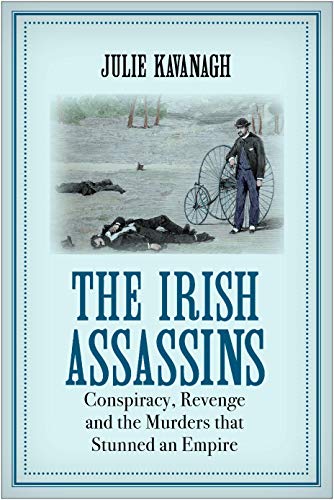


The title is unfortunate because it make the book sound like a Victorian sensationalist 'true crime' tale, when The Irish Assassins: Conspiracy, Revenge, and the Phoenix Park Murders That Stunned Victorian England (2021) by Julie Kavangh, is a serious work of history. In Serbia it was the Black Hand, the open-secret society that funded and planned the assassination of Duke Ferdinand and his wife in 1914.  Here in 1882, it's the Irish American funded, Invincibles, the militant arm of the Irish Independence Movement. At the moment when talks between the Movement and the British government were making headway, the day after Gladstone's emissary, Lord Frederick Cavendish arrives, he and the Irish undersecretary, Thomas Burke, are assassinated by the Invincible in Dublin's Phoenix Park.
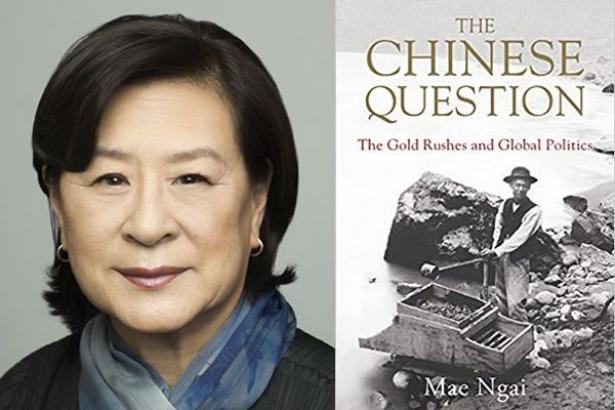


The Chinese Question: The Gold Rushes and Global Politic (2021) by Mae Ngai, traces the anti-Chinese racism in the gold fields around the world 1848-1899. It was remarkably the same in South Africa and Australia as it was in California.


People still buy our books. We just heard a school in New Orleans is purchasing two hundred copies of The World That Made New Orleans: From Spanish Silver to Congo Square. In the meantime, most of New Orleans's power was restored by the end of last week, but not so out there in Cajun Country.  People we know have organized a truck convoy to take supplies to Thibodeaux and Houma. With our contribution I requested sanitary supplies in various sizes be included. People, even when women are part of the organizing and planning, tend to forget this necessity.


~~~~~~~~~~~ Watching

Tomorrow Postmambo Movie Night presents The Rumba Kingsfollowed by a conversation with filmmaker Alan Brain.



~~~~~~~~~~~~~~~~~My Favorite Thing This Week (so far)

Alexandria Ocasio-Cortez, at Monday night's Metropolitan Museum of Art Costume Institute Gala (part 1), in a borrowed dress from her designer girlfriend and 'escort':


The meta and the irony of this.  So much reading one can do -- 
"I don't really care - do you?"  That one has never attended any Met Costume gala!
 

Wednesday, November 11, 2020

Watching In Our Days of Darkness + Reading Wednesday

     . . . Last week we got tipped to a Korean streaming site that allows free access to Nirvana in Fire (2015), the Chinese series with which so many viewers in the US and Asia have passionately fallen in love. There are many fan sites and fan writing so the title may be a familiar one.  One does not need to sign-up for the paid service without commercial interruptions. As I haven't interest in the full service, I'll put up with the short commercials.

The English subtitles are good, the viewing quality is outstanding. Evidently the showrunners had an unlimited budget for production, locations and wardrobe, cameras and editing. The capital city is a huge, lavish set, which is shared with other productions. What we get on the screen is beautiful as well as graceful, so much so, it hovers at Too Much, at any moment about to fall into an overly styled realm of rococo preciosity -- at least to my USian eyes. 


However, the actors save the screen every time. They are not mannered or styled, or precious.  At least so far. Their screen presence is like to that of the most centered characters in Marco Polo, which Netflix lamentably canceled in 2016 after only two seasons.

Nirvana in Fire's first season has 54 episodes; The sequel season has 50 episodes, but I don't know if that's included on this service with the first.


Like the Turkish 13th-14th C epic series, Ertugrul: Resurrection (2014 >>>), with which I fell in love around the same time West Coasties were falling for Nirvana in Fire, two eps per day were broadcast. Like Ertugrul, extremely popular also outside of Turkey, Nirvana in Fire (extraordinarily poor title in English -- what it would be in Chinese?) this 6th Century Chinese epic, is extremely popular outside China too. Ertugrul also shares all the themes and concerns that Nirvana In Fire dramatizes, as did the real Turkish tv equivalent to Nirvana In Fire, set as it is primarily within the claustrophobic, toxic atmosphere of an imperial palace, The Magnificent Century (2011 >>>), also passionately popular outside of Turkey. What Nirvana in Fire doesn't share with Ertugrul, is the splendid horses and the relationships the riders, particularly the protagonist, Ertugrul, have with their steeds.

Back in 2018, Strange Horizons provided the best description of Nirvana in Fire that I, at least, know of in English, written by Erin Horáková.

Nirvana in Fire participates in several generic categories, aligning itself with historical fiction, fantasy, political fiction, family sagas, romance, the cop show, drama, and comedy. I get a strong sense that it’s positioning itself largely against Asian genres I’m not very familiar with: the umbrella categories of C-drama, most obviously, but as SF, Nirvana in Fire works something like a super-heroic wuxia. I saw a weakly translated fanfic reimagining the story as shenmo, which is both a fascinating idea and an illustration of how various international definitions of the fantastic may not neatly map onto one another.

I finally settled into watching two nights ago. (For some reasons it takes some energy to fulling commit to watching a new series.)  Having now viewed 4 episodes, I think Nirvana in Fire may well be my always dependable Watching through the end of the year. Thank goodness for that, since we have dark days ahead.

~~~~~~~~~~

O ya, Reading Wednesday: This Vast Southern Empire: Slaveholders At the Helm of American Foreign Policy (2016)  by Matthew Karp. 


Which they were, the slaveholders, running US foreign policy to protect slavery everywhere in view of protecting their own economy, for most our nation's history until the election of Abraham Lincoln.  And then, they really cranked up the steam engines for protection of slavery and a slavery system.  By then of course, despite Britain having freed the West Indian colonies' slaves, Britain was fully operational with other forms of slavery, in the West Indies and their other colonies in Asia.  In many places such as the opium plantations and factories in India, it was plain, out-and-out slavery.  Other European nations with colonies were doing the same.  This is an informative account of how then how the US's southern slaveowners and their counterparts in Europe worked in other parts of the world to prohibit abolition in Cuba and Brazil.  Protecting these two hemispheric slave systems meant protection for their own.