LINES OF THE DAY

". . . But the past does not exist independently from the present. Indeed, the past is only past because there is a present, just as I can point to something over there only because I am here. But nothing is inherently over there or here. In that sense, the past has no content. The past -- or more accurately, pastness -- is a position. Thus, in no way can we identify the past as past." p. 15

". . . But we may want to keep in mind that deeds and words are not as distinguishable as often we presume. History does not belong only to its narrators, professional or amateur. While some of us debate what history is or was, others take it into their own hands." p. 153

Silencing the Past: Power and the Production of History (1995) by Michel-Rolph Trouillot

Showing posts with label Art and Love in Renaissance Italy. Show all posts

Tuesday, July 3, 2018

Ivanhoe (BBC) 1997; A Very English Scandal (BBC One) 2018

     . . . . After the exertions of Saturday in the heat, and the heat ongoing without any prediction for an end, any time in the foreseeable future, I was a wrung out limp rag of a person, unfit for anything, which meant the traditional Pasta & Jazz Saturday night dinner was reduced to heritage tomato salad and a pre-cooked egg pappardelle, sweet sausage, eggplant and zucchini dish from Raffetto's (est. 1908!).     . . . . 

This meant a lot of weekend tv watching.

 . . . I don't know what to think about the three-part A Very English Scandal.  It seemed, o I dunno, inappropriately light-hearted and cheeky for an exploration of how a man loses his political career via the necessity of being a closeted queer and because he tried to have murdered another queer whose life has been warped by the laws about homosexuality -- and gets off from attempted murder charge because Eton etc.  I just don't know.


It was, of course, a delight to watch this mature, and o so not pretty, Hugh Grant in the role of disgraceful Labor party tentpole, Jeremy Thorpe, and the still very pretty Ben Whishaw as Norman Scott, Thorpe' lovely, but deeply disturbed young lover, whom Thorpe concludes must be killed to remove his inconvenient demands and loud mouth, once Thorpe tires of his 'bunny.' 

 . . .  I then comforted myself with the  BBC 1997 very sincere, yet a bit sly, 6-part miniseries adaoted from Walter Scott's Ivanhoe (1827 -- one of my favorite novels as an adolescent, and I still re-read it every so often) Among the many delights of this series is Ciarán Hinds as  Brian de Bois-Guilbert and Christopher Lee as Lucas de Beaumanoir.  Lee emotes in the role exactly as he does as Saruman in Jackson's Lord of the Rings. The scenery is splendid -- terrific forests and roads through them, and magnificent baileys, tilting fields and the rest. There are some impressive fight scenes during which the viewer will not miss CGI enhancement one bit.


The political slant of royals and the middle ages chosen present the Lion-Heart as heavier and less jovial than maybe Scott chose -- more in line with Steven Runciman's third volume of his classic history of the Crusades, though he's still a hero.

But then Scott's novel was not middle-ages light either.  Horrible torture, anti-semitism, slavery, corruption of all sectors of the society's institutions from the crown to the church, sexual abuse of innocent women are all essential plot points in Ivanhoe, which are not prettified out of the story here. There are departures from Scott's text though, and all for the good, particularly with the character of Rowena and Athelstane.


Ciaran Hinds as Bois Guilbert and Susan Lynch as Rebecca


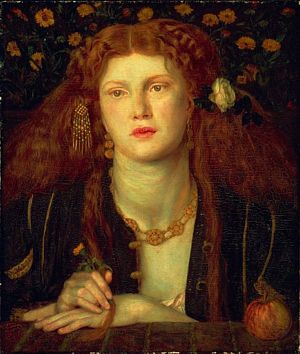
Maybe the best of all the delights is the actress who plays Rebecca possesses the perfect sofa-divan pillow mouth,  hooded eyes and extravagant waves of hair so beloved of Pre-Raphaelite-Rossetti pseudo mid-Victorian fantasy of medieval sirens.


Every time she appears on the screen I am as riveted by the actress's mouth shaping her words as were those men staring at Rossetti's  paintings of Jane Morris (wife of William Morris) in "Proserpine,"

"Bocca baciate non perda ventura, anzi rinova come fa la luna’, which translated means ‘The mouth that has been kissed loses not its freshness; still it renews itself even as does the moon’.

 or  Fanny Cornforth in "Bocca Baciata" 


and his own wife, Elizabeth Siddel in "Beata Beatrix."


"It's too Darned Hot" dance sequence from Kiss Me Kate

Yah, it remains too darned hot.

Sunday, January 25, 2009

Ship Wrecks and Dickheads

Friday we walked through the Met's "Art and Love in Renaissance Italy" exhibit, which was largely uninteresting. NY Times review here.

Too many dishes, we thought, even if the dishware is maiolica. We're the plebian sort, generally interested in plates as far as what is on them is for us to eat. We gave most of the objects and paintings cursory attention. As well I was beyond my endurance, in screaming pain, after 3 hours in the "Beyond Babylon" exhibit. But the Met is like that. Once you're there, you keep going because you are forever stumbling on something that takes your breath away. The problem is that destroys me for the rest of the day, and the next one – and that's when I'm lucky. Marble floors and standing are absolutely counter-indicated for someone with my spinal condition.

What was of interest among the many depictions of weddings, pregnancy and childrbirth, couples and clasped hands (emblematic of fidelty), were the round, ornate gift boxes in which the bride then kept the smaller, valuable gifts from her betrothed and others, such as jewels, cosmetics and their ornate containers, sewing tools, encased in their own ornate, gilded and be-jeweled containers, such as needles and pins, and again ornate, gilded and embossed in the perhaps silver chased leather cases, her writing implements. These are not the same object as the canzoni, the huge, ornate chests with narrative painted panels. These are all customs of the wealthy and powerful. What the lower classes do with betrothal, marriage, childbirth and whoredom is not present in these galleries.

There were also a few pornographic – erotic, since this a museum and everything is art? objects included in the section called, if I recall correctly, "Sensual Love." My favorite was a print of a Venetian courtesan, whose skirt can be lifted by the viewer in order to see her nether parts garbed in lace trimmed transparent silk, a 16th c predecessor of the pop-up book. In the exhibit the skirt is permanently lifted by a pin for our delectation.

An exception to the boring maiolica was a plate that memorializes 'The Dickhead.' You can see it too, if you scroll down the screen here.

You can also learn more about "The Dickhead" here.

I badly wanted to visit "Provocative Visions: Race and Identity—Selections from the Permanent Collection, but I could hardly walk, so we went home. The pain was worth it.

"The Wreck of the ship Ululubrun", i.e. "Beyond Babylon," where we spent the most time, later.