Friday we walked through the Met's "Art and Love in Renaissance Italy" exhibit, which was largely uninteresting. NY Times review here.
Too many dishes, we thought, even if the dishware is maiolica. We're the plebian sort, generally interested in plates as far as what is on them is for us to eat. We gave most of the objects and paintings cursory attention. As well I was beyond my endurance, in screaming pain, after 3 hours in the "Beyond Babylon" exhibit. But the Met is like that. Once you're there, you keep going because you are forever stumbling on something that takes your breath away. The problem is that destroys me for the rest of the day, and the next one – and that's when I'm lucky. Marble floors and standing are absolutely counter-indicated for someone with my spinal condition.
What was of interest among the many depictions of weddings, pregnancy and childrbirth, couples and clasped hands (emblematic of fidelty), were the round, ornate gift boxes in which the bride then kept the smaller, valuable gifts from her betrothed and others, such as jewels, cosmetics and their ornate containers, sewing tools, encased in their own ornate, gilded and be-jeweled containers, such as needles and pins, and again ornate, gilded and embossed in the perhaps silver chased leather cases, her writing implements. These are not the same object as the canzoni, the huge, ornate chests with narrative painted panels. These are all customs of the wealthy and powerful. What the lower classes do with betrothal, marriage, childbirth and whoredom is not present in these galleries.
There were also a few pornographic – erotic, since this a museum and everything is art? objects included in the section called, if I recall correctly, "Sensual Love." My favorite was a print of a Venetian courtesan, whose skirt can be lifted by the viewer in order to see her nether parts garbed in lace trimmed transparent silk, a 16th c predecessor of the pop-up book. In the exhibit the skirt is permanently lifted by a pin for our delectation.
An exception to the boring maiolica was a plate that memorializes 'The Dickhead.' You can see it too, if you scroll down the screen here.
You can also learn more about "The Dickhead" here.
I badly wanted to visit "Provocative Visions: Race and Identity—Selections from the Permanent Collection, but I could hardly walk, so we went home. The pain was worth it.
"The Wreck of the ship Ululubrun", i.e. "Beyond Babylon," where we spent the most time, later.
Showing posts with label January 2008. Show all posts
Showing posts with label January 2008. Show all posts
Sunday, January 25, 2009

Thursday, January 8, 2009
Guantánamo: A Working Class History Between Empire and Revolution
Guantánamo: A Working Class History Between Empire and Revolution (Dec. 2008) is by a newly-achieved Ph.D. in history, who arrived on the faculty of the history dept. at Tulane in 2006, Jana Lipman.
Unfortunately the publisher of this book is aloof from contact, thus no reviews, thus no one knows about it. For example, we could review it, if we had a copy.
Fortunately, due to the Cuban Revolution's 50th anniversary January 1, Lipman scored a spot on "The Lenny Lopate Show" here on WNYC -- and um, how many people under 30 even have radios or listen to them? Or over 30 for that matter?
By chance I heard this segment while doing some housecleaning. The author is personable and knows her stuff. One of the most interesting parts was her description of how employment at the base worked, the employees joining the AFL-CIO, which backfired on the employers -- they expected it to give them more control over the Cubans, and how some of the Cubans employed at the base managed to smuggle out both goods and arms for the Revolution.
Listening to her speak with such energy and enthusiasm about the city of Guantánamo brought back happy memories. It's a beautiful city in the mountains of eastern Cuba, where culture remains deep and history vital.
Sunday, January 4, 2009
Art, Culture, Activism -- Tavis Smiley -- Black Latino Summit
This weekend Tavis Smiley re-ran his two-hour radio program (heard here on Sats. and Suns., 2 PM, in two parts, one each day) made from the "Black Latino Summit" held in Los Angeles late last year. One of the moderators and spokespeople is Wendell Pierce (Bunk - The Wire -- he's also starring in the new Simon series set in contemporary New Orleans).
Wendell Pierce is a serious artist. He's also a cogent thinker and articulate. He spoke clearly to the need for people to not confuse art with culture, that these are not necessarily the same sorts of expression. He defined the differences. He followed up with describing how art can, and may, and often does, grow out of culture. Then he connected both art and culture with activism, while insisting that there is a necessary place in any community's culture for art, and that parents should do their best to bring up their children with art as much as culture. IOW, museums, theaters and ballet lessons are as important for nurturing identity and community as is church and other cultural expression.
He describes the split between the African American communities and the Latino communities. He explained how his move to Los Angeles taught him what their communities shared culturally. His connection of the funeral second lines of New Orleans to the Latinos' El Día del Muertos was brilliant.He and the other moderators did a spectacular job too, of explicating just how the power structure works -- and spends lots of money on -- keeping the African American and Latino communities divided, along that same old effective strategy of 'divide and conquer.' We all must be smarter than to be used that way.
The Tavis Smiley show website is here.You may find the broadcast archived there, or listen to it streaming, depending on the time it broadcasts in your area. Listening is highly recommended.
Thursday, January 31, 2008
The Last Angry Man
'They' took him out, just as 'they' threatened / promised. (See my post of January 8, 2008, "The Chamber of Commerce Talks Like the Wise Guys here.)
The last, the only, angry candidate, angry on behalf of the little guy (to quote my farmer dad, a Dem and Populist in a state that appreciated neither), Edwards went out a class act.
Just as he made his announcement to run for the dem party's nomination for POTUS in New Orleans, he and Elizabeth made the announcement that they had to drop out in Music Village, in the Lower 9th, in New Orleans. On his way to the press conference, he stopped to talk to the people living in a homeless camp under a bridge.
We've been blinded by the smoke&mirrors, faux Prez Campaign '08 since 2006. By the time I get to vote in a primary the guys I would vote for happily are gone -- the election's in November, and it's still January. My first choice would have been Dodd, who supported an intelligent approach to Cuba, scrapping the embargo and who speaks Spanish. We were not going to be allowed to have that! Clinton's married into a Miami Cuban ruling family, so is more likely declare an invasion of the island. Obama says that he would allow some people to visit family in Cuba, but not allow people like me to go there. My second choice was Edwards, who talked some truth and spoke of and to veterans and other homeless people. We were not going to be allowed to have him either.
Edwards ended his campaign where he began it: in New Orleans. Then he and Elizabeth picked up hammers and went to work rebuilding the city. A class act, both of them, all the way.
The pull quote:
[ He started his address about 30 minutes after stopping at an interstate underpass to talk to homeless people at an encampment of about 200 people. "One woman said to me, 'You won't forget us, will you?' Well, I say to her,we will never forget you. We will fight for you, stand up for you," he said. ]
Courtesy The Black Agenda Report:
[ Through fourteen Republican Debates, no moderator has asked any Republican Presidential candidates a single question about rebuilding New Orleans and the Gulf Coast. ]
Edwards drops out of presidential race
The Times-Picayune
Wednesday January 30, 2008, 7:34 AM
By Bill Walsh and David Hammer Staff writers
[ Ending his presidential bid in the city where he launched it 13 months ago, Democrat John Edwards told a crowd at the Musicians Village in the 9th Ward on Wednesday that he is giving up the political chase, but not his advocacy for New Orleans and the nation's poor people that was a focus of his campaign.
He told a crowd at the Musicians' Village in the 9th Ward today that he is giving up the political chase but not the battle against poverty that had been the theme of his campaign.
"We joined together in this city that had been abandoned by our government and had been forgotten, but not by us," Edwards told about 250 people who gathered in the chilly early afternoon. "Someday, one day, the trumpets will play loud in Musicians Village, where we stand today." ]
Wednesday, January 30, 2008
Colombia in a Bubble
Center for International Policy
"Colombia in a Bubble"
[ They did a good job of keeping it under wraps. We heard nothing about Condoleezza Rice’s visit to Colombia until it was announced on Tuesday. (Not surprisingly, nobody at the U.S. embassy mentioned it to us when we were in Bogotá last week.)
Only yesterday did we see a list of the ten Democratic members of Congress who will be accompanying the Secretary. This made it impossible to prepare any briefing materials or lists of suggested questions to ask.
Those ten members, who will spend about 24 hours in Medellín, are:
a.. Eliot Engel (D-Bronx/Westchester, New York), the Chairman of theWestern Hemisphere Subcommittee of the House Foreign Affairs Committee;
b.. Jane Harman (D-El Segundo/Wilmington, California);
c.. Solomon Ortiz (D-Corpus Christi/Brownsville, Texas);
d.. Alcee Hastings (D-Ft. Lauderdale/West Palm, Florida);
e.. Jim Moran (D-Alexandria/Reston, Virginia);
f.. David Scott (D-Jonesboro/Smyrna, Georgia);
g.. Rick Larsen (D-Everett/Bellingham, Washington);
h.. Melissa Bean (D-Schaumburg, Illinois);
i.. Ron Klein (D-Ft. Lauderdale, Florida);
j.. Ed Perlmutter (D-Lakewood, Colorado).
Three of these ten (Bean, Moran and Ortiz) were among the fifteen Democratswho voted for the Central American Free Trade Agreement in 2005. Two (Moranand Ortiz) have voting records that reflect support for Plan Colombia over the years, while six (Engel, Harman, Hastings, Scott, Larsen and Bean) have tended to vote for amendments to cut military aid and increase economic aid to Colombia. The other two, Klein and Perlmutter, are in their first term.
CIP’s Colombia Program is not an active participant in the Free TradeAgreement debate - our expertise is security and human rights, not economics. (We share Human Rights Watch’s view, however, that the U.S.government should use the pending agreement as “leverage to press Colombia’sgovernment to effectively confront impunity and break the paramilitaries’power.”)Beyond the FTA, though, we worry that some of these ten Democrats might come back to Washington with a skewed view of Colombia, and U.S. policy toward Colombia, after their two highly staged days there. Over the years, we’ve seen trips like these distorting the views that members of Congress hold about Colombia, a country about which they probably don’t think too often. Normally thoughtful members of Congress, prefacing their remarks with “I’ve been to Colombia, I’ve talked to the Colombian people,” go on to declaim about the wonders of Plan Colombia and President Uribe’s hard-line policies. “I don’t know what you’re going on about, Plan Colombia is working,” they will say to congressional colleagues who have paid longer, unofficial fact-finding visits to less-charming regions of the country. “I think you’re being overly negative.
”We ask the members of Congress in Medellín today: please return toWashington wanting to know more. You’ve only heard half the story. After one day in the Secretary of State’s bubble in Medellín being shown just what they want you to see, you’ve “been to Colombia” as much as a Cancún springbreaker has “been to Mexico.” Your intellectual curiosity should be provoked, not satisfied.
Incidentally, while in Medellín it’s a shame that you won’t be meeting with any of the following people. These uninvited individuals and groups could have given you a much fuller idea of how complex the situation really is inColombia, and what the true consequences of your aid and trade decisionswill be.
a.. Medellín has been a center of paramilitary activity, and lately has hosted many of the confessions that top paramilitary leaders have given to prosecutors as part of the “Justice and Peace” demobilization process. Being in Medellín would have offered a great opportunity to speak to the paramilitaries’ victims, who stand vigil outside these prosecutorial sessions. You could have taken a moment to hear of their desire to know what happened to their loved ones, to see a measure of justice done, or to win the return of lands that were stolen from them. You could have pondered why nearly all who aided and funded the paramilitaries who victimized them remain not only unpunished, but unnamed.
b.. You could have met with the overworked, underfunded prosecutors and investigators in the “Justice and Peace” unit of Colombia’s Prosecutor-General’s office (Fiscalía), to find out what their needs are -everything from manpower to security to the ability to uncover mass graves -and how the United States could be supporting them.
c.. You could have met with relatives of civilians who were detained by the Colombian military, only to show up dead, presented as guerrillas killed in combat. Colombia has seen a rash of these “extrajudicial executions” in the past few years [PDF], and the Colombian Army’s Medellín-based 4th Brigade is alleged to be one of the worst offenders.
d.. Medellín is the capital of a department (province) called Antioquia. In 2006 Antioquia, according to the UN, was fifth among Colombia’s 32 departments in production of coca, the plant used to make cocaine - more than 15,000 acres were detected there that year. Being in Medellín would have offered an opportunity to speak with coca-growing families, to find out why they chose to plant the crop, and what economic options remained after U.S.-funded spray planes fumigated them.
e. You could have met with members of indigenous nations living just a few hours’ drive from Medellín, such as the Embera-Katío. Beset by theconflict and by people who would evict them to profit from their land, these nations’ cultures, languages and traditions face the very real possibilityof extinction.
f. You could have spoken to Medellín’s ombudsman (Personería) or to respected NGOs like the Popular Training Institute (IPC) to get an overview of the city’s complex security situation, including concerns that new armed groups, fueled by the drug trade, may be asserting themselves in the poor barrios that ring the city.
g.. You could have met with Medellín-based negotiators and accompaniers of the ongoing, promising peace process with the ELN guerrilla group. Theywould have explained the possibilities and challenges that thesenegotiations face, and how the United States could be supporting them.
We are pleased that the ten Democratic House members accompanying Secretaryof State Rice today have taken an interest in Colombia. We encourage them to remain engaged, and to seek a much broader spectrum of views and facts, after they return to Washington. ]
Tuesday, January 29, 2008
For Castle Lovers -- "El Cid" is now on dvd
Announced in the NY Times Tuesday "New DVDS" column, the release of the Sophia Loren - Charleton Heston El Cid. Because I am a Castle Lover, I loved this movie. I finally got to see it as an adult some years back at the Film Forum, when the Film Forum still was located on Grand Street. Imagine the sighs of contentment at the historically created battle scenes, the armor, the Visigoth castles and Moorish palaces. Imagine my chagrin reading this in the column today, information re El Cid of which I was unaware:
[ Mann’s most characteristic work was in film noir (“Raw Deal,” 1948) and the western (“The Far Country,” 1954), and his best period was behind him when he went to Spain to work for Samuel Bronston, the enterprising producer of “El Cid.” In “The Red and the Blacklist: The Intimate Memoir of a Hollywood Expatriate,” Norma Barzman, Ben Barzman’s widow, writes that Mr. Bronston had been able to finance his Spanish operations thanks to an arrangement with the DuPont family, who wanted to sell oil to Spain under Franco but did not want to be paid in unexportable Spanish pesetas. Instead the DuPonts plowed their local profits into Mr. Bronston’s films, which could then be sold around the world for more convertible currencies.
As Mr. Bronston’s biographer, Neal M. Rosendorf, and son, Bill Bronston, note on the commentary track, the film draws flattering parallels between Heston’s medieval hero and Franco, whose government was in on the oil deal. The dastardly Moors, led by a kohl-eyed, black-robed Herbert Lom, became stand-ins for the Communists, whom Franco had crushed in the Civil War. And in the cold war context of 1961, such foes were still perceived as enough of a clear and present danger to make Franco a prized American ally.
To top it off, Mr. Bronston (born Bronstein) was related to Leon Trotsky (born Lev Davidovich Bronstein), a relationship that could hardly have thrilled Franco or even Mr. Barzman, still a member in good standing of the Stalinist Communist Party U.S.A. at the time he rewrote the script. Surely setting some kind of record for the number of strange bedfellows packed into a single cot, “El Cid” ought to have been either an extremely lively, contentious film or a total smoking train wreck. Oddly enough, it is neither, but rather a handsome, rather placid, perfectly professional production. (The Weinstein Company, $24.95; “limited collector’s edition,” $39.95; not rated.) ]
Sunday, January 27, 2008
NOT Billary, Please! Please! Please!
Over the last 8 - 10 weeks my disquiet at the thought of Hillary being the dem candidate and / or getting into the oval office has continued to grow and to sprout ever more ramifications as to why this would be another disaster for our country. We're already up against the ropes from the succession of 8 years of the regime's deliberately disasterous policies, part of which has been to spend the national government out of existence financially, and to create distrust of every federal agency and institution by deliberately turning them into centers of incompetence, and often as well, cesspools of corruption and politicalization. (Ya really didn't believe 'they' were that stupid, didja? Smart enough to steal elections and take out any candidate of their choosing? No, the destruction of centralized federal government is 'their' objective, and 'they've' reached a lot of 'their' goals -- if only by appointing who 'they've' appointed to judgships and pillaging the treasury, the greatest transfer of wealth into the fewest hands the world maybe has ever seen.)
My disquiet began with no longer trusting or believing in Hillary, based on her lies concerning serving in the U.S. senate, and her pandering to the regime over Iraq, as well as her early debacle with health care, and her deep connections to the health insurance companies, her cronyism with Murdoch and other corporatist power brokers, and her long-known secrecy. Transparency is not Hillary. She'll no more make our government answerable to public scrutiny than the regime has.
Now my disquiet includes Bill. He royally screwed us all over while in the Oval Office. He'll do it again, when it's supposed to be Hillary in that Oval Office. The 2 of them will also be fighting over who has the real power. Bill still doesn't control himself sexually, by all accounts. His heart surgery didn't change his life-time behaviors, except in diet. It will be another politically paralyzed presidency, paralyzed by Bill. His rhetorical outbursts in the last 2 weeks on the primary and caucus trails have reminded us all what he is. It will be another politically paralyzed presidency, paralyzed by Hillary, as she tries to stay out of Bill's shadow, and he walks in front of the vice president, creating yet more disunion in the nation.
Bob Herbert had a piece today in the NY Times op-ed page that applies to this, "Questions for the Clintons".
Gary Wills has another, that says everything I've been thinking, "Two Presidents Are Worse Than One."
While The WaPo Magazine has this rather sad article on Edwards, who clearly people admire and respect and maybe even trust, so why don't more people vote for him? I admire him more and more, and believe, considering the break down of who voted for whom in today's SC primary, he's the one of the three who is actually electable, and who also can really pull this country together.
Obama won SC yesterday. Black women evidently are right turned off by the Billary deal. Can you blame them, with all that barely concealed rhetoric that African Americans have heard the entire history of the U.S., that "boy, you just aren't ready yet." Not to mention the disgusting, repellant remarks on the level of "Bill Clinton's had more black women than Obama." Using black women as the bridge in a childish weenie-wave contest between two men is the most dispicable thing they've done yet. As Hillary's well-known for being in control of everything around her, and of Bill too, and even announced by her campaign as an endorsement for abilities as an administrator, can you believe for a second that she was unaware of this as a short-term strategy? How much more of their bad judgment and lack of self-control can this nation endure?
If Obama's not ready now then, when? Obama is NOT my favorite by a very long shot. But he, at least, won't be paralyzed by scandals, if he goes into the White House. And I tell ya, we are all sick to death of those 3 voices out of the last 16 years: the shrubbery AND the billary. I want to hear different tones, different timbres, new language. My ears cringe at the sound of the voices of all three -- shrub and billary.
Frank Rich has weighed in today on this as well.Go here for "The Billary Road to Republican Victory.
It's rather heartening, than otherwise, to see so many of the dem-leaning chattering class leaning toward this point of view today.Here's another, Glenn Greenwald, who has always been more of a billary supporter than not. Bill Clinton: The Chris Matthews of South CarolinaThat so many of this very loosely labeled 'us' are rejecting strongly this trashy behavior of the billary machine to make this suddenly about 'race' rather than character and all the other legitimate issues that lead to choice, speaks well of this 'us.'Or -- maybe, merely our self-interested terror of what the billary machine's ultimate consequences will be: another 8 years of 'them.'
Friday, January 25, 2008
Saturday, January 19, 2008
El Mundo de Gabriel García Márquez

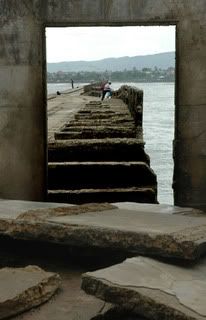

A freighter on its side, abandoned in the mud. The difference between what Joseph Conrad would make of that, vs. how Gabriel García Márquez would treat it.
The freighter was finally dug out and hauled away a couple of years ago.
Friday, January 18, 2008
Barranquilla, Colombia
An article about Vaquero here, reporting from the Arts Festival that has brought Caribbeanists and Latin American arts people from all over the Spanish-speaking hemisphere. It's running along with the city's Carnaval.
Ladies of the city arriving at the hotel to celebrate their Carnaval costumes.


Ladies of the city arriving at the hotel to celebrate their Carnaval costumes.
Monday, January 14, 2008
Dance: The Knife That Slices Open Parallel Worlds
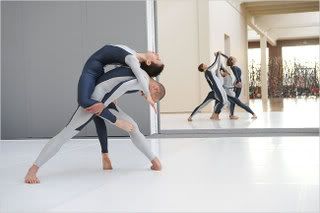
Pullman's His Subtle Knife:
Choreographed by Merce Cunningham;
Danced by the Cunningham Company
Choreographed by Merce Cunningham;
Danced by the Cunningham Company
Alternate Worlds Moving on Two Stages,
Performing for One Audience
I've been attending the revelatory Merce Cunningham 'events' all my adult life -- on occasion the spouse has been honored as a composer for an edition of these events, so famous, for so long, in the world of art and dance. These were informal gatherings of audience and company in the Cunningham studio, devised for choreographer, dancers, composer and audience to exchange energies via the matrix of Cunningham at play, with his constant playmates, time and space.
This weekend the Cunningham Company held an 'event' at the glorious Dia Art Foundation - museum, which is located outside of Beacon, NY. I can personally testify that the land upon which the the arts' container, a work of architectual art itself, is sited, provides a canvas of seasonal light and shadow display that is breathtaking, no matter the weather or the time of year. This weekend's event at Dia included choreography inspired by Pullman's The Subtle Knife. The NY Times dance critic describes the event thus:
[ To watch his company on Saturday afternoon in the first of two Cunningham Events last weekend at Dia:Beacon was to see a poetically compelling exposition of parallel-universe theory. Before at Dia:Beacon, Mr. Cunningham has staged events on two or more stages at the same time. In 2004, working on three stages at the Tate Modern in London, he employed a barrier that prevented audiences from seeing all three at once unless they looked up to the lofty mirrored ceiling in Turbine Hall (where the full action was visible, though very distant).
On Saturday at Dia:Beacon he placed his two stages adjacent but on either side of a square doorway. Wherever you were sitting, you could see only part, never all, of the stage on the opposite side. That door, leading from one world to a parallel stage, evoked the controlling image of The Subtle Knife, the second novel of Philip Pullman's trilogy His Dark Materials. In it the young hero can cut his way, slicing a square aperture in the air, from this Oxford into different worlds, at least one of which contains an alternative Oxford.
As the event began, the stage farthest from me looked breathtakingly like a mirror of the one closer to me. One group of dancers was moving in slow, controlled adagio, stepping, arching and bending with precision, while another, dressed identically, was doing the same but facing the other way.
Then, more than a minute into the dance, the denizens of the through-the-looking-glass world started to move in other steps and in a different tempo, whereupon the dichotomy between these two now dissimilar stages became both frustrating and entrancing. Here the dancers were balancing, fixed, waiting; there they were leaping fast across the space, caught up in some rush of which we could see only a fraction. And, like characters in the Pullman novels, dancers moved from one world, or stage, to another and back again. ]
Watching a Cunningham choreography, whether from early in his career (he's now 91), or one just recently created, one feels she has left this world and re-entered another that has been lost, a world in which the sacred exists, as both sublime and far beyond any rigid and short-sighted religion, to a world that has existed long before this one, and which will survive hard and passionate once we have departed. It's a privilege that everyone should be entitled to experience.
So it's natural that this man would be drawn to a book by a YA author that speaks to slicing open gates that allow him, his dancers and us, to enter parallel worlds.
Sunday, January 13, 2008
U.S. and the Struggle for Civil Rights
The national commemoration of Martin Luther King's birthday is looming, along with the month of February, which is 'black history month," (about which Spike Lee has been attributed as observing something like, "You know they'd give us the coldest month," but if that is true or not I don't know.)
Reading about this new book, published, of course, at this time of the calendar, brings the sober realization that in the U.S. the struggle for civil rights has been going on so long that it can now be studied as an historical movement of 'longue durée" ("a term used by the French Annales School of historical writing to designate their approach to the study of history"):
Defying Dixie: The Radical Roots of Civil Rights, 1919-1950 by Glenda Elizabeth Gilmore.
[ Forgotten Revolutionaries
How Southern communists, socialists and expatriates paved the way for civil rights.
Willful amnesia has been a chronic problem in American historical thought. Many of us, it seems, have preferred a simplified and sanitized version of national history, one that smooths out the rough edges that might complicate comforting visions of harmony and progress. This mythic approach to the past was especially popular during the two decades following World War II, when patterns of violence, extremism and political discord were either ignored or discounted. Politics, in the two-party context of American exceptionalism, had been reduced to a mere quibbling over details. In this fulsome view of the great American success story, there was no room for radical dissent, no place for systemic failure.
Recent decades, of course, have witnessed a withering assault on this attitude by an increasingly diverse cadre of professional historians, many of whom have shown a special interest in the evolution of social and political movements and the history of marginalized groups such as African Americans, women and the poor. Shining a light on the darkest recesses of U.S. history, revisionist scholars have challenged the presumptions of American exceptionalism. In the process, they have fostered a greater appreciation for the power of dissent and disorder, uncovering the radical roots of everything from the American Revolution and abolitionism to populism and organized labor. In the burgeoning field of civil rights studies, such an appreciation has been an important undercurrent for at least a decade. But with the publication of Glenda Gilmore's remarkable new book, Defying Dixie, the left-wing origins of the civil rights movement have risen to the surface of historical debate.
Gilmore, a North Carolina native and Yale history professor, transformed our understanding of the Southern progressive movement with her first book, Gender and Jim Crow, published in 1996. Defying Dixie promises to do the same for the emerging freedom struggle of the post-World War I era. The early stages of what Jacquelyn Dowd Hall has aptly labeled "the long Civil Rights Movement" have attracted considerable scholarly attention in recent years, so much so that most historians no longer feel comfortable with accounts of the movement that begin in the mid-1950s with the Brown decision or the Montgomery bus boycott. But even the most enlightened civil rights historians will find new material and much to ponder in Gilmore's richly textured study of the Southern communists, socialists and expatriates who challenged Jim Crow during the three decades following the Bolshevik Revolution. ]
My o my, isn't Senator Obama a long duration away from all this!
But -- and this is a most significant qualifier -- how much further away than this is Hillary Clinton's latest denial scramble re Martin Luther King and his effect upon the Civil Rights Movement. Just like her scramble that insists she thought she was voting for something other than the specifically titled, "Authorization for Use of Military Force Against Iraq Resolution of 2002." Feh.
Friday, January 11, 2008
Death From The Air
What this country does best.
More aerial bombardment in Iraq????
Try to reconcile these three accounts, from three countries.
I'm not clear on how this "extraordinary amount of firepower" can be"precision" bombing. sounds kinda like what the us military does best: raindown death from above, in which anyone killed was by definition aninsurgent.
Curiously, not two weeks ago, Arab Jabour was being exhibited as a case of "progress in security", as per the first dispatch below, which notes"farmers working" outside and "children going to schoo".
Mot to worry about those farmers and children, though. One of thesearticles (the US one) quotes a local militia member that "civilian casualties in his area were avoided Thursday because American forces instructed his group to warn residents to leave the area." So presumablythey left their homes behind after being told to do so. and maybetheir homes were reduced to rubble. But hey.
http://www.militaryconnection.com/news/december-2007/local-governance-center.htm
http://english.aljazeera.net/NR/exeres/34FF8497-B1B6-4739-BB4F-7C500D389CE0.htm
http://www.guardian.co.uk/Iraq/Story/0,,2239001,00.html
This.
This.
This is beyond any human excuse.
Wednesday, January 9, 2008
Dog Whistle Politics
Imagine both Hillary and Obama up against this gop Mighty Dirty Trix Machine through the south, Texas, the southwest and the west, which is jam-packed with those who see the Huckuck as just like them -- mean, greedy and proudly ignorant of anything not his own backyard (I have loads of relatives on both sides in those regions, and they are just like him, and evangelical to boot -uck).
From the Daily Kos:
[ An interesting discussion today on language used by Mike Huckabee in his campaign. He is fond of talking about "vertical" politics rather than "horizontal" politics. Josh Marshall brought this up over at Talking Points Memo, where he includes a video of this Huckabee answer on NBC's Meet the Press last January. ]
Saturday, January 5, 2008
They've Declared Edwards Dead
Everyone says so, particularly NPR and everything associated with it. Coz he came in second.
But, oddly, Hillary, who came in third is NOT dead.
Why is this? Coz Edwards scares 'em (like Dean did -- they killed Dean at Iowa too, recall?).
Coz, Edwards is that NO-NO! He's angry! He encourages all those other people who are angry about their kids having rotten education and no health care coz their parents have no jobs or garbage jobs to DO SOMETHING ABOUT IT.
He's not a corporatist, like Obama or Hillary. Which is why Huckyuck won't get to go anywhere either, as disgusting a Caleb (the Big Bad's prophet in the concluding Season 7 of Buffy the Vampire Slayer) that Huckyuck is -- and a racist, wingnutxtianrightist, misogynist warmonger ignoramous, he's also a populist. In fact, the only authentic current gop corporatist potus wannabe is Romney, and he's not electable coz of that Mormon factor. So, thus, Bloomberg and the unity 'indie' party.
Which nobody Thursday night or since has talked about (except, a teeny bit, on Air America). That black Obama's acceptable is largely due to the fact that he isn't out of slavery heritage African Americans. He's the immigrant story, the successful immigrant fairy tale story, not the miserable tragic cruel story of forced immigration to die to make others rich that the slavery story is. Thus he's so much more -- like 'us' and acceptable, because he's not one of 'them'. You can hear it in the way those dorkdongs talk about him ... sure, in code, but that's what they're saying.
In the meantime, this journalist shows how nasty and dirty a game politics is, even when played by the better sort. That is, if this journalist can be trusted to be providing objective and factual information from Iowa on Thursday night. She says that at least some of the Obama and Edwards people coluded in order to make sure Hillary got stalled -- and additionally Hillary's people played into their hands due to arrogance and blindness, and as well, very callously treated elderly, unwell caucus female participants (I keep wanted to type 'couscous!' -- I like couscous and make it often ....).
Subscribe to:
Posts (Atom)
