Attempting to write coherently of Benjamin Franklin's thinking regarding the North American British colonies' political economy, I am working my way through Marx's essay on Franklin's A Modest Inquiry into the Nature and Necessity of a Paper Currency.
BF was perhaps the first person to ever work out that money = labor, thus, regretably one must have slave labor, at least in these colonies. Not to mention a wife. Because, extracting the most production for the least labor cost is how wealth is produced. Marx's analysis is fascinating and illuminating. But I have to work on this longer.
I might have gotten this clear yesterday except we had our Saturday errands to do, and then we had to attend the benefit gospel performance for a scholarship fund at school. When we got home it was after 8 and we still had dinner to make and eat. By then I didn't have much of a brain for either Franklin or Marx, alas. But that is how it is with we Poohs who never knew economix anyway, and have no natural talent in that area. So much so that PH, JJ and I agree that come the Revolution first we hang the economists, except for Paul Krugman. This, re chatting after the concert. Which was spectacular.
Among the several memorable words spoken by the MC, the Rev. Clarence Hawkins, particularly about song and singing, he quoted the man in whose honor the scholarship was created, Vincent Hynson: "Volunteerism and community service are the price you pay to be on this earth."
The amount of volunteerism that has gone into the creation of the scholarship, the maintenance and administering of it, the numbers of the County's members who perform the volunteer work, including raising their voice in song -- it's not named the 100 Voice Choir without reason -- I kept trying to calculate the production extracted per hour of labor in Franklin's terms. But would he have considered this a worthwhile product at all, since all it did was bring together diverse parts of a community in celebration, worship and song?
Sunday, January 30, 2011

Friday, January 28, 2011
An Afternoon With Benjamin Franklin
I've been attempting to plot a coherent course through his thinking on political economy.
When we are speaking of Benjamin Franklin, or most of pre-Independence, colonial America in the enlightening 18th c, this term in their terms generally means how to best achieve wealth, the most wealth for an individual and for the colonies.
The first item is population, meaning people who are there already (Indians, who might be hindrences or assets), and the people who arrive, whether they wish to or not. The second item is labor, which means the most labor = production extracted from the 'population' for the cheapest price you can manage.
There is the rub for the colonies, these two inextricably bound elements which are the foundation of wealth. Because the North American British colonies have such a small population, while having infinite access to land, labor is always expensive. Thus products from the colonies cannot, and will never be able to, compete either in Britain's or the global market. The price of labor, that scarce commodity, essential for an individual to make his way into secure wealth, that leads to power and influence is too high, and will always be since newcomers can always push out west to the infinite accessible land there.
Thus, alas, we cannot do without slavery, and African slavery in particular, because the members of that class of (inferior) person can be tracked through the population and not light out for the territory where there is all that free land, as indentures (including himself as a young man, for that matter, though he went to Philadelphia merely) do all too often. Anyway, the British forced slavery on us early on and now its too late (a deeply held conviction by the colonialists, which continues in certain venues to this very day).
BF gave much thoughtful written attention to slavery, its part in the road to riches for an individual and a nation. He also was a part of the colonial trade in slaves, by which he made a decent percentage of his personal wealth. His personal slaves disgusted, disappointed and irritated him continually, enough that he writes about them in his correspondence. He's always stating he's going to get rid of them -- or else free them. But he doesn't do either. As Patrick Henry and others say, it's inconvenient to not have slaves, particularly when you're used to having slaves all your life.
Slavery, slaves and slave trade are not listed in the index of that lauded (2000) study of Franklin, The First American: The Life and Times of Benjamin Franklin by H.W. Brands. This is the case of many a study of Benjamin Franklin; when slavery's mentioned it's usually in the unexamined context that BF was anti-slavery and an abolitionist. This was not the case until very late in his life, when 90 and occasionally dotty, at the time of the Philadelphia (Constitutional) Convention; I'm not convinced, either, that it was on generally humanitarian grounds.This is one of the many reasons to appreciate David Waldstreicher's (2004) Runaway America: Benjamin Franklin, Slavery, and the American Revolution.
Next installment in Benjamin Franklin and political economy: what he has to say about the relationships among wealth, labor, your wife.
When we are speaking of Benjamin Franklin, or most of pre-Independence, colonial America in the enlightening 18th c, this term in their terms generally means how to best achieve wealth, the most wealth for an individual and for the colonies.
The first item is population, meaning people who are there already (Indians, who might be hindrences or assets), and the people who arrive, whether they wish to or not. The second item is labor, which means the most labor = production extracted from the 'population' for the cheapest price you can manage.
There is the rub for the colonies, these two inextricably bound elements which are the foundation of wealth. Because the North American British colonies have such a small population, while having infinite access to land, labor is always expensive. Thus products from the colonies cannot, and will never be able to, compete either in Britain's or the global market. The price of labor, that scarce commodity, essential for an individual to make his way into secure wealth, that leads to power and influence is too high, and will always be since newcomers can always push out west to the infinite accessible land there.
Thus, alas, we cannot do without slavery, and African slavery in particular, because the members of that class of (inferior) person can be tracked through the population and not light out for the territory where there is all that free land, as indentures (including himself as a young man, for that matter, though he went to Philadelphia merely) do all too often. Anyway, the British forced slavery on us early on and now its too late (a deeply held conviction by the colonialists, which continues in certain venues to this very day).
BF gave much thoughtful written attention to slavery, its part in the road to riches for an individual and a nation. He also was a part of the colonial trade in slaves, by which he made a decent percentage of his personal wealth. His personal slaves disgusted, disappointed and irritated him continually, enough that he writes about them in his correspondence. He's always stating he's going to get rid of them -- or else free them. But he doesn't do either. As Patrick Henry and others say, it's inconvenient to not have slaves, particularly when you're used to having slaves all your life.
Slavery, slaves and slave trade are not listed in the index of that lauded (2000) study of Franklin, The First American: The Life and Times of Benjamin Franklin by H.W. Brands. This is the case of many a study of Benjamin Franklin; when slavery's mentioned it's usually in the unexamined context that BF was anti-slavery and an abolitionist. This was not the case until very late in his life, when 90 and occasionally dotty, at the time of the Philadelphia (Constitutional) Convention; I'm not convinced, either, that it was on generally humanitarian grounds.This is one of the many reasons to appreciate David Waldstreicher's (2004) Runaway America: Benjamin Franklin, Slavery, and the American Revolution.
Next installment in Benjamin Franklin and political economy: what he has to say about the relationships among wealth, labor, your wife.
Could This Not Have Been In *Children of Dune*?
"Several women shouted “dirty government,” leaning from the balconies of their high-rise apartments to hurl bottles down on the police. Officers pounded their clear shields with their billy clubs and chanted in unison.From the NY Times round-up of news out of Egypt, mostly via Al-Jazeera, though it claims all these reporters on the ground -- they're mostly with Al-Jazeera and other regional orgs. What I read in the NY Times, I read first mostly via Al Jazeera and or Brit publications, so I say that. In recent years our nation's official news gathering institutions and organizations, such as the NY Times, have basically shut down their overseas bureaus as not cost effective, and as cost cutting measures.
Then, almost incredibly, a more than two-hour pitched street battle ended with protesters and police officers shaking hands and sharing water bottles on the same street corner where minutes before they were exchanging hails of stones and tear-gas canisters were arcing through the sky. Thousands stood on the six-lane coastal road then sank to their knees and prayed. In Cairo, too, an eerie silence fell in one section of the city at midafternoon, as hundreds of protesters began a prayer session in the middle of the street, according to live images from Al Jazeera, the Qatar-based satellite channel. Protesters bowed their heads as smoke billowed into the air behind them from the skirmishes between demonstrators and riot police."
This helps fill in the picture, for those who feel confused as to what is really going on in Egypt, as to why it is looked at differently by the U.S. than is Tunis or Yemen, while others, elsewhere laud the idea of -- I quote from a story earlier this week in the U.K. Telegraph -- "Egyptian police have been fighting protesters in intensifying clashes, and demonstrations have reported from Yemen and Gabon – a sign that defiance against authoritarian rulers in the Middle East is spreading." BTW, when did Gabon become a part of the region categorized as the "Middle East?"
As for 'shutting off the internetz can't happen here,' check out this lieberman supported bill which is continuing to gain support.
In hyperlocal news, it's snowing here again. The geese are getting hungry -- they are flying, looking for accessible food that isn't closed off by the layers of snow and ice, and the very weight of stems and branches that are flattened by their casings of snow and ice. I'm starting to get cabin fever. Also, the winter doldrums seem to have set in very early this year in many of the places I rather depend on to stimulate my sluggish brain.
Thursday, January 27, 2011
The Revolution Cannot Be Socially Networked
According to a report from The Arabist, "Egypt has shut off the internet."
Here is as much info as we've got. Even the links within the story are not responding now.
You want to change things? It's still hands on, face-to-face, getting Out There. Clicking and thumbing won't do it. They can shut you off so damned fast you don't know what hit you. On the other hand They don't do hands on, face-to-face, and that's a lot harder to shut off.
Once it was said the Revolution will not be televised. Nothing's changed since then, though the tech's now digital and more global than even Gil Scott-Heron could imagine in 1970.
Here is as much info as we've got. Even the links within the story are not responding now.
You want to change things? It's still hands on, face-to-face, getting Out There. Clicking and thumbing won't do it. They can shut you off so damned fast you don't know what hit you. On the other hand They don't do hands on, face-to-face, and that's a lot harder to shut off.
Once it was said the Revolution will not be televised. Nothing's changed since then, though the tech's now digital and more global than even Gil Scott-Heron could imagine in 1970.
Snowstorm 01/26/11 -- Backyard From Upstairs
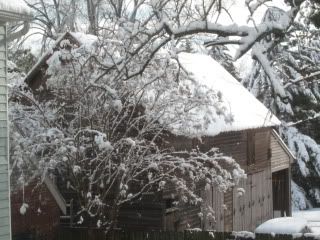
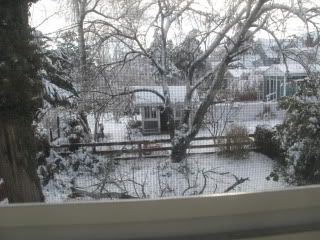
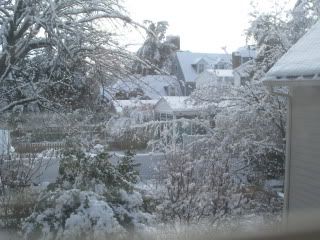
One of the small trees in the back came down, as did some the oldest branches from the giant sycamore. There was thunder and lightning. Over 350,000 have lost power in the region. Though we had a few moments -- computer was already shut down and disconnected, thank goodness -- we are not among them. The street in front of the house looks like a small stream or creek, so much water came with this storm in the form of sleet and rain, as well as the huge, wet flakes. Thus the downed trees and branches, then the power outages, doubtless. That stuff weighs a ton, and some places got 15 inches. It looks as though we received in C'town a measly 4 - 5 inches.
Wednesday, January 26, 2011
Snowy, Sloppy, Slushy = Ice
It's a mess out there, and the variety of all the roads' surfaces are treacherous.
Everything for today, except classes, to which the students by-and-large walk to here, have been canceled, including the Winter's Bone viewing. I'm sorry about that, but a lot of the Ladies would have a long way to drive, and then drive home again, when the temps will have fallen below freezing for several hours by then, so I'm glad.
Classes are going to be cancelled for tomorrow, from what I understand. I'm in the process of cooking up a hearty pea soup that contains left-over ham and left-over pork roast, among other ingredients.
Everything for today, except classes, to which the students by-and-large walk to here, have been canceled, including the Winter's Bone viewing. I'm sorry about that, but a lot of the Ladies would have a long way to drive, and then drive home again, when the temps will have fallen below freezing for several hours by then, so I'm glad.
Classes are going to be cancelled for tomorrow, from what I understand. I'm in the process of cooking up a hearty pea soup that contains left-over ham and left-over pork roast, among other ingredients.
Tuesday, January 25, 2011
A Book! A NOVEL! Not for Research!
I am going to read it, for fun. It's been months since I did that.
It's an historical fiction, naturally -- but finding one of those I can read isn't easy these days, when what is called historical fiction is mostly historical Romance, a genre that I cannot read whether historical or not. Also, whether historical romance or even Historical Fiction, so much is written to formula now there's nothing exciting in the book: poor, unappreciated, lost, orphaned, exiled, enslaved young female -- finds an unusual for anyone and particularly for a young woman profession in which to be trained by sympathetic older person(s), meets one or more interesting young man, men, against a background of a big historical era or event(s), she succeeds becomes married, a wealthy mother running her own business blahblahblah. It's so predictable a/k/a boring. Oh, yes, she also has unexpected attributes of beauty.
Wench (2010) by Dolen Perkins-Valdez doesn't contain any of these blahblahblahs. I devoured the first 60 pp. last night after putting down the study of Benjamin Franklin and his thinking as well as profit-making from slaves and indentured labor, and before putting out the lights. Also it's beautifully written.
What kind of novel Wench is can be seen here.
I've also received the new Heartstone by English author, C.J. Sansom, himself a lawyer, the tale of a lawyer in the later parts of the reign of Henry VIII, and the dissolution of the Roman Church and its properties. This Shardlake series has been among the few new finds of recent years. They are published usually 10 - 12 months earlier in England than here.
It's an historical fiction, naturally -- but finding one of those I can read isn't easy these days, when what is called historical fiction is mostly historical Romance, a genre that I cannot read whether historical or not. Also, whether historical romance or even Historical Fiction, so much is written to formula now there's nothing exciting in the book: poor, unappreciated, lost, orphaned, exiled, enslaved young female -- finds an unusual for anyone and particularly for a young woman profession in which to be trained by sympathetic older person(s), meets one or more interesting young man, men, against a background of a big historical era or event(s), she succeeds becomes married, a wealthy mother running her own business blahblahblah. It's so predictable a/k/a boring. Oh, yes, she also has unexpected attributes of beauty.
Wench (2010) by Dolen Perkins-Valdez doesn't contain any of these blahblahblahs. I devoured the first 60 pp. last night after putting down the study of Benjamin Franklin and his thinking as well as profit-making from slaves and indentured labor, and before putting out the lights. Also it's beautifully written.
What kind of novel Wench is can be seen here.
I've also received the new Heartstone by English author, C.J. Sansom, himself a lawyer, the tale of a lawyer in the later parts of the reign of Henry VIII, and the dissolution of the Roman Church and its properties. This Shardlake series has been among the few new finds of recent years. They are published usually 10 - 12 months earlier in England than here.
Subscribe to:
Posts (Atom)