Literature grad students specializing in the English novel have long given thanks for Stella Gibbons's Cold Comfort Farm (1932) -- and even more so for the BBC 3-part 1995 adaptation, which had a theatrical release in the U.S.
Cold Comfort Farm parodied a genre popular then, sometimes called the 'Loam and Lovechild' novel. Among the writers well-known for their efforts in this sort of specifically located rural life were Mary E. Mann, the Brontës, Mary Webb, D. H. Lawrence, Sheila Kaye-Smith and Thomas Hardy. Some will include the George Eliot of Adam Bede in this earthy school.*
Wuthering Heights doesn't have characters with redeeming features, except perhaps Mr. Earnshaw's own honor, and his compassion for this foundling. This is what fascinated me. Heathcliff's and Catherine's great struggle for dominance -- their so-called romance -- never spellbound me, as it seems to have so many. It was destructive to the players and everyone around them -- and perhaps even to the land, their shared passion for the land, supposedly the foundation of their passion for each other.
It's a very strange book. What's even more strange is how so many readers have persisted in reading it as something it is not. But then, the film versions are what most of them are referencing anyway, which have generally glossed over how severe, cruel, amoral and hard it is. A fitting composition of a woman who refused treatment or assistance while dying in terrible pain for months, a woman who was able to beat her obstinate, fierce dog, Keeper -- not only into submission -- but into absolute loyalty to herself -- when Keeper committed the crime of sleeping on a white counterpaned bed.
What has fascinated me about Wuthering Heights was the Heathcliff tale -- what is not said about him, what is implied through Brontë's word choices, -- and its parallel to Charlotte Brontë's Rochester and his mad wife in the attic, brought back from the Caribbean, in Jane Eyre. Additionally to consider, the Victorian deus ex machina of plot resolutions, the unexpected legacy from a distant relative that Jane Eyre receives comes from an uncle who exported wine to the Caribbean colonies.
This why I've so liked Patricia Rozema's 1999 film version of Jane Austen's Mansfield Park. She too opened up a classic novel to the reality of slave economy of the time that supported so many of England's wealthy men. Rozema did it, it seems to me, in manner plausible to what Austen would know, and Fanny Price would encounter. They just wouldn't talk about it in a drawing room -- unless in the terms of abolitionism, of which there was a strong movement even in those days in England, with many supporters. Fanny Price or Jane Austen wouldn't talk about this in public, not due to a silly kind of modesty, but because the knowledge of slavery was so awful, it wasn't fit for children to know. Knowing what slavery meant about men you lived with, were dependent on -- you could not throw this out to the winds. You would be so horrified and ashamed for them -- and even more so for they would not be ashamed themselves. They would, however, be angry that you knew of their behaviors. They would blame you for possessing the knowledge, be horrified by you, a female who has knowledge of impurity. Yet they, the men who do these things, are not considered either impure or to be shamed -- it is the slaves who are impure and shameful -- like you are, now that you know. Moreover, women are not allowed to judge what men do, because men are set above women in all things. This is all implied with a very few images and screen shots in Rozema's Mansfield Park.
This is something everyone knew about as part of their world, but conventionally couldn't speak of much, or at all -- if they were nice**. But then, the Brontës were widely considered not nice for writing what they wrote. So here's a paradox: these sisters' books, generally criticized at publication as having gone wildly out of polite and womanly bounds in their expression of experience, are now icons of the apotheosis of the ideal Romance -- at least Jane Eyre and Wuthering Heights are. Throwing slavery and the slave trade into the mix of any story is the antithesis of Romance.
But Emily Brontë's novel was anti-romance in another way. Wuthering Heights is a portrait of home life as power struggle, the power struggle conducted via domestic and animal abuse.*** It is the trajectory of the abused becoming the abuser, the now widely recognized signals of abusive personality starkly in evidence: the violence against a child followed by tenderness, and, particularly, the many incidents of hurting animals, especially dogs. Heathcliff hangs a King Charles Spaniel as the last thing he does before taking Isabella Linton off to marry, in order to hurt Catherine who married Isabella's brother Edgar and got pregnant by him. (What happens to Isabella and the child Heathcliff gets on her are not included in the film -- the child himself isn't in the film either.) Later, Hindley Earnshaw's son (Hareton, who is never named in this film of Wuthering Heights -- seemingly only Cathy-Catherine and Heathcliff are large enough to receive frequent, articulated naming in this church-invaded yet godless universe of Yorkshire moors) is seen hanging dogs too. These cruelty to animals scenes have been left out of the previous films based on Wuthering Heights. Arnold's camera lingers, in tight frame, on the dogs' struggles.****
Arnold's Wuthering Heights is the mud and cold of Yorkshire, the shit and piss, the obstinacy, the cruelty, the dumbness of animals and humans, the hardness -- and the pointlessness -- of this rural life. Only the wild creatures are free, can live (that is, if they can evade snares, and surely, in season, the beaters for shooting parties). The beauty to be found here, is found in very small things that are enlarged to fill the entire movie screen, so enlarged they frequently transform into shapelessness, losing all identifying markers: a single feather from a lapwing, a drop of the endless rain hanging from a bud of heather, a leaf falling in the endless chill. Or in the vastness of the endless sky. The blood and feathers and wool of domestic animals on stone of kitchen hearth, in the cold muck of cold barn floor, in the buckets of endless offal fed to the dogs, these are mirrors of the blood spilled in domestic violence, the beatings Hindley gives Heathcliff, wounds layered over old slave whipping scars that Cathy kisses in twisted rapture, the beatings that Heathcliff inflicts upon others, and upon himself.
According to the Wiki entry for Andrea Arnold, she wrote a paper***** when a young school girl about the evils of the slave trade. Presumably, then, this, as well as Liverpool and Yorkshire's attention to the regional slave trade industry in 2007-08 (2007 was the 200th anniversary of England's abolition of the Africa-Atlantic slave trade) prompted her to cast the young and older Heathcliff with actors of color. However, Arnold does nothing with this casting. ****** In contrast Rozema's Mansfield Park used the fact of the West Indian colonies' slave system to open up the enclosure of the Park. She shone some light on the darkness that supported so many Austen lovers's fantasy of English country estate-and-gentry, to further expose the character of some the principals in the story. She did this without invalidating Austen's novel. Arnold did not do this.
What Arnold does with the overt centering of Heathcliff as a black slave is to treat the actor as a slave, i.e. take his body for her / the camera to do with as she / it likes. She frequently exposes his nakedness to our gaze. No other character in this film is seen even partially nude. Yorkshire is a cold climate. Casual nudity isn't natural. So why is Heathcliff frequently seen entirely naked? This is what we do to people of color in film: we make them naked, we make them kill each other, and make them be killed. Showing us Heathcliff's naked back, with the scars of whipping is one thing. But showing him disrobing entirely before getting into bed in conditions that don't even include a fireplace or much in the way of bedclothes, providing full frontal glimpses, camera lingering upon his buttocks, is exploitation. Further -- it is ridiculous -- see cold climate.
If the camera's micro and macro shots are of natural beauty, the middle ground, upon which the human beings are centered, those shots consistently swirl together the erotic gaze with equal parts grossness and the ridiculous. The longest scenes are of Heathcliff suctioning Isabella's mouth, beating himself in rages, and his necrophilic sexual release upon Catherine's corpse. These scenes are portrayed so grossly they make you sick. Heathcliff's obsession is not awe-inspiring, it's disgusting -- and implausible -- the watcher cannot suspend her disbelief.
Nor does the mere fact that a black man is playing these scenes have a significance. Whoever enacted the script as Arnold and her collaborator, Olivia Hetreed, wrote it, would be equally preposterous and gross, as very little is shown of the characters. Most of the characters are not even provided names, though Brontë names everyone, and the first framing narrator, Lockwood, like so many other characters who make the story, is not in the film. To us, the audience, the constant brutality, which all commit upon each other (which is not the case in the novel, particularly between Catherine and her father), seems unprovoked and mysterious.
This is what we see:
It's dark, Mr. Earnshaw brings home a mysterious fellow who is almost full grown, it's dark, Hindley hates him, it's cloudy on the moors, Cathy takes the youth to some rocks, it rains and blows and is dark, Hindley goes away, Cathy and Heathcliff sit on rocks, Mr. Earnshaw dies, it's dark, it's cloudy, Hindely comes back with a wife, it's dark, Hindley beats Heathcliff some more, it rains and blows, Cathy meets Edgar, it's dark (sometime Hindley's wife dies and there's a baby), Catherine announces she's getting married, somebody gets beaten, it's dark, Heathcliff goes away, Heathcliff comes back, it's cloudy (does Hindley die now? or does he just go poof from the film?), Heathcliff runs away with Isabella, it rains and blows (does Heathcliff own Wuthering Heights now or did he own it before?), Heathcliff and Isabella return, it's dark, Catherine dies, Heathcliff beats himself, it rains and blows, Heathcliff goes (even more) mad, it's dark, Heathcliff beats himself, it rains and blows, Heathcliff beats himself, has sex on Catherine's corpse, it rains and blows, (somewhere Heathcliff howls) Heathcliff beats himself, it rains and blows, Heathcliff digs up Catherine's coffin, it rains and blows, mud. The End.
This is less than satisfying to the movie goer. Even if that's Arnold's objective, that we be dissatisfied, we have no idea why she wants us dissatisfied.
She's made a Wuthering Heights that is about the camera. If you allow, the camera divides you from what you are seeing.
The telling element Arnold brought to Wuthering Heights was to tightly frame the brutality embedded in the novel, which perhaps was nurtured by the stark and even bleak beauty of the landscape in Brontë's book. Arnold works transformation of this bleakness into ugliness and grossness. Brontë's transformations were into the formless quietude of the infinite, while still showing a truth of living a life filled work, mud, guts and blood. Arnold left out the deeper context of the novel's universe, despite casting a black man as Heathcliff, despite the rain beaded spider webs and sun shafted cloud giants. She neglected the novel's reconciliation, also a part of the natural world, a coming of peace, to the most non peaceful of personalities.
This why we are grateful there is the witty parody of Cold Comfort Farm to cleanse our palates from this noxious nostrum of a film, that fails to show us the true strangenesses of Emily Brontë's novel, while exposing yet another person of color to an objectifying, exploitative gaze.
--------------------------
* My own critical judgment challenges those who want to include Adam Bede in the Loam and Lovechild tradition. I've finely sifted Eliot's methodist, political reformist movement and science infused text via many re-readings, and do not find the pagan and primitive strands for which some of these novelists, such as Lawrence or the Brontës, are noted. Nor is it a depiction of the desperation of rural poverty that Hardy and Mann have done in some of their works. It shows an honest rural prosperity earned by hard work and common sense.
** Beyond the social conventions of polite discourse, particularly for women, not speaking of 'not-nice' matters -- slaves are not allowed to protest their condition verbally or physically -- further, slaves, like women, are forbidden, in the ideal world of the slave holding economies, to feel sadness or pain from being beaten, sold, losing their families. Forbidding the subject speech, with the associated coercion of violence, are the primary tools of domination. If the subject of abuse cannot speak, then, the surrounding society cannot speak of the abuse either, and thus the abuse -- and the abuser -- is safely protected not only by the legal system that sanctions the violence, but by the even more powerful social system that demands silence and invisibility from those it rules.
*** An excellent analysis (though the author has some of the details of the novel wrong -- Cathy Earnshaw and Heathcliff are not cousins, as she states, for instance -- Heathcliff is a foundling from Liverpool, not a relative of any sort) of the connection of domestic abuse and animal abuse in Wuthering Heights is:
"Emily Brontë and Dogs"
Maureen B. Adams in Society & Animals Journal of Human-Animal Studies; Volume 8, Number 2, 2000
The connection between those who abuse animals and domestic violence was understood by George Eliot too, as we see in Daniel Deronda. Henleigh Mallinger Grandcourt treats his dogs the way he treats his other dependents, including his wife, Gwendolyn Harleth. Unlike his dogs though, his wife does not bond to her abuser, and she escapes. This is a different solution from Catherine and Heathcliff, each determined to make the other a thrall, neither of them succeeding, unless Catherine does, as the first of the two to escape into death from the endless struggle between them. (Why do they struggle for dominance? Why are they obsessed with it? I've never figured it out, and this film doesn't help any.) For that matter, Emily's sister Anne, finds escape from a violent, drunken husband the right solution for her primary character in The Tenant of Wildfell Hall. Animals also play important roles in Anne Brontë's novel, as they do in her sister's, including precepitating her protagonist's escape, when she sees her son abusing birds, at his drunken father's instigation.
**** This audience member wondered how these scenes were staged to protect the dogs from physical and mental anguish. I stayed until the house lights went up. "No animals were hurt or harmed during the course of filming," was not included in the credit crawl.
***** At first it seemed Arnold would do something to open further the tale by presenting Heathcliff s as an escaped, lost or freed slave in Liverpool. The old house of Wuthering Heights creaks in the wuthering of the wind. The roar is like the constant roar surrounding the slaves of the Middle Passage, chained below water level, as heard in the video simulation in the International Slave Museum. It's an awful video; nothing is spared, from the vomit of sea sickness, the galls from the shackles, the slop provided to eat once a day, the roiling feces and urine. But that's the last thing in the film that might be brought in by the virtue of casting a black actor as Heathcliff. That, and the whipping scars on his back, are all there is -- and the exploitive, objectifying gaze at his nakedness.
****** During my undergrad years the prof of a history of the novel course set us to do a 'creative' project for our final class project instead of yet another paper. I created Isabella's diary of her time with Heathcliff, which included how she learned he'd made his fortune when away from Wuthering Heights and the moors via the slave trade -- which was vigorously pursued during the presumed timeline of the novel, which reaches from 1757 to 1803, when Cathy, Catherine's daughter, makes plans to marry her cousin, Hareton, Hindley's son. (The genealogy of Wuthering Heights's three generations is as hard to grasp as anything else about the book, at least for me.)
Saturday, October 6, 2012

Friday, October 5, 2012
Liverpool's International Museum of Slavery and Andrea Arnold‘s film of *Wuthering Heights*
Looking into the New York Times Wednesday morning, the first day after getting back from England and our visit to Liverpool's International Museum of Slavery on Monday* -- imagine the thrill I felt reading that Andrea Arnold's 'black' Wuthering Heights was finally opening here. Mr. Earnshaw finds Heathcliff in the gutters of Liverpool, from where he brings the child to his Yorkshire family farm on the moors. I've been anxious to see this film ever since first reading about in the English papers last year.
Andrew O'Hehir says Arnold's Wuthering Heights is his film Pick of the Week; he makes his case for his judgement with passion. The reviews in the NYC papers have been favorable. But Michael Atkinson in the Village Voice, who may well know his film history, doesn't know the history of the African diaspora or slavery. He blithely declares:
Atkinson doesn't comprehend that enslaved Africans and free people of color existed in ports all over the world, side-by-side, even in countries like England, that didn't have a domestic slave trade, but allowed slavery. It wasn't until 1772 and the Somerset (Mansfield) Decision that domestic slavery in England was overturned (This, incidentally frightened the American colonial slaver owners all way to the bottom of their pockets -- and their account books -- that the Decision paved the way for Abolitionists to have their way throughout the colonies; this fear was another reason the southern power elite spent so much energy creating the propaganda agitation for political independence from England.)
As well, everywhere ships and the sea provided many jobs for men of color, whether slave or free. Among other sources for this, particularly in Liverpool, Marcus Rediker's The Slave Ship: A Human History, provides extensive, tragic documentation.
Andrea Arnold's Wuthering Heights opens here in NYC today, at the Film Forum, which is just a few blocks away from here. I'll be there.
------------------------
* Among other exciting information gleaned even from this truncated visit to the museum is that several Liverpool slave traders -- all very powerful, very wealthy and very respected citizens of the city -- traded in slaves directly with slave owners in Maryland and Virginia throughout the 18th century, until the War for Independence.
Andrew O'Hehir says Arnold's Wuthering Heights is his film Pick of the Week; he makes his case for his judgement with passion. The reviews in the NYC papers have been favorable. But Michael Atkinson in the Village Voice, who may well know his film history, doesn't know the history of the African diaspora or slavery. He blithely declares:
In the 1770s, when the story is set, a black child was rare, even in Liverpool, the African chattel of the busy Brit-run slave trade going almost exclusively to British, Spanish, French, and Portuguese colonies in the Americas.Atkinson is wrong. See this, from the Liverpool International Slavery Museum site:
Of the little research into the Black presence in Britain during the slave trade period most has focused solely on London, yet Liverpool had a considerable Black population during the 18th and 19th centuries, many of whom were slaves. Although there seems to be no evidence of large scale slave auctions taking place here, slaves can be found advertised for sale in the early Liverpool newspapers. Merchants would also place 'WANTED' advertisements in the press, demonstrating their eagerness to purchase an African servant.
As well as slave sales, there were also advertisements for runaways, showing that Black people did not accept their enslavement in Britain passively. The newspapers also show the reality of life for Black people in Britain's most important slave trading port after the lauded Mansfield Decision of 1772. The last slave sale advertised in a Liverpool newspaper took place in 1779, seven years after Mansfield had ruled in the case of James Somersett.
Church records of the time also give us a great insight into the African presence in the town and show many Black people being baptised and buried in Liverpool churchyards. From these records and others, we know there were many free Black people living in Liverpool during the latter part of the 18th century, including students and craftsmen, as well as soldiers and sailors who fought with honour during the American War of Independence and the Napoleonic Wars.
Atkinson doesn't comprehend that enslaved Africans and free people of color existed in ports all over the world, side-by-side, even in countries like England, that didn't have a domestic slave trade, but allowed slavery. It wasn't until 1772 and the Somerset (Mansfield) Decision that domestic slavery in England was overturned (This, incidentally frightened the American colonial slaver owners all way to the bottom of their pockets -- and their account books -- that the Decision paved the way for Abolitionists to have their way throughout the colonies; this fear was another reason the southern power elite spent so much energy creating the propaganda agitation for political independence from England.)
As well, everywhere ships and the sea provided many jobs for men of color, whether slave or free. Among other sources for this, particularly in Liverpool, Marcus Rediker's The Slave Ship: A Human History, provides extensive, tragic documentation.
Andrea Arnold's Wuthering Heights opens here in NYC today, at the Film Forum, which is just a few blocks away from here. I'll be there.
------------------------
* Among other exciting information gleaned even from this truncated visit to the museum is that several Liverpool slave traders -- all very powerful, very wealthy and very respected citizens of the city -- traded in slaves directly with slave owners in Maryland and Virginia throughout the 18th century, until the War for Independence.
It's A Bonded Classic: Adele sings *Skyfall*
I love this, -- it is perfectly Bond musical bombast, as a Bond movie theme is to be.
You can hear it here, if you scroll down the article.
Or here:
You can hear it here, if you scroll down the article.
Or here:
Wednesday, October 3, 2012

Time and the River, Time and the Builder
When I originally wrote this, it was 8:46 PM NYC time:
It's going on for 2 AM in London. We'd been awake since 8 AM London time. We were in the air for over 7 hours. Then forever to get off the plane, another forever to get baggage, more forever to get a taxi and then the other forever of getting back to home.
Then unpacking like mad people. El V's made pasta, but I'm not eating any. I can't face the idea of eating. I got cleared to start putting life back together today, and getting ready for New Orleans. After that particular NO visit, el V will be going back-and-forth between Haiti and New Orleans for a bit.
It's hard to comprehend that at this time last night (well, sort of, as time is different there -- see, time = cat) we were getting on the train to leave Liverpool. Where I saw a guy about 25 years old take out from its packaging his souvenir Beatles tea towel and ... kiss it. Like a priest would kiss his surplice before mass. I am not making this up. Ourselves, we had gone to Liverpool to visit the Museum of the International Slave Trade – the African slave trade, from which an enormous amount of Liverpool’s wealth was built – which I could even rattle off in my sleep then helped down the line to create the Beatles.
Now it is 8:46 AM NYC time, and Iblither responded to an Egyptologist friend's question about the condition of the sphinxes along the Thames:
I saw some of the Thames sphinxes, N. The ones I saw, fairly close to Trafalgar Bridge, appeared smooth and sleek. London's public spaces and what is in them. received some serious spiffing in preparation for the Jubilee and the Olympics.
So your eyes are just wandering about, darting about -- and there are -- sphinxes!
Perhaps that is what provides London its underlying charm: it's a whimsical city? Even some of the contemporary architecture makes you smile. There's a brand new Hilton, designed to provoke thoughts of Tudor era country manors -- you know, with all that criss-crossing pattern timber pattern and gables piled on? Except, it's a skyscraper made from those currently so popular reflecting materials. However, there are 'gables,' higgly piggly, and you smile with surprised delight -- at least both el V and I did, and think. "Howl's Moving Castle," from the animated film.
There's so much, from so many eras, whether so intentioned back in the day, that provides a sense of lightness and fun to the contemporary viewer.
In bleak contrast, there are those gapes, from the Blitz bombing, filled with impoverished post-war practical, dark, clunky square ugliness. Which allows even those whose grandparents weren't born then, to remember and grieve England's terrible losses and terrible prices paid. Yes, not everywhere is all history the past and done with*.
This is particularily so of places that have BBC, some might say .... All week, I think it was on BBC 2, ran an endless documentary - recreation series -- British agriculture during the War.
--------------
* These are the places, the cities, that I fall in love with -- or like New Orleans, in love and hate with.
It's going on for 2 AM in London. We'd been awake since 8 AM London time. We were in the air for over 7 hours. Then forever to get off the plane, another forever to get baggage, more forever to get a taxi and then the other forever of getting back to home.
Then unpacking like mad people. El V's made pasta, but I'm not eating any. I can't face the idea of eating. I got cleared to start putting life back together today, and getting ready for New Orleans. After that particular NO visit, el V will be going back-and-forth between Haiti and New Orleans for a bit.
It's hard to comprehend that at this time last night (well, sort of, as time is different there -- see, time = cat) we were getting on the train to leave Liverpool. Where I saw a guy about 25 years old take out from its packaging his souvenir Beatles tea towel and ... kiss it. Like a priest would kiss his surplice before mass. I am not making this up. Ourselves, we had gone to Liverpool to visit the Museum of the International Slave Trade – the African slave trade, from which an enormous amount of Liverpool’s wealth was built – which I could even rattle off in my sleep then helped down the line to create the Beatles.
Now it is 8:46 AM NYC time, and I
I saw some of the Thames sphinxes, N. The ones I saw, fairly close to Trafalgar Bridge, appeared smooth and sleek. London's public spaces and what is in them. received some serious spiffing in preparation for the Jubilee and the Olympics.
So your eyes are just wandering about, darting about -- and there are -- sphinxes!
Perhaps that is what provides London its underlying charm: it's a whimsical city? Even some of the contemporary architecture makes you smile. There's a brand new Hilton, designed to provoke thoughts of Tudor era country manors -- you know, with all that criss-crossing pattern timber pattern and gables piled on? Except, it's a skyscraper made from those currently so popular reflecting materials. However, there are 'gables,' higgly piggly, and you smile with surprised delight -- at least both el V and I did, and think. "Howl's Moving Castle," from the animated film.
There's so much, from so many eras, whether so intentioned back in the day, that provides a sense of lightness and fun to the contemporary viewer.
In bleak contrast, there are those gapes, from the Blitz bombing, filled with impoverished post-war practical, dark, clunky square ugliness. Which allows even those whose grandparents weren't born then, to remember and grieve England's terrible losses and terrible prices paid. Yes, not everywhere is all history the past and done with*.
This is particularily so of places that have BBC, some might say .... All week, I think it was on BBC 2, ran an endless documentary - recreation series -- British agriculture during the War.
--------------
* These are the places, the cities, that I fall in love with -- or like New Orleans, in love and hate with.
Tuesday, October 2, 2012
Horse As Motif
Elgin Marbles ...
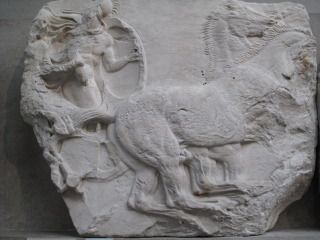
"Considered the finest of the frieze sections depicting horses -- there are four here, not that you can tell from a photograph of this nature, posted on this site, unworked in photoshop:
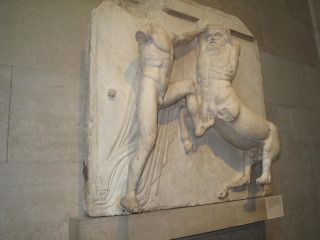
Energy in motion and three dimensions -- the centaur wins:
Horses everywhere in London and England as images and the living animal.
"Considered the finest of the frieze sections depicting horses -- there are four here, not that you can tell from a photograph of this nature, posted on this site, unworked in photoshop:
Energy in motion and three dimensions -- the centaur wins:
Horses everywhere in London and England as images and the living animal.
Monday, October 1, 2012
Heart of Darkness
Liverpool after all, not Bristol, for our last day here.
Appropriately it's foggy, cold and rainy for this trip into the heart of darkness, i.e. the English slave trade.
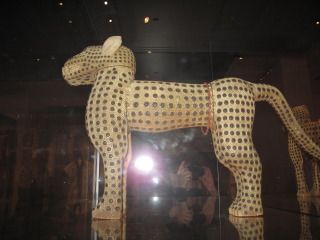

The Yoruba Leopard case in the Africa galleries of the British Museum.
Appropriately it's foggy, cold and rainy for this trip into the heart of darkness, i.e. the English slave trade.
Subscribe to:
Posts (Atom)