Over the last 8 - 10 weeks my disquiet at the thought of Hillary being the dem candidate and / or getting into the oval office has continued to grow and to sprout ever more ramifications as to why this would be another disaster for our country. We're already up against the ropes from the succession of 8 years of the regime's deliberately disasterous policies, part of which has been to spend the national government out of existence financially, and to create distrust of every federal agency and institution by deliberately turning them into centers of incompetence, and often as well, cesspools of corruption and politicalization. (Ya really didn't believe 'they' were that stupid, didja? Smart enough to steal elections and take out any candidate of their choosing? No, the destruction of centralized federal government is 'their' objective, and 'they've' reached a lot of 'their' goals -- if only by appointing who 'they've' appointed to judgships and pillaging the treasury, the greatest transfer of wealth into the fewest hands the world maybe has ever seen.)
My disquiet began with no longer trusting or believing in Hillary, based on her lies concerning serving in the U.S. senate, and her pandering to the regime over Iraq, as well as her early debacle with health care, and her deep connections to the health insurance companies, her cronyism with Murdoch and other corporatist power brokers, and her long-known secrecy. Transparency is not Hillary. She'll no more make our government answerable to public scrutiny than the regime has.
Now my disquiet includes Bill. He royally screwed us all over while in the Oval Office. He'll do it again, when it's supposed to be Hillary in that Oval Office. The 2 of them will also be fighting over who has the real power. Bill still doesn't control himself sexually, by all accounts. His heart surgery didn't change his life-time behaviors, except in diet. It will be another politically paralyzed presidency, paralyzed by Bill. His rhetorical outbursts in the last 2 weeks on the primary and caucus trails have reminded us all what he is. It will be another politically paralyzed presidency, paralyzed by Hillary, as she tries to stay out of Bill's shadow, and he walks in front of the vice president, creating yet more disunion in the nation.
Bob Herbert had a piece today in the NY Times op-ed page that applies to this, "Questions for the Clintons".
Gary Wills has another, that says everything I've been thinking, "Two Presidents Are Worse Than One."
While The WaPo Magazine has this rather sad article on Edwards, who clearly people admire and respect and maybe even trust, so why don't more people vote for him? I admire him more and more, and believe, considering the break down of who voted for whom in today's SC primary, he's the one of the three who is actually electable, and who also can really pull this country together.
Obama won SC yesterday. Black women evidently are right turned off by the Billary deal. Can you blame them, with all that barely concealed rhetoric that African Americans have heard the entire history of the U.S., that "boy, you just aren't ready yet." Not to mention the disgusting, repellant remarks on the level of "Bill Clinton's had more black women than Obama." Using black women as the bridge in a childish weenie-wave contest between two men is the most dispicable thing they've done yet. As Hillary's well-known for being in control of everything around her, and of Bill too, and even announced by her campaign as an endorsement for abilities as an administrator, can you believe for a second that she was unaware of this as a short-term strategy? How much more of their bad judgment and lack of self-control can this nation endure?
If Obama's not ready now then, when? Obama is NOT my favorite by a very long shot. But he, at least, won't be paralyzed by scandals, if he goes into the White House. And I tell ya, we are all sick to death of those 3 voices out of the last 16 years: the shrubbery AND the billary. I want to hear different tones, different timbres, new language. My ears cringe at the sound of the voices of all three -- shrub and billary.
Frank Rich has weighed in today on this as well.Go here for "The Billary Road to Republican Victory.
It's rather heartening, than otherwise, to see so many of the dem-leaning chattering class leaning toward this point of view today.Here's another, Glenn Greenwald, who has always been more of a billary supporter than not. Bill Clinton: The Chris Matthews of South CarolinaThat so many of this very loosely labeled 'us' are rejecting strongly this trashy behavior of the billary machine to make this suddenly about 'race' rather than character and all the other legitimate issues that lead to choice, speaks well of this 'us.'Or -- maybe, merely our self-interested terror of what the billary machine's ultimate consequences will be: another 8 years of 'them.'
Sunday, January 27, 2008

Saturday, January 26, 2008
2 New Books of Interest (at least mine!)
The number of meticulously researched and sourced histories of the U.S. post-Civil War era commonly called "Reconstruction" continues to add titles. This is the latest one of which I'm aware. I've seen reviews of it in other places, but this week it's covered by one of my favorite writers about book, Jonathan Yardly, in this weekend's Washington Post Book World section, THE BLOODY SHIRT: Terror After Appomattox by Stephen Budiansky. Here follows a pull, the first 2 paragraphs of JY's essay:
[ The decade-long period known as Reconstruction, which began shortly after the Civil War and ended with the presidential election of 1876, probably has been subjected to more misinterpretation, misunderstanding and outright factual distortion than any other time in American history. For a variety of reasons, including white Southern mythologizing and national indifference to the desperate situation of the former slaves, beginning in the late 19th century fictions about Reconstruction gained not merely wide popular acceptance but also the endorsement of many prominent historians, who gave them legitimacy and staying power.
These fictions presented the white South not as instigator, perpetuator and defender of black slavery, but as the victim of politically motivated mistreatment by "carpetbaggers" and other outsiders dispatched by Radical Republicans in Washington to wreak vengeance on the South. By contrast with the rapacious industrial North, the South was portrayed as -- in the words of one historian -- "a garden for the cultivation of all that was grand in oratory, true in science, sublime and beautiful in poetry and sentiment, and enlightened and profound in law and statesmanship." Slavery metamorphosed from a "peculiar" institution into a benevolent one, and it was argued that only the South could hope to help the former slaves because "the Southern white man is the only man on earth who understands the Negro character." If only the North had left the South to settle its own problem, the fictions contended, everything would have been fine. If Reconstruction failed, the fault lay solely with the North. ]
In other words, the phony mythology that made Griffith's Birth of a Nation, and brought back the Ku Klux Klan, the foundation of decades of the movie industry's propaganda machine re the "Western," which was from the beginning of the cinema age in the U.S. the financial and popular mainstay of studios, and remained so until comfortably post the WWII era. I continue to marvel at the success of the historical revision of the Reconstruction era -- as well as of the Civil War. The principal reason for the success of this revisionism is the development of the penny press Western, followed so soon by the movies. From the beginning the pioneers of this format saw it as an unparalleled means of propaganda, and so it was, and continues to be. The principals of Western movies, even the occasional few made now, were enlisted in the Confederacy.
This is particularly ironic when examined by the light shed by the founding father of the Western as a genre (as he also founded the genre of sea stories and that of the Revolutionary romance), James Fenimore Cooper, in "The Leatherstocking Tales."
Then, to go with my reading of the Keay The Honorable Company: A History of the English East India Company, pub date 1993 -- and which, despite a plethora of fascinating personalities and lots of really great adventure tales, I'm finding very hard going, and, in fact, rather dull -- and the reading of of a history of New Amsterdam, The Island at the Center of the World, comes this, reviewed by another terrific WaPo writer about books, Michael Dirda, Vermeers's Hat: The Seventeenth Century and the Dawn of the Global World by Timothy Brook.
[ . . . There doesn't seem to be any obvious reason why such a formidable Sinologist should be bringing out a book with a 17th-century Dutch painting on the cover and the title Vermeer's Hat.
But the explanation turns out to be quite simple: This book isn't about Vermeer's brushstrokes or the use of light in his paintings. Instead, it really does focus on the fur hats -- and the old maps and the dishes of fruit and the silver coins -- pictured in those paintings. As his subtitle suggests, Brook hopes to use these pictorial elements to describe "the dawn of the global world," in particular the economic entanglements between the Netherlands and China. . . .
. . . . For instance, in the chapter titled "School for Smoking," he notices that 17th-century Dutch porcelain, representing Chinese scenes, often shows people smoking. Where did the painter get the idea that the Chinese smoked? This leads to an overview of tobacco commerce and consumption in Asia, building on accounts of the shipping routes, the trade laws and the movement of silver, as well as tobacco, to the East. But Brook also takes time to discuss the social impact of chi yan or "eating smoke."
Such interlacing of the economic with the social and ideological Brook labels "transculturation," a term first coined by the Cuban historian Fernando Ortiz to describe "the process by which habits and things move from one culture to another so thoroughly that they become part of it and in turn change the culture into which they have moved." Sometimes this results in the destruction of what is already there, and usually "the outcomes of these globalizing processes cannot be controlled." ....
. . .Throughout Vermeer's Hat, Brook keeps his economic history striking and anecdotal. "If there is one overwhelming condition that shaped the history of the seventeenth century more than any other, it is global cooling." Between 1550 and 1700, according to the book, temperatures fell all over the world. Grain prices rose; cold and plague decimated Venice and Amsterdam. But Dutch fleets enjoyed a herring boom, giving them money to invest in shipping. Why did Champlain push into unexplored Canada? For beaver pelts. And why did Europeans want those pelts? For expensive, durable hats. Profits from those hats would pay for something important: the search for the supposed water route across North America to China. ...
. . . . Commercially, the 17th century was an age of silver, tobacco and slaves, and Brook shows how the three interconnect to form an intricate economic network. This new international economy is revealed in every aspect of life, not only in the account books of the VOC and the histories of the Jesuit missionaries in China and Latin America, but also in the items depicted in paintings by a Delft artist who died young. All our experience is global. ]
Thus this book appears filled with answers to questions I never asked, such as the Chinese tobacco one, despite life-long acquaintance with quaint illos of sedate Chinese bearded sages with pipes in hand, if not in mouth -- even as described in the pages of Louisa May Alcott's Eight Cousins, in a scene at the Boston wharfs, in a warehouse that is part of her wealthy, merchant ship owning family's fortunes.
[ The decade-long period known as Reconstruction, which began shortly after the Civil War and ended with the presidential election of 1876, probably has been subjected to more misinterpretation, misunderstanding and outright factual distortion than any other time in American history. For a variety of reasons, including white Southern mythologizing and national indifference to the desperate situation of the former slaves, beginning in the late 19th century fictions about Reconstruction gained not merely wide popular acceptance but also the endorsement of many prominent historians, who gave them legitimacy and staying power.
These fictions presented the white South not as instigator, perpetuator and defender of black slavery, but as the victim of politically motivated mistreatment by "carpetbaggers" and other outsiders dispatched by Radical Republicans in Washington to wreak vengeance on the South. By contrast with the rapacious industrial North, the South was portrayed as -- in the words of one historian -- "a garden for the cultivation of all that was grand in oratory, true in science, sublime and beautiful in poetry and sentiment, and enlightened and profound in law and statesmanship." Slavery metamorphosed from a "peculiar" institution into a benevolent one, and it was argued that only the South could hope to help the former slaves because "the Southern white man is the only man on earth who understands the Negro character." If only the North had left the South to settle its own problem, the fictions contended, everything would have been fine. If Reconstruction failed, the fault lay solely with the North. ]
In other words, the phony mythology that made Griffith's Birth of a Nation, and brought back the Ku Klux Klan, the foundation of decades of the movie industry's propaganda machine re the "Western," which was from the beginning of the cinema age in the U.S. the financial and popular mainstay of studios, and remained so until comfortably post the WWII era. I continue to marvel at the success of the historical revision of the Reconstruction era -- as well as of the Civil War. The principal reason for the success of this revisionism is the development of the penny press Western, followed so soon by the movies. From the beginning the pioneers of this format saw it as an unparalleled means of propaganda, and so it was, and continues to be. The principals of Western movies, even the occasional few made now, were enlisted in the Confederacy.
This is particularly ironic when examined by the light shed by the founding father of the Western as a genre (as he also founded the genre of sea stories and that of the Revolutionary romance), James Fenimore Cooper, in "The Leatherstocking Tales."
Then, to go with my reading of the Keay The Honorable Company: A History of the English East India Company, pub date 1993 -- and which, despite a plethora of fascinating personalities and lots of really great adventure tales, I'm finding very hard going, and, in fact, rather dull -- and the reading of of a history of New Amsterdam, The Island at the Center of the World, comes this, reviewed by another terrific WaPo writer about books, Michael Dirda, Vermeers's Hat: The Seventeenth Century and the Dawn of the Global World by Timothy Brook.
[ . . . There doesn't seem to be any obvious reason why such a formidable Sinologist should be bringing out a book with a 17th-century Dutch painting on the cover and the title Vermeer's Hat.
But the explanation turns out to be quite simple: This book isn't about Vermeer's brushstrokes or the use of light in his paintings. Instead, it really does focus on the fur hats -- and the old maps and the dishes of fruit and the silver coins -- pictured in those paintings. As his subtitle suggests, Brook hopes to use these pictorial elements to describe "the dawn of the global world," in particular the economic entanglements between the Netherlands and China. . . .
. . . . For instance, in the chapter titled "School for Smoking," he notices that 17th-century Dutch porcelain, representing Chinese scenes, often shows people smoking. Where did the painter get the idea that the Chinese smoked? This leads to an overview of tobacco commerce and consumption in Asia, building on accounts of the shipping routes, the trade laws and the movement of silver, as well as tobacco, to the East. But Brook also takes time to discuss the social impact of chi yan or "eating smoke."
Such interlacing of the economic with the social and ideological Brook labels "transculturation," a term first coined by the Cuban historian Fernando Ortiz to describe "the process by which habits and things move from one culture to another so thoroughly that they become part of it and in turn change the culture into which they have moved." Sometimes this results in the destruction of what is already there, and usually "the outcomes of these globalizing processes cannot be controlled." ....
. . .Throughout Vermeer's Hat, Brook keeps his economic history striking and anecdotal. "If there is one overwhelming condition that shaped the history of the seventeenth century more than any other, it is global cooling." Between 1550 and 1700, according to the book, temperatures fell all over the world. Grain prices rose; cold and plague decimated Venice and Amsterdam. But Dutch fleets enjoyed a herring boom, giving them money to invest in shipping. Why did Champlain push into unexplored Canada? For beaver pelts. And why did Europeans want those pelts? For expensive, durable hats. Profits from those hats would pay for something important: the search for the supposed water route across North America to China. ...
. . . . Commercially, the 17th century was an age of silver, tobacco and slaves, and Brook shows how the three interconnect to form an intricate economic network. This new international economy is revealed in every aspect of life, not only in the account books of the VOC and the histories of the Jesuit missionaries in China and Latin America, but also in the items depicted in paintings by a Delft artist who died young. All our experience is global. ]
Thus this book appears filled with answers to questions I never asked, such as the Chinese tobacco one, despite life-long acquaintance with quaint illos of sedate Chinese bearded sages with pipes in hand, if not in mouth -- even as described in the pages of Louisa May Alcott's Eight Cousins, in a scene at the Boston wharfs, in a warehouse that is part of her wealthy, merchant ship owning family's fortunes.
Friday, January 25, 2008
Sunday, January 20, 2008
"A Cutting Tradition"
The Sunday NY Times Magazine has another article today on FGM, this time in Indonesia, where females who have been subjected to FGM are [ " . . . a quiet majority in Indonesia, where, according to a 2003 study by the Population Council, an international research group, 96 percent of families surveyed reported that their daughters had undergone some form of circumcision by the time they reached 14." ]
The procedures are performed everywhere, including the schools. The reasons for it?
[ According to Lukman Hakim, the foundation’s chairman of social services, there are three “benefits” to circumcising girls.
“One, it will stabilize her libido,” he said through an interpreter. “Two, it will make a woman look more beautiful in the eyes of her husband. And three, it will balance her psychology.” ]
Can anyone enlighten me as to just wtf "it will balance her psychology” means?
[ Female circumcision in Indonesia is reported to be less extreme than the kind practiced in other parts of the globe — Africa, particularly. Worldwide, female genital cutting affects up to 140 million women and girls in varying degrees of severity, according to estimates from the World Health Organization. The most common form of female genital cutting, representing about 80 percent of cases around the world, includes the excision of the clitoris and the labia minora. A more extreme version of the practice, known as Pharaonic circumcision or infibulation, accounts for 15 percent of cases globally and involves the removal of all external genitalia and a stitching up of the vaginal opening. ]
The procedures are performed everywhere, including the schools. The reasons for it?
[ According to Lukman Hakim, the foundation’s chairman of social services, there are three “benefits” to circumcising girls.
“One, it will stabilize her libido,” he said through an interpreter. “Two, it will make a woman look more beautiful in the eyes of her husband. And three, it will balance her psychology.” ]
Can anyone enlighten me as to just wtf "it will balance her psychology” means?
[ Female circumcision in Indonesia is reported to be less extreme than the kind practiced in other parts of the globe — Africa, particularly. Worldwide, female genital cutting affects up to 140 million women and girls in varying degrees of severity, according to estimates from the World Health Organization. The most common form of female genital cutting, representing about 80 percent of cases around the world, includes the excision of the clitoris and the labia minora. A more extreme version of the practice, known as Pharaonic circumcision or infibulation, accounts for 15 percent of cases globally and involves the removal of all external genitalia and a stitching up of the vaginal opening. ]
Saturday, January 19, 2008
El Mundo de Gabriel García Márquez
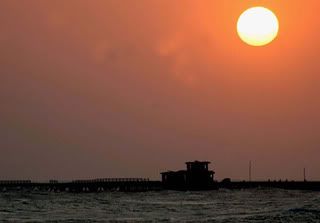
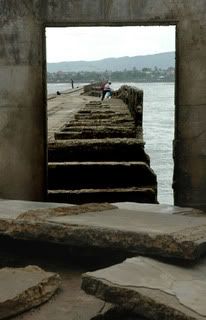

A freighter on its side, abandoned in the mud. The difference between what Joseph Conrad would make of that, vs. how Gabriel García Márquez would treat it.
The freighter was finally dug out and hauled away a couple of years ago.
Friday, January 18, 2008
Barranquilla, Colombia
An article about Vaquero here, reporting from the Arts Festival that has brought Caribbeanists and Latin American arts people from all over the Spanish-speaking hemisphere. It's running along with the city's Carnaval.
Ladies of the city arriving at the hotel to celebrate their Carnaval costumes.


Ladies of the city arriving at the hotel to celebrate their Carnaval costumes.
Tuesday, January 15, 2008
Crawling Back Up The Stairs
I posted this originally as a comment in response to another comment to an entry down below, but it seems worth an entry itself.
Have you ever read great Polish journalist, Rhyzard Kapuscinski's Shah of Shahs (1982), available in this country from Vintage - Random House, his account of how the Iranian shah came to power, and the unspeakably evil police state of surveillance, informants, arrest, disappearance and torture, corruption and extortion and terror instituted by his father, first, and elaborated on by himself -- with all the propping and assistance of the U.S. and the CIA that you can imagine? While, what Iran was, under these two men's control, and who were only there because the U.S. kept them there, has been conveniently relegated to media amnesia, whereas the Cuba political and economic New World ragamuffin island, gets dragged up over and over and over as a great state of evil. This is extremely ironic, as Fidel is the only despot in modern history, at least, who has managed to wield his despot power so wisely as to keep the majority of his people satisfied with him enough that they've never reaching an angry tipping point to change that. (Kapuscinski includes a most wise analysis and blow-by-blow description of just how these points can be reached and what will happen; he must have learned a lot, by living in a soviet block state.)
In the chapter titled, "The Dead Flame," our narrator / observer / reporter write thusly about rulers and politicans:
[ The most difficult thing to do while living in a palace is to imagine a different life -- for instance, you own life but outside of and minus the palace. Toward the end the rule finds people willing to help him out. Many lives regrettably, can be lost at such moments. The problem of honor in politics. Take de Gaulle -- a man of honor. He lost a referendum, tidied up his desk, and left the palace, never to return. He wanted to govern only under the condition that the majority accept him. The moment the majority refused him their trust, he left. But how many are like him? The others will cry, but they won't move; they'll torment the nation, but they won't budge, Thrown out one door, they sneak in through another; kicked down the stairs, they begin to crawl back up. They will excuse themselves, bow and scrape, lie and simper, provided they can stay -- or provided they can return. They will hold out their hands -- Look, no blood on them. But the very fact of having to show those hands covers them with the deepest shame. They will turn their pockets inside out -- Look, there's not much there. But the very fact of exposing their pockets -- how humiliating! The Shah, when he left the Palace, was crying. At the airport he was crying again. Later he explained in interviews how much money he had, and the it was less than people thought. (pp.119-20) ]
This is why people are able these days admire Jimmy Carter and Al Gore, while despising both Clintons -- though they may not quite realize it as clearly as Kapuscinski explained it in Shah of Shahs. The Clintons are expending every bit of their own energies and those of everyone else they can draw in, to crawl back up those stairs, to get back inside the palace. The shrubbery has never been OUTSIDE the palace in his life, nor has any of his family for several generations. Which is why so many of just can't bear to have a Clinton back in the OO -- so many years of the palace belonging to only 2 families. We need someone else, desperately. Additionally, Nixon's Watergate break-in was about clinging with bloody nail to his palace, and it did him in, vs. old Joe Kennedy's committing a criminal act to insert his family into the White House (vote fraud in Chicago), and of course, the Florida and Ohio voter fraud of more recent times. Think of ol' 'Wide Stance,' the Minneapolis airport john -- who was going to resign and then just could not get himself to do so. Plus, recall -- their helpers, as Kapuscinski so carefully includes in his description of these palace folk.
Have there been more true words written about rulers and politicians ever?
Have you ever read great Polish journalist, Rhyzard Kapuscinski's Shah of Shahs (1982), available in this country from Vintage - Random House, his account of how the Iranian shah came to power, and the unspeakably evil police state of surveillance, informants, arrest, disappearance and torture, corruption and extortion and terror instituted by his father, first, and elaborated on by himself -- with all the propping and assistance of the U.S. and the CIA that you can imagine? While, what Iran was, under these two men's control, and who were only there because the U.S. kept them there, has been conveniently relegated to media amnesia, whereas the Cuba political and economic New World ragamuffin island, gets dragged up over and over and over as a great state of evil. This is extremely ironic, as Fidel is the only despot in modern history, at least, who has managed to wield his despot power so wisely as to keep the majority of his people satisfied with him enough that they've never reaching an angry tipping point to change that. (Kapuscinski includes a most wise analysis and blow-by-blow description of just how these points can be reached and what will happen; he must have learned a lot, by living in a soviet block state.)
In the chapter titled, "The Dead Flame," our narrator / observer / reporter write thusly about rulers and politicans:
[ The most difficult thing to do while living in a palace is to imagine a different life -- for instance, you own life but outside of and minus the palace. Toward the end the rule finds people willing to help him out. Many lives regrettably, can be lost at such moments. The problem of honor in politics. Take de Gaulle -- a man of honor. He lost a referendum, tidied up his desk, and left the palace, never to return. He wanted to govern only under the condition that the majority accept him. The moment the majority refused him their trust, he left. But how many are like him? The others will cry, but they won't move; they'll torment the nation, but they won't budge, Thrown out one door, they sneak in through another; kicked down the stairs, they begin to crawl back up. They will excuse themselves, bow and scrape, lie and simper, provided they can stay -- or provided they can return. They will hold out their hands -- Look, no blood on them. But the very fact of having to show those hands covers them with the deepest shame. They will turn their pockets inside out -- Look, there's not much there. But the very fact of exposing their pockets -- how humiliating! The Shah, when he left the Palace, was crying. At the airport he was crying again. Later he explained in interviews how much money he had, and the it was less than people thought. (pp.119-20) ]
This is why people are able these days admire Jimmy Carter and Al Gore, while despising both Clintons -- though they may not quite realize it as clearly as Kapuscinski explained it in Shah of Shahs. The Clintons are expending every bit of their own energies and those of everyone else they can draw in, to crawl back up those stairs, to get back inside the palace. The shrubbery has never been OUTSIDE the palace in his life, nor has any of his family for several generations. Which is why so many of just can't bear to have a Clinton back in the OO -- so many years of the palace belonging to only 2 families. We need someone else, desperately. Additionally, Nixon's Watergate break-in was about clinging with bloody nail to his palace, and it did him in, vs. old Joe Kennedy's committing a criminal act to insert his family into the White House (vote fraud in Chicago), and of course, the Florida and Ohio voter fraud of more recent times. Think of ol' 'Wide Stance,' the Minneapolis airport john -- who was going to resign and then just could not get himself to do so. Plus, recall -- their helpers, as Kapuscinski so carefully includes in his description of these palace folk.
Have there been more true words written about rulers and politicians ever?
Subscribe to:
Posts (Atom)