I've been able to catch up with the Vikings episodes I missed while away. "Unforgiven" was broadcast Thursday night
With the arrival of Jarl Borg of Gottland at Ragnar's table in Kattegat, the lines from Shakespear's
Hamlet ran into my ears:
"O villain, villain, smiling, damnèd villain!
My tables! [this is a "table" game to which Hamlet is referring] —Meet it is I set it down
That one may smile, and smile, and be a villain.
At least I’m sure it may be so in Denmark."
There were three men at Ragnar's table, who smiled and smiled: King Horik, fairly freshly returned from getting his ass kicked by King Ecbert and losing Athelstan, invader of Ragnar's Kattegat, Jarl Borg (who is also responsible in a way for introducing Ragnar to Aslaug, which is enough reason to dislike Borg) and the most terrifying smiler of them all, Ragnar. Why Jarl Borg didn't just turn around again and gallop -- sail? -- back to Gottland we'll never know.
There was also present, as invoked in that same speech of Hamlet's:
"O most pernicious woman!"
We always knew Siggy, in her heart of hearts, was pernicious!
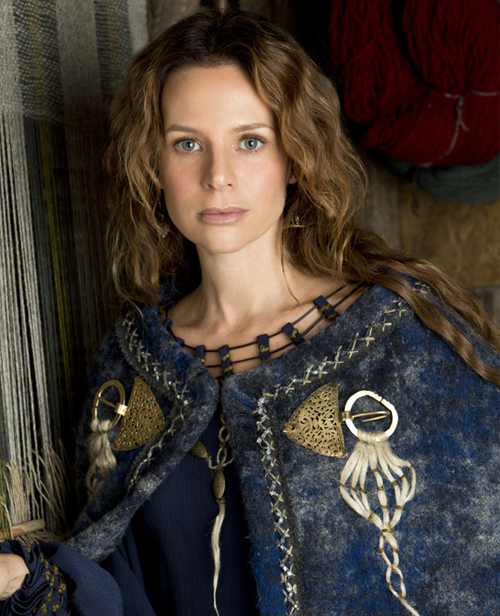
She confessed to Odin's Seer, that she is bitter, angry and filled with hate still that she's no longer the First Woman in Kattegat. She believes her only way to achieve such a position again is to, again, be a power behind the man in the First Chair as she was with the husband Ragnar killed in a fair fight -- and for excellent reasons. To this end she's managed to attract Ragnar's brother, Rollo, as her recognized partner. Further, she's saved his ass from his drunken assery -- but has been having sex with King Horik, during which meetings she tells him about Ragnar's character and plans. Alas, King Horik has no respect for her, demeaning Siggy in this episode, demanding she also sexually service his young son. While he watches. This bodes badly for King Horik.
But in "Unforgiven," the only Smiler to get whacked is Jarl Borg -- or is going to be whacked -- by the means of the blood eagle no less. The blood eagle is an excruciating way to die, a very slow way to die. So much for the celebrated laws of hospitality. But then, Jarl Borg did invade and conquer Kattegat, did his best to kill the whole clan, so what should he expected? Odin and Floki shall surely be pleased. The Blood Eagle is also a sacrifice,
if I have that right. Nordic religion, customs and history are not my specialties. But they are King Horik's and he ought to think about this, as the reason Jarl Borg was at Kattegat at all is because Horik wanted him to be, for the sake of Borg's ships and men.
As well, also right at the top of this "Unforgiven" epsisode, runs the fathers jealous of their sons theme.
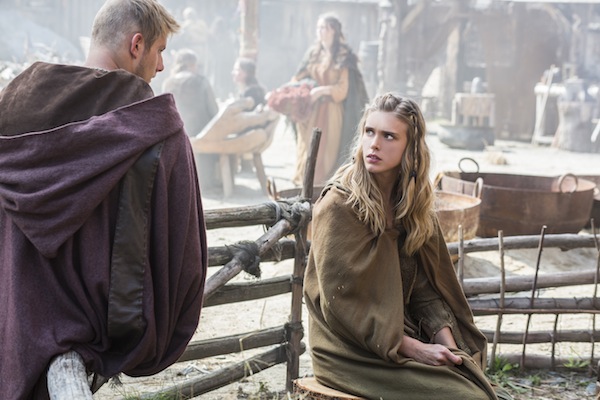
Bjorn, struck by the very attractive slave, Porunn,, the slave earlier in the season who Aslaug called Ragnar out for showing he lusted for her. We watch Bjorn with Porunn; we watch Ragnar watching Bjorn with Porunn; we watch Aslaug watch Ragnar watch Bjorn with Porunn. The inevitable envy and jealousy has sprouted. Beyond this though -- Bjorn, Bjorn, surely you get it as an aristo, slaves have no right of refusal, no matter how sweetly and gently you ask her to sleep in your bed. Shame.
Despite knowing Lagertha is a very competent, wise and asskicking woman, I, at least, did not see Lagertha stabbing in the eye with a table knife, her nameless husband. Or that one of his men would follow up with beheading the sorry excuse for a husband. The actions were entirely plausible though, for the man was a stupid sadist from whom no one could be safe. That Lagertha was going to do something at some point, for a Shield Maiden can hold in her fury only so long, yes. But it was as explosive an act for us as it was intended to be.
As for King Ecbert and Athelstan, their meetings are more interesting each scene. The two of them are both more sophisticated and educated than most of those among whom they live. We learn that both of them had been at Charlemagne's court.
In various ways this episode centered the women more, including even Jarl Borg's first wife, who was present as he consulted her skull (one wonders how he treated her really, when she was alive, considering her advice). There was violence, but it was directed against two specific individuals for specific and personal reasons, so one those against whom the violence happened was a woman. Or two women, if the watcher is among those that consider such things as sexual coercion, no matter how gentle, to be rape. However, we're not exactly sure it happened with Porunn. It's another element of
Vikings I like very much -- it doesn't do violent, salacious, torturous acts so that the audience can revel in in the acts and be entertained. They're included for a good reason (such as Rollo raping the slave in the first season) -- and mostly it's done off-screen. The causes are shown, as are the consequences, but there's no gratuitous reveling (though the scene with Siggy, Horik and his son skirted dangerously close).
When saying I "like" a character, it doesn't have anything to do with so-called likeability -- would I want to have a beer with them or identify with them. It has to do how well the character is written, how well the actor inhabits that character, the personality the actor gives the character and whether the character is interesting in her/him self and even more so within the kaleidoscope of the rest of the cast of characters and the milieu in which they live. I like all the characters in this series.
The newest character, King Ecbert, is getting very interesting. It's splendid the
Vikings writers aren't setting up a conventional binary them vs. them, with one side 'good' and the other side 'bad.' That they were taking a non-cliched route was signaled so early when Ragnar asked -- who? I forget? -- what Ecbert was like, and he was told, "He's like you."
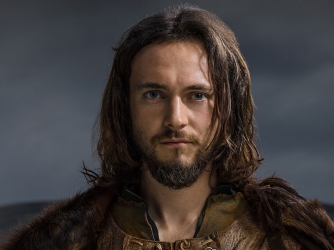
So far we've seen Athelstan the Christian monk, the slave, the Norse warrior and now -- besides copyist, librarian and manuscript illuminator, seemingly King Ecbert's clandestine confidant and counselor. It would be so interesting to see Athelstane within yet another milieu, and watch him slowly put on those clothes too, as he gets to know and understand them, as he did while a slave in Ragnar's household. There are people like that -- actors in particular, but other artists too. It's unconscious on their part, but they take on the behaviors, mores and even the thinking of where they are at the time, and inhabit these clothes so convincingly that they are accepted. This is also a great asset for spies, say, or anthropologists too.
I'm a little anxious about Athelstan's Christian imagery hallucinations though. Whatever psychotropic he was given at Upsalla played bloody hell with his mind.
Probably this is why Floki's strange; he's taken too many drugs. This perhaps is why Floki dislikes Athelstan -- as Ragnar and King Ecbert have so much common, he and Athelstan do too, including their probing minds. They both see visions now too.
This series remains on the top of its game, thank goodness!
I heard since returning that
Vikings has been renewed for a third season, at which I rejoice.
Edited to add a response to a question asked me about Floki and Athelstan Elsewhere:
Floki doesn't recognize what he has in common with Athelstan. Understandably at first, because starting with the Lindesfarne sack Floki has only contempt for monks and Christians, and after the sack, Athelstan now is a slave, commanding in their society no regard at all.
There's been nothing to indicate so far what Athelstan might think about Floki. But what we have been shown of the two in their various capacities, there is something about Athelstan that powerful men who have a vision beyond mere power recognize quickly as useful to them. Both Ragnar and King Ecbert see it. This is something that Floki can see bloom; he's suspicious of of Ragnar's regard, or more likely more accurately, object of Ragnar's probing curiosity. Perhaps Floki, with his intuition, becoming jealous and increasingly anxious about Athelstan the more of an equal participant Athelstan become sin their society -- first learning the language, engaging in religious and cultural discussions, learning their ways, then a free man and warrior, grown far beyond a source of information about enemies. That's also what I meant by perhaps Floki not knowing about himself, since he was Ragnar's special friend, the one who played several roles in Ragnar's life, beyond warrior and follower.
Floki see the Christians in Britain as enemies to be plundered, enslaved and killed to earn glory on the battlefield and Vahalla. For him England is a source from which to extract resources to bring back home. Ragnar sees the productive future of permanent settlement, which Floki doesn't agree with either (or so it seemed to me -- but perhaps I'm making this up myself). These are threats as Floki sees it, to his place in Ragnar's regard, and threats to his way of life -- he wraps these threats in Athelstan's existence, at least his existence for Ragnar.
As previously observed, Athelstan, like King Ecbert, is more experienced in the larger world, which is what Ragnar is also groping toward being. Floki wants to everyone to always bring it back home and do it the way they've always done.