LINES OF THE DAY

". . . But the past does not exist independently from the present. Indeed, the past is only past because there is a present, just as I can point to something over there only because I am here. But nothing is inherently over there or here. In that sense, the past has no content. The past -- or more accurately, pastness -- is a position. Thus, in no way can we identify the past as past." p. 15

". . . But we may want to keep in mind that deeds and words are not as distinguishable as often we presume. History does not belong only to its narrators, professional or amateur. While some of us debate what history is or was, others take it into their own hands." p. 153

Silencing the Past: Power and the Production of History (1995) by Michel-Rolph Trouillot

Showing posts with label culture. women. Show all posts

Wednesday, April 29, 2015

Reading Wednesday - Personal - A Jack Reacher Novel

I spent most of the day getting to, waiting around in and coming back from a hospital appointment.  The moment I began the trip up to the hospital I pulled the latest Jack Reacher novel, Personal (2014), from my bag and began reading it. It took only two sentences and I ask myself, "Did Lee Childs write this?"  Because though the signature pacing of a Childs's Reacher novel was there from the first two sentences, the voice, the tone, even the vocabulary and smart ass cracks, were off the Reacher mark from what my mind's ear had become accustomed over the course of 18 Reacher thriller novels.  The timing and rhythm is also just a bit off.


That nagging sense that this wasn't really Childs's Reacher was sustained all the way through the day of reading, and only increased as I reached the conclusion It is pacey!).

It has not been unknown for a very successful writer to employ sub-writers to follow plot and character instructions, and then run it through his own word processing program to put on the finish.  I can't help but wonder.

Also, whoever did write the text: be it known to you that women don't say nylons and haven't worn nylons in decades. We say, and we wear, tights, leggings, stockings and / or panty hose. Even female military personnel who wear skirts do not wear nylons these days.

Unless we're church ladies of as certain age in the upper midwest, of whom there naturally aren't that many left, we don't carry purses, but we do carry satchels, totes, even computer bags and cases, or tablet folders, etc. (neither men nor women carry brief cases much anymore since the portable digital device revolution), handbags or bags -- see: handbags, designer.*  Go into any place that sells such things and the signs are "Handbags and Accessories."

As well, to write,  " . . . she wore good shoes . . . " doesn't tell us a damned thing about the woman's character, but goes along with the writer's ignorance of putting her into nylons.

That kind of block clunk dumb kicks me out of the story. Among other things it broadcasts the male author's underlying contempt for women and the very many women who buy his books. This is particularly evident when it's the male author's male character telling us what a woman is like.  Worst of all, all through the books the writer / Reacher makes such a huge deal out of what an authority he is about women, including what they wear, which is part of the reason he's had so many really fine women over the decades (he ages but the fine women he has stay the same age more or less). What he does sound like to a female reader who has ears is an old guy, ogling women 30 - 40 years younger than he is, which, by the way is kind of the situation here.  Need it be mentioned that always these women throw themselves at him?

Feh.

-------------------

*  See, first paragraph above as first person (anecdotal) proof of this assertion.  I wrote "bag" without even thinking about it, without explaining, because just about every person inhabiting the universe that reads Jack Reacher novels knows what I mean.  Millions and millions and millions read Jack Reacher novels, at least half of them female.

Monday, December 9, 2013

Love In A Cold Climate - BBC 1980

This production is not to be confused with the 2001 one,


 produced in association with PBS's WGBH-Boston, featuring Alan Bates as (Lord Alconleigh) Uncle Matthew Radlett. However, this later one, like the 1980 production featuring Judi Dench as (Lady Alconleigh) Aunt Sadie Radlett, also melds of the first two novels in Mitford's Fanny-the-Narrator trilogy, The Pursuit of Love (1945) and Love In A Cold Climate (1949).  Two novels, yet a mere 2 1/2 hours!

Since  1980 production runs almost 7 hours, I'm glad this is the production available from Netflix, since the 2001 version is not.  Seven hours just about does the two books seamless justice. Two and half hours could not possibly.


Among the strongest points in this 1980 production is how much screen time we have at the Spanish refugee camp. We see the camp in in all of its misery in a way we did not through Fanny recreating Linda's later descriptions of it, via Mitford-the-author.  That we understand if her husband had been in the least interested in Linda, and not in love with Violet, Linda would have remained in the camp, makes Linda a much more sympathetic figure on screen than she was on Mitford's pages. It's the same when Linda goes to Paris.  We see all those places that Mitford merely writes Linda saw.

Despite the title being Love in a Cold Climate, more time is devoted to the scenes from The Pursuit of Love.


But -- we do have One, Boy, Polly and all the others that were in Cold Climate, and we see enough of them to be satisfied.  It's an excellent production all around, particularly if one admires the books.

The only caveat I have is purely personal: Lucy Gutteridge plays Linda in the same mode Audrey Hepburn would have, if Audrey Hepburn had been young enough in 1980, or wanted to -- all wide eyes that suggest she just waked up, and o so innocent, when anything but.  In the refugee camp Linda's more of a person than a beauty, lord's daughter or Hon, so she's much more sympathetic.  Also, she's working to be useful, whereas before or after Linda does nothing useful to anyone at all, including herself or even her coming child. Now, to make up for saying such mean things about Linda, I will say that the actress thoroughly convinces us that


such a dedicated rake as Fabrice, Duc de Sauveterre, could actually fall in love with Linda, rather than merely dally (though recall nearly the last words of The Pursuit of Love, and in the series too, are the Bolter's response to Linda's declaration that hers and Fabrice's love is for life -- "That what we always think, every time.").


The actress who plays Fanny the Narrator - Radlett Cousin presents a much plainer Fanny than I'd imagined from the books.  But, like everyone else in this cast, she's really good in the role.


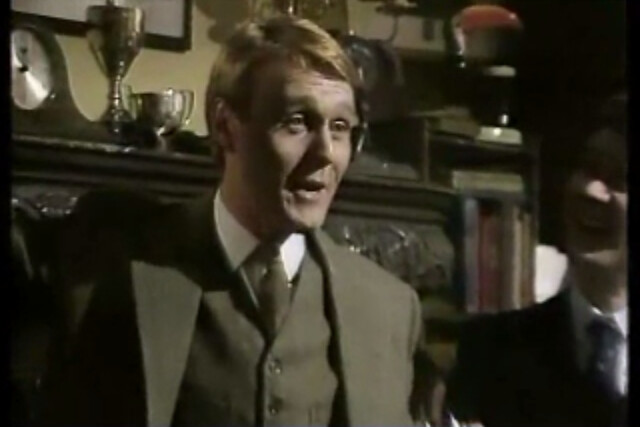
Shocking point: Anthony Head plays Linda's first husband, the 'Hun' banker, Tony Kroesig; I didn't recognize him -- hadn't a tingle, didn't know until looking at the cast list on IMDB.

As I do when reading the books, part of what I admire intensely is the frequent declarations unabashed, unashamed indifference, and not infrequently, downright dislike, mothers have for their children.  One could hardly dare even suggest that any mother, no matter how wretched the mothering (and / or fathering) might be, might not give a damn about their progeny.  Even Fanny, duly domestic -- at the end of book and series informs us that she prefers Linda's orphaned child to her own children!  The series and The Pursuit of Love Fanny very early makes the point that both Lord and Lady Alconleigh were bemused and somewhat mystified that they'd "filled so many cradles" and were indifferent as to any preparation for their futures.

The same unselfconscious candor is articulated about their class privilege.  As I said earlier *, monsters they were, and they minded not.  They know they are are superior to most of the world and invoke that knowledge at all times.  But somehow it goes down more easily in books about people long dead, than now, when articulated by our contemporary monsters who know they are entitled to make war on the poor.

After re-reading The Pursuit of Love, and watching 7 hours of Love In A Cold Climate, I am feeling somewhat bereft of the monsters.


So, I shall proceed to re-reading the third Fanny-the-Narrator, Don't Tell Alfred (1960).

----------------

 * Recent re-read of The Pursuit of Love, looked at here.

Tuesday, February 19, 2013

*Downton Abbey* Season 3 Finale


I watched Downton Abbey's finale -- the Christmas Special over in the UK -- last night during dinner time. As much of the episode takes place at Duneagel, a Highland's castle in the possession of one of Lord Robert's relatives, it as though we'd  returned to the comedy-drama series, Monarch of the Glen (2000-2005), complete with those glen monarch stags, one of which Our Lord Robert successfully bags, thereby demonstrating his manhood has fully recovered from killing his daughter and losing his wife's money. It even can be read as a signal that "Since Old Robert's still got what it takes to be the King, the new, young King must die" element, that the episode executes, I think, rather skillfully, though I hate it because it is so good for again centering the Horrid Mary.

This Monarch of the Glen association with Downton isn't arbitrary whimsy on my part.  Julian Fellowes played one of the characters in the Glen series. He was the frenemy of  Richard Briers's character, who played the husband of Susan Hampshire's character. I will watch Susan Hampshire, a fountain of bottomless charm, in the very best sense of the word, in anything.  By sheer chance it was announced yesterday that Richard Briers had died. Like the entire world, knowing this Christmas Special Downton Abbey was set on a Highlands estate, I was inspired to watch it in Briers' and Susan Hampshire's honor. Monarch of the Glen was absurdly and unexpectedly charming in its first seasons, but by the end of season 4 I quit the series as it turned stupid. The actor-characters I'd so enjoyed had all departed by the end of season 4. Evidently this left the writers without ability to craft a decent seasonal arc or even a decent line of script.

Here is the link to a Q & A with Fellowes addressing Downton Abbey's season 4.

Fellows tells us season four resumes 6 months after this Christmas Special episode's final event.

Quote:
Q. Was it your decision to dispense with Sybil and Matthew in the same season?
A. No. You see, in America, it’s quite standard for an actor to sign, at the beginning of a series, for five or seven years. The maximum any British agent will allow you to have over an actor is three years. And Jessica and Dan wanted to go. The show had been very, very successful, tremendously so, and they were being offered great opportunities. Don’t think I’m saying it critically – I don’t blame them at all. I can remember when I was a young actor, and I just had this feeling it was time to go to London. I was doing repertory theater in the country, and I resigned halfway through the season. Of course, all my friends and my parents thought I was completely mad. I went up to London and I got a job in a West End show with Hayley Mills. I reminded myself of that when Jessica and Dan said they wanted to go.
 I thought, “Well, you can’t be that snippy because on a scaled-down version, that’s exactly what you did.” 

Inadvertently or not though, what it looks like is that Matthew Crawley, the resented heir of Downton Abbey due to the entail, performed his role as the perfect gentleman.  He marries the horrid Mary thus saving the estate for this generation of Grantham-Crawleys, he further saves the estate by becoming the unexpected heir to a fortune after Our Lord Robert runs the Downton estate into the ground and loses his wife's fortune via very bad business judgment, and he provides these Crawleys via Mary a male heir all within their family -- then immediately dies, his function in the order of things accomplished. Just like the shot Highland stag, dispensable now that he's fulfilled his biological function as the male, to impregnate the does, ensuring species' continuity.

Quote:
Q. Once you’d made your peace with their departures, how did you decide to handle them narratively? 

A.With Jessica, it seemed right to give her a whole episode that was about her death. With Dan, I had hoped that we would have one episode of this fourth season that I’m writing now, so we could have ended the Christmas episode on a happy note – the baby, everything lovely. And then kill him in the first episode of the next series. But he didn’t want to do that. I didn’t want his death to dominate the Christmas special, so that’s why we killed him at the very, very end. In a way I think it works quite well because we begin Series 4 six months later. We don’t have to do funerals and all that stuff. That’s all in the past by then. 

G-dang-dayem, what are the consequences of the end of Matthew Crawley? It's going to be ALL ABOUT MARY. So much for Edith getting some of her own.

Quote:
A.I’m not giving anything away by saying that one of the main themes is the rebuilding of Mary, that Mary has to rebuild her life in a society which is changing. We would see women’s roles in the ’20s as being very much behind women today. But it was a big advance on what it had been 30 years before. And that’s all explored in the show. 
Worst of all, with Mary as the mother of  THE MALE HEIR to Downton Abbey, we're not going to get much more of Branson or his and Sybill's daughter.  It's going to be ALL ABOUT MARY ALL THE TIME.  Damn, damn, damn.

If I hadn't watched this episode, however, I would have missed one of the most charming and genuine feeling sequence in television, Anna,  now our Mrs. Bates, dancing the Reel, with the most attractive foot, ankle and calf ever made visible in those days when decent women covered to the tops of their high top shoes.  She-actress was adorable -- and danced so very well, as well as loving the dance.


Friday, August 24, 2012

*Mirror Mirror* - Why Did the Reviewers Hate It?

Mirror Mirror (2012) turns out to be:

adult
historical fantasy, though with contemporary political reference
comic
an extravaganza of set and costume - vividly, deliberately artificial in the way it's vaguely time period of the 18th century ancien régime was

based on the Grimm fairytale of Snow White.

The film stars Julia Roberts as the EviLe Queen.  Roberts displays a sense of comic line delivery and facial expression that turns on a dime.

Snow White is played by Lily Collins, a young actress of whom I know nothing, but somehow, at least in this film, reminded me of a very young Morena Baccarini (Firefly) as well as Lucia Micarelli, the charming violinist on HBO Treme. She's a sharp in her role as is Julia Roberts, but she's got further to go than Roberts, whose character begins as psycho and obtuse, and only has to lose it to greater degree as the story goes on.  Collins needs to be an anxious, oppressed mouse who becomes the rescuer of her kingdom

Of course Snow White needs some help in her transformation, and that is provided by the seven dwarfs, who were expelled from their village and occupations by the EviLe Queen because they were -- get this! unattrractive in her sight!  Unlike another Snow White film this year, we see Snow White train and develop her martial skills as well as other ones, though in scenes that are intentionally comic.  This training includes Prince Charming, who crows about how often he's spanked her in their sparring sessions.  She fixes that, thank you.  And she rescues him more than once.

Everything about this film is fun, a joy to look at, while avoiding dumb and dumber.  It's always fast to the point of every scene.  It's an action film too, though the landscapes are as artificial the backdrops in King Louis Whichever Number's private theater -- as then, in this film too, the overt artifice is part of the audience's viewing pleasure.

So why was this film's box office then disappointing?  Is it because it really isn't for children or maybe even adolescents, or even adults who don't recognize the historical and cultural reference points?  One would think though even not so historically oriented girls would enjoy this film because it's as up-to-date with a strong young young woman at the center of the tale as you could desire.


All this and the film captures that effortless sense of lightness that we find commonly in French creations from ballet to Dumas. The French have a term for it, a word that entered the language with the development of the French ballet in the eighteenth century, and from there entered the ideal of individual presentation of those inhabiting the French court:

ballon: "The ability of a dancer to jump easily and lightly into the air. Ballon is the appearance of being weightless, or defying gravity."

We seldom see this particular mode here, though back in the day the best of the screwball comedies and the dance films of Fred and Ginger demonstrate the quality perfectly, uniting the comic and elegant movement/action and crackling repartee and fast-firing plot under the same umbrella. -- just like Dumas did in his Musketeers novels