". . . But the past does not exist independently from the present. Indeed, the past is only past because there is a present, just as I can point to somethingover there only because I amhere. But nothing is inherently over there or here. In that sense, the past has no content. The past -- or more accurately, pastness -- is a position. Thus, in no way can we identify the pastas past." p. 15
". . . But we may want to keep in mind that deeds and words are not as distinguishable as often we presume. History does not belong only to its narrators, professional or amateur. While some of us debate what history is or was, others take it into their own hands." p. 153 Silencing the Past: Power and the Production of History (1995) by Michel-Rolph Trouillot
This week I've been watching David Lean's three hour Plus restored screen version of Lawrence of Arabia (1962).
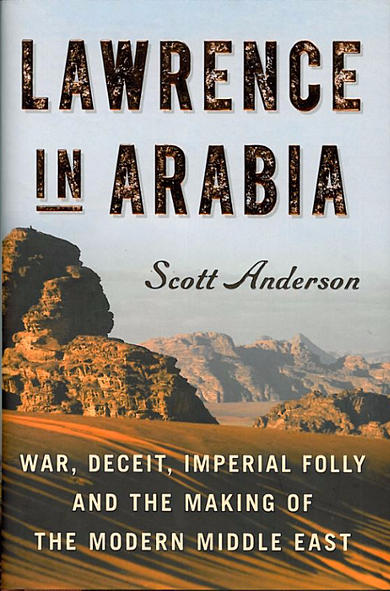
Recall just prior to embarking upon this cinemtographic journey, I had been immersed in reading Scott Anderson's Lawrence in Arabia: War, Deceit, Imperial Folly and the Making of the Modern Middle East(2013). As Anderson refers frequently to Lean's film in the course of his myth-busting history of the Middle East theater in WWI, it felt right to look at the film again, because, naturally, as this is the movies, Lean consciously participated, almost gloatingly, in the mythologizing of all of it.
How could Lean not mythologize when he centers this instead of Arabs? Which, by the way, this is not the real topography of the deserts that Lawrence and his tribes traverse. Endless, dreary gravel and stone, bare of of almost all but thorns and bare mountain outcrops, that's what they traveled over. Not sand.
There's a great deal to think about here, in terms of how movies and other kinds of entertainments cannot deal honestly with history by the rules of their own engagement. Nor evidently could the arrogant, ignorant, incompetent, mendacious men who sent millions into the meat grinder that was WWI, and never learned. Anderson's still furious about them and the sheer idiocy that was the war. But not tonight. I'm too tired from dealing with my own idiocies of the day.
Yet another book about Lawrence of Arabia? This isn't one of those, despite the title. It's T.E. Lawrence within the context of a whole cast of characters in the run-up to, during and after World War One, as the scramble for control of the Middle East by the Powers plays out. After the war ends, some of these Powers, such as Austria-Hungary and czarist Russia will no longer exist, and a new one, the U.S., will be firmly established on the scene. Lawrence In Arabia: War, Deceit, Imperial Folly and the Making of the Modern Middle East (2013) by Scott Anderson is well worth reading. It isn't biography as much as it is a history of the Ottoman Empire's loosening grip upon Egypt, Arabia and the Middle East generally -- and the Powers that were already racing in the nineteen aughts to control the region's oil resources.
So, as well as the famous figure of T.E. Lawrence, the reader is introduced to a number of other personages. These other significant figures were from Germany, Russia, Britain, France, the United States and some of the Jewish migrants from Turkish controlled Rumania and czarist Russia, who were attempting to create what would become Israel after the next Great War. Among them are the French and British Lords Rothschild. All of these people, and the interests they represented, schemed with or against the Ottomans, while Istanbul's young Turks dreamed of updating and reforming the Empire, joining the industrial world.
Emir Faisel, championed by Lawrence
In the meantime all these various sides had vicious intra-conflicts as well. "Betrayal and Lies", as Lawrence learned, was the real name of the game, whether nationalist, corporate, military or Zionist. Tragedies in real life make for a great cast of colorful personalities in a book of history.
The German Arabist Dr Curt Prüfer (unlike the other figures, there are no photos of him on the web, it seems) is one of the most interesting of these men (for some reason, with the exception of Sarah Aaronsohn, in this history they are all men, these figures loyally working to control the region for their nation or their employer). A sickly baby and child, a botched operation produced his whispery voice and frail physique, leaving him wide-open to accusations not usually even barely concealed of homosexuality, despite his wife and numerous liaisons with other women. Nor was he member of the German aristocracy, so rising beyond a certain point in a diplomatic career (also, read for diplomacy, intelligence). was out of the question. However, like Lawrence, he was born with a facility for languages, picking them up quickly and accurately. As Arabic is a most difficult language to master, he was a valuable player. He ended his life as a nazi ambassador-spy to Brazil during WWII.
The American aristocrat in the game was William Yale (yes, a descendant of that Yale), an employee of the Standard Oil Company of New York. He came to the region originally undercover as a wealthy playboy -- which disguise the young Lawrence ferreted out immediately -- to prospect for the same oil that the British coveted, as they were converting the British navy from coal power to oil. When the U.S. joined the War on the side of Britain he began gathering intelligence for the U.S. Later he became a distinguished history professor.
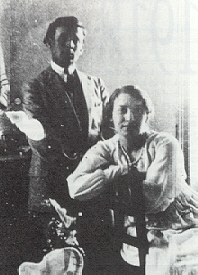
Aaron Aaronsohn and wife.
Born in Romania, Aaron Aaronsohn emigrated to Palestine, toured the U.S. as an agricultural scientist, His dream was not only a Jewish state in Palestine, but one that supported itself by agriculture. His initial botanical station at Athlit, on the Palestine coast, was successful -- and plundered by the Ottoman overlord's military under the guise of requisition. He chose to support the British in the region when war came, even before Turkey entered the war. Aaronsohn died in an airplane crash after he attended the 1919 Peace Conference.
Sarah Aaronsohn,sister of botanist Aaron Aaronsohn, referred to as The Heroine of Nili;" the Nili was a Zionist spy ring working for the Brits in Palestine in WWI.
Earlier, his sister and spy collaborator, Sarah, had killed herself, during a brutal Turkish captivity.
Like Lawrence, all of these men and their associates became vital forces in intelligence for their governments and / or allies, helping determine the decisions and the direction of actions during the war and after.
They tended to converge in Cairo. Their descriptions of the thousands of Aussie troops stuck in Cairo after long confinement on ships to get there, waiting transport to Europe, are vivid. The Aussies turned Cairo into a puke-drowned brothel, raping and fighting constantly, dead drunk in the gutters. The British were deeply concerned because, until now, they claimed, the average "arab" had viewed "the white man" as a vastly superior creature. The Aussies destroyed that image of "the white man" forever.
Scott Anderson is interviewed about his book and Lawrence in this YouTube video.
Among the valuable take-aways, i.e., what I didn't know before reading the book, for me from Lawrence in Arabia, is the role of the oil industry in wrenching the Palestine and the region from Turkey. It also gives a coherent picture of the Young Turks, their goals and how they went about achieving them, to make Turkey a modern country.
The book is lengthy, but it's consistently interesting; though dense with information, it reads easily.
This is a period (crime) family drama from the BBC.
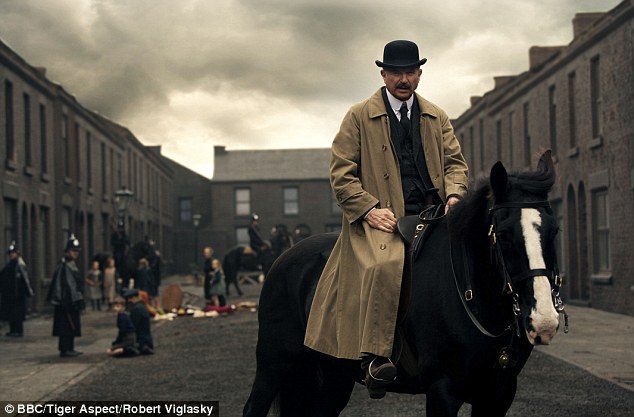
The time is 1919. The place is Birmingham. Location shooting in Birmingham, Liverpool, Leeds and another city I don't know, Dudley. Among the rcognizable
actors Sam Neill has a lead role, though he's neither a Cardinal nor a magician this time around, but Inspector Major Chester Campbell, the antagonist of the
Peaky Blinders' gang leader, Thomas Shelby, played by Cillian Murphy.
It will bring Boardwalk Empire to mind, not only because of the time period, but by how stylish-glossy-classy the production values and the framing of scenes are, the ensemble cast, how hard it is out here for a gangster whose family will screw with his brilliant planning, while he and his cronies are suffering PTSD from their sacrifice in France for a King George who doesn't give a damn today. And yes! Winston Churchill has a part too.
Moreover, it takes all the way through most of the five of the six episodes before the romantic leads, Tommy and Grace, have sex. Nor do they do they do the rippingofclothesthrowagainstthe wallonthetable etc. They do it slowly, carefully, Their connection is about a kind of healing for them both. They have gotten to take the measure of each other. They fairly know each other in important ways already.
These are the sorts of elements that appeal to this viewer. I particularly like the scenes of men who are making Birmingham steel, and why communist addresses about the need for solidarity and striking appeal to them, come home to even lower wages than before. The flames, sparks and heat pour from the furnaces into the streets. Coal is heaped everywhere.
Like Boardwalk Empire, Peaky Blinders relies nonperiod music, which I dislike , particularly since there's so much good music from the era that could have been used. To be fair, Peaky Blinders, like Boardwalk, does use period music as well, however it's mostly as solo vocalist. There was, thoug, a splendid St. James Infirmary in the first episode, which was ideal, as one can see from the history of the song. But for narrative and the title sequences, the show uses instruments and arrangements that weren't invented yet. This may not be a problem for others since it doesn't seem to be brought up, but it bothers me a great deal. It sort of tells me that the production doesn't have faith in its own effort.
Some have said Peaky Blinders moves so slowly they lost interest (people have said the same about Boardwalk Empire. The first episode was slow, I'll agree, but I didn't mind. It gave me the time to find out who these people are with whom I would spend six episodes. As well it gave my ear a chance to acclimate a bit to dialect. The following episodes move much faster.
I do have a question -- there are a large number of horses, some of them magnificent, in the series. Considering, this is 1919, would the equine population expended during WWI have been replenished to such a degree so soon? Or, which is more than possible, I don't know what I'm talking about? OTOH, with all that coal and all those horses, the streets are remarkably pristine.
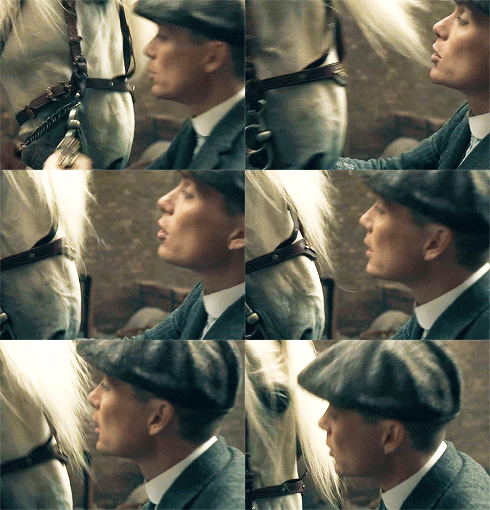
At one point Thomas Shelby rides a pure white (well, probably, technically grey) stallion through these coal-lined streets. Though the stallion balks at the noise and the fire, his coat remains pristine -- not even a fleck of soot on his fetlocks. I don't believe that.
There is ample blood and violence and occasions to show men being as awful to each other as they can be. They're often not much nicer to women either.
Season 1 is available on disc and streaming from netflix. Season 2 will be available in November.
Vulpine, canine, feline, porcine & equine avatars. Gone to heaven Gone to hell Gone to jail Gone to work Gone to school Gone to lunch Gone to bed Gone to bad Gone to pee Gone to earth. Gone Gone Gone. Fox's earth is Blue Gotham City. Shorter sojourns are spent in other, more dangerous, locations.