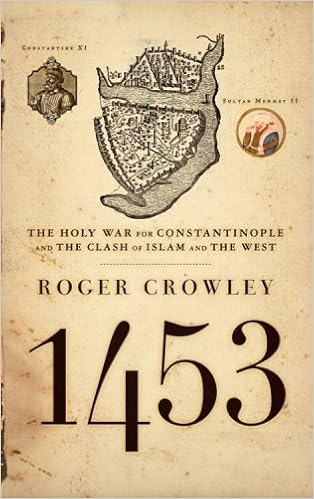
This month I've been listening to 1453: The Holy War for Constantinople and the Clash of Islam and the West (2005) by Roger Cowley. The book isn't finished yet, but the city that had survived every siege and attack for over a thousand years, with the shameful exception of those who one might have thought her allies, the Christians of the Crusades in 1204 has finally been taken. And that too happened due to an error, not an actual breaching of the walls by force.
Which of these are Minas Tirith and which Constantinople?


More than ever I am convinced that Tolkien carefully read the first hand witness accounts, particularly the diary of the Venetian Nicolò Barbaro, of this battle that went on day and night for almost two months, and drew on those accounts heavily for the siege of Minas Tirith.


However Gandalf's magic worked while the Christian magic that had so long kept the protective dome of God and the Virgin over the Great City failed. Rohan and the armies of the dead came to save the White City, whereas the living armies from the west never did, fighting as they were among themselves. Finally the massive numbers of the orcs overwhelmed the walls. The warriors within the walls that had never before been breached, though valiant beyond comprehension, were too few, too few.
But in the end it was truly the conflicting Churches' theologies and commercial greed on the part of the West that took down the ancient Red Apple, The City of the World's Desire -- not Islam.
I'm beginning to wonder that Mehmet II's success in taking the ancient Christian capital of the east, when all others had failed (and he nearly did himself -- the continual turning tides of fortune for both sides makes so much of this story's drama and tension) had so much to do with his successor, Süleyman the Magnificent, obsession to take Vienna, within the heart of the not holy or imperial Roman empire. He must equal his forefathers' achievements, and taking Vienna would even outdo Mehmet's conquest of Constantine's city (which he tried and failed at in 1529).
And from that victory which didn't happen, Süleyman expected to move on to take Rome. The Ottomans been trying to conquer Rome from the south in previous decades, thereby terrifying Queen Isabella, and solidifying Spain's belief that Islam was coming for them very soon. After all, the Ottoman emperor had announced to the world that it was. (So, as many moriscos as possible were expelled, to prevent them from becoming a third front in the Iberian peninsula.) In the meantime the Ottomans had occupied a significant extend of Italy's boot.

Cowley's book has made fine companion to the audio book that engaged me in January the outraged philosphical history of what did not happen (and could not then,, have happened), James O'Donnell's The Ruin of the Roman Empire: A New History (2008) -- which outrages most readers, particularly his presentation of Justinian as the effective villain.
In-between the falls of Rome and Constantinople, I remain occupied with the Merovingians. El V got himself a book to read on the plane to Miami and back and in the Hampton Inn room, a history of the Middle Ages. It begins with Charlemagne, as these things all do; it has not a single Henri Pirenne cite, which I allowed boded well for the book's value.* It's fairly elementary, meaning that I pretty much know this outline quite well, but he knows nothing, but has gotten interested via my interest in the Merovingians and the Carolingians.
He's promised though to get me some more up-to-date histories of the Merovingians because I'm frustrated by what we've got. None of the contributions to this history by archeology are included, thus we get nothing of the people: only the power elites. Nothing about the buildings, or agriculture. And hardly anything about trade and commerce. Additionally, as a Belgian, Pirenne was more than willing to always rank the Carolingians as the most important development in the transition.\
---------------------------
* The Pirenne Thesis concerning the change from the Roman world to what some call Late Antiquity, others, the Dark Ages. was promulgated to its fullest in 1935, in his Mohammed and Charlemagne. That was nearly a century ago, based in scholarship older than that. Research and scholarship has moved on significantly since then. Full text of "The Pirenne Thesis Analysis and Criticism" here.