LINES OF THE DAY

". . . But the past does not exist independently from the present. Indeed, the past is only past because there is a present, just as I can point to something over there only because I am here. But nothing is inherently over there or here. In that sense, the past has no content. The past -- or more accurately, pastness -- is a position. Thus, in no way can we identify the past as past." p. 15

". . . But we may want to keep in mind that deeds and words are not as distinguishable as often we presume. History does not belong only to its narrators, professional or amateur. While some of us debate what history is or was, others take it into their own hands." p. 153

Silencing the Past: Power and the Production of History (1995) by Michel-Rolph Trouillot

Monday, January 14, 2008

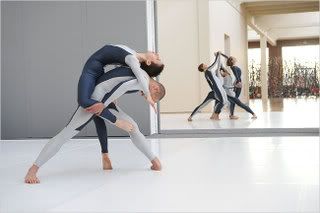
Dance: The Knife That Slices Open Parallel Worlds


Pullman's His Subtle Knife:
Choreographed by Merce Cunningham;
Danced by the Cunningham Company

Alternate Worlds Moving on Two Stages,
Performing for One Audience
I've been attending the revelatory Merce Cunningham 'events' all my adult life -- on occasion the spouse has been honored as a composer for an edition of these events, so famous, for so long, in the world of art and dance. These were informal gatherings of audience and company in the Cunningham studio, devised for choreographer, dancers, composer and audience to exchange energies via the matrix of Cunningham at play, with his constant playmates, time and space.
This weekend the Cunningham Company held an 'event' at the glorious Dia Art Foundation - museum, which is located outside of Beacon, NY. I can personally testify that the land upon which the the arts' container, a work of architectual art itself, is sited, provides a canvas of seasonal light and shadow display that is breathtaking, no matter the weather or the time of year. This weekend's event at Dia included choreography inspired by Pullman's The Subtle Knife. The NY Times dance critic describes the event thus:
[ To watch his company on Saturday afternoon in the first of two Cunningham Events last weekend at Dia:Beacon was to see a poetically compelling exposition of parallel-universe theory. Before at Dia:Beacon, Mr. Cunningham has staged events on two or more stages at the same time. In 2004, working on three stages at the Tate Modern in London, he employed a barrier that prevented audiences from seeing all three at once unless they looked up to the lofty mirrored ceiling in Turbine Hall (where the full action was visible, though very distant).
On Saturday at Dia:Beacon he placed his two stages adjacent but on either side of a square doorway. Wherever you were sitting, you could see only part, never all, of the stage on the opposite side. That door, leading from one world to a parallel stage, evoked the controlling image of The Subtle Knife, the second novel of Philip Pullman's trilogy His Dark Materials. In it the young hero can cut his way, slicing a square aperture in the air, from this Oxford into different worlds, at least one of which contains an alternative Oxford.
As the event began, the stage farthest from me looked breathtakingly like a mirror of the one closer to me. One group of dancers was moving in slow, controlled adagio, stepping, arching and bending with precision, while another, dressed identically, was doing the same but facing the other way.
Then, more than a minute into the dance, the denizens of the through-the-looking-glass world started to move in other steps and in a different tempo, whereupon the dichotomy between these two now dissimilar stages became both frustrating and entrancing. Here the dancers were balancing, fixed, waiting; there they were leaping fast across the space, caught up in some rush of which we could see only a fraction. And, like characters in the Pullman novels, dancers moved from one world, or stage, to another and back again. ]
Watching a Cunningham choreography, whether from early in his career (he's now 91), or one just recently created, one feels she has left this world and re-entered another that has been lost, a world in which the sacred exists, as both sublime and far beyond any rigid and short-sighted religion, to a world that has existed long before this one, and which will survive hard and passionate once we have departed. It's a privilege that everyone should be entitled to experience.

So it's natural that this man would be drawn to a book by a YA author that speaks to slicing open gates that allow him, his dancers and us, to enter parallel worlds.


Sunday, January 13, 2008

U.S. and the Struggle for Civil Rights

The national commemoration of Martin Luther King's birthday is looming, along with the month of February, which is 'black history month," (about which Spike Lee has been attributed as observing something like, "You know they'd give us the coldest month," but if that is true or not I don't know.)

Reading about this new book, published, of course, at this time of the calendar, brings the sober realization that in the U.S. the struggle for civil rights has been going on so long that it can now be studied as an historical movement of 'longue durée" ("a term used by the French Annales School of historical writing to designate their approach to the study of history"):

Defying Dixie: The Radical Roots of Civil Rights, 1919-1950 by Glenda Elizabeth Gilmore.

[ Forgotten Revolutionaries

How Southern communists, socialists and expatriates paved the way for civil rights.

Willful amnesia has been a chronic problem in American historical thought. Many of us, it seems, have preferred a simplified and sanitized version of national history, one that smooths out the rough edges that might complicate comforting visions of harmony and progress. This mythic approach to the past was especially popular during the two decades following World War II, when patterns of violence, extremism and political discord were either ignored or discounted. Politics, in the two-party context of American exceptionalism, had been reduced to a mere quibbling over details. In this fulsome view of the great American success story, there was no room for radical dissent, no place for systemic failure.

Recent decades, of course, have witnessed a withering assault on this attitude by an increasingly diverse cadre of professional historians, many of whom have shown a special interest in the evolution of social and political movements and the history of marginalized groups such as African Americans, women and the poor. Shining a light on the darkest recesses of U.S. history, revisionist scholars have challenged the presumptions of American exceptionalism. In the process, they have fostered a greater appreciation for the power of dissent and disorder, uncovering the radical roots of everything from the American Revolution and abolitionism to populism and organized labor. In the burgeoning field of civil rights studies, such an appreciation has been an important undercurrent for at least a decade. But with the publication of Glenda Gilmore's remarkable new book, Defying Dixie, the left-wing origins of the civil rights movement have risen to the surface of historical debate.

Gilmore, a North Carolina native and Yale history professor, transformed our understanding of the Southern progressive movement with her first book, Gender and Jim Crow, published in 1996. Defying Dixie promises to do the same for the emerging freedom struggle of the post-World War I era. The early stages of what Jacquelyn Dowd Hall has aptly labeled "the long Civil Rights Movement" have attracted considerable scholarly attention in recent years, so much so that most historians no longer feel comfortable with accounts of the movement that begin in the mid-1950s with the Brown decision or the Montgomery bus boycott. But even the most enlightened civil rights historians will find new material and much to ponder in Gilmore's richly textured study of the Southern communists, socialists and expatriates who challenged Jim Crow during the three decades following the Bolshevik Revolution. ]

My o my, isn't Senator Obama a long duration away from all this!

But -- and this is a most significant qualifier -- how much further away than this is Hillary Clinton's latest denial scramble re Martin Luther King and his effect upon the Civil Rights Movement. Just like her scramble that insists she thought she was voting for something other than the specifically titled, "Authorization for Use of Military Force Against Iraq Resolution of 2002." Feh.

Friday, January 11, 2008

Death From The Air

What this country does best.

More aerial bombardment in Iraq????

Try to reconcile these three accounts, from three countries.

I'm not clear on how this "extraordinary amount of firepower" can be"precision" bombing. sounds kinda like what the us military does best: raindown death from above, in which anyone killed was by definition aninsurgent.

Curiously, not two weeks ago, Arab Jabour was being exhibited as a case of "progress in security", as per the first dispatch below, which notes"farmers working" outside and "children going to schoo".

Mot to worry about those farmers and children, though. One of thesearticles (the US one) quotes a local militia member that "civilian casualties in his area were avoided Thursday because American forces instructed his group to warn residents to leave the area." So presumablythey left their homes behind after being told to do so. and maybetheir homes were reduced to rubble. But hey.

http://www.militaryconnection.com/news/december-2007/local-governance-center.htm

http://english.aljazeera.net/NR/exeres/34FF8497-B1B6-4739-BB4F-7C500D389CE0.htm

http://www.guardian.co.uk/Iraq/Story/0,,2239001,00.html

This.

This.

This is beyond any human excuse.

Wednesday, January 9, 2008

Dog Whistle Politics

Imagine both Hillary and Obama up against this gop Mighty Dirty Trix Machine through the south, Texas, the southwest and the west, which is jam-packed with those who see the Huckuck as just like them -- mean, greedy and proudly ignorant of anything not his own backyard (I have loads of relatives on both sides in those regions, and they are just like him, and evangelical to boot -uck).

From the Daily Kos:

[ An interesting discussion today on language used by Mike Huckabee in his campaign. He is fond of talking about "vertical" politics rather than "horizontal" politics. Josh Marshall brought this up over at Talking Points Memo, where he includes a video of this Huckabee answer on NBC's Meet the Press last January. ]

Tuesday, January 8, 2008

Chamber of Commerce Talks Like the Wise Guys

What matters to those who are really in charge of the country is that Obama isn't anti-business, unlike the perception that Edwards is anti-business, who is being turfed out of the election process as Kucinich was, because of the progressive messages re lack of jobs, outsourcing, NAFTA, etc:

[ Chamber of Commerce vows to punish anti-business candidates --AP

“We plan to build a grass-roots business organization so strong that when it bites you in the butt, you bleed,” chamber President Tom Donohue said.

The group indicates it will spend in excess of the approximately $60 million it put out in the last presidential cycle. ]

http://www.latimes.com/news/politics/la-na-chamber8jan08,0,4301350.story?coll=la-home-center

[ WASHINGTON -- Alarmed at the increasingly populist tone of the 2008 political campaign, the president of the U.S. Chamber of Commerce is set to issue a fiery promise to spend millions of dollars to defeat candidates deemed to be anti-business.

"We plan to build a grass-roots business organization so strong that when it bites you in the butt, you bleed," chamber President Tom Donohue said.

The warning from the nation's largest trade association came against a background of mounting popular concern over the condition of the economy. A weak record of job creation, the sub-prime mortgage crisis, declining home values and other problems have all helped make the economy a major campaign issue.

Presidential candidates in particular have responded to the public concern. Former Sen. John Edwards of North Carolina has been the bluntest populist voice, but other front-running Democrats, including Sen. Hillary Rodham Clinton of New York and Sen. Barack Obama of Illinois, have also called for change on behalf of middle-class voters.

On the Republican side, former Arkansas Gov. Mike Huckabee -- emerging as an unexpected front-runner after winning the Iowa caucuses -- has used populist themes in his effort to woo independent voters, blasting bonus pay for corporate chief executives and the effect of unfettered globalization on workers. ]

Ron Paul, for instance, has characterized this as "soft fascism." For more on the relationship of this 'soft fascism' and 'homeland security,' there is this essay, published not here in the U.S., but in a Brit paper:

http://books.guardian.co.uk/review/story/0,,1332840,00.html

Saturday, January 5, 2008

They've Declared Edwards Dead

Everyone says so, particularly NPR and everything associated with it. Coz he came in second.
But, oddly, Hillary, who came in third is NOT dead.

Why is this? Coz Edwards scares 'em (like Dean did -- they killed Dean at Iowa too, recall?).

Coz, Edwards is that NO-NO! He's angry! He encourages all those other people who are angry about their kids having rotten education and no health care coz their parents have no jobs or garbage jobs to DO SOMETHING ABOUT IT.

He's not a corporatist, like Obama or Hillary. Which is why Huckyuck won't get to go anywhere either, as disgusting a Caleb (the Big Bad's prophet in the concluding Season 7 of Buffy the Vampire Slayer) that Huckyuck is -- and a racist, wingnutxtianrightist, misogynist warmonger ignoramous, he's also a populist. In fact, the only authentic current gop corporatist potus wannabe is Romney, and he's not electable coz of that Mormon factor. So, thus, Bloomberg and the unity 'indie' party.

Which nobody Thursday night or since has talked about (except, a teeny bit, on Air America). That black Obama's acceptable is largely due to the fact that he isn't out of slavery heritage African Americans. He's the immigrant story, the successful immigrant fairy tale story, not the miserable tragic cruel story of forced immigration to die to make others rich that the slavery story is. Thus he's so much more -- like 'us' and acceptable, because he's not one of 'them'. You can hear it in the way those dorkdongs talk about him ... sure, in code, but that's what they're saying.

In the meantime, this journalist shows how nasty and dirty a game politics is, even when played by the better sort. That is, if this journalist can be trusted to be providing objective and factual information from Iowa on Thursday night. She says that at least some of the Obama and Edwards people coluded in order to make sure Hillary got stalled -- and additionally Hillary's people played into their hands due to arrogance and blindness, and as well, very callously treated elderly, unwell caucus female participants (I keep wanted to type 'couscous!' -- I like couscous and make it often ....).

Tuesday, January 1, 2008

You / We Know What To Do ....

May 2008 Bring More Blessings Than Last Year