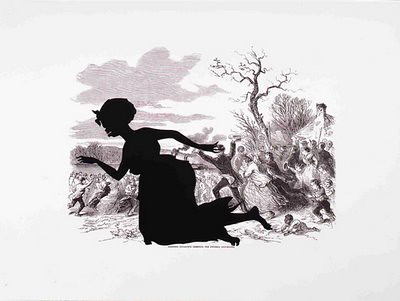
"Slavery is not a fit subject for children."
This is the beginning of a section I wrote for The World That Made New Orleans that attempts to explain why so few white Americans have any real sense of what slavery here in this country was for those enslaved, for those who owned the slaves, and for everyone else too. The Whitney's show of a ten-year arc of Kara Walker's work, My Complement, My Enemy, My Oppressor, My Love, takes head on this subject so unfit for children. One of the great consequences of slavery are children, products of coerced sex with slave women by their owners, children raised by slaves, children separated from their families and friends, children who are taught that one is superior forever, and one who is taught s/he's little more, maybe even less than an animal, forever, in the regard of the rulers of the world. Images of fornication, birth, babies, small children, twisted into every possible configuration, are present in all 7 sections that make up this show of Walker's work at the Whitney, images of love, hate, lust, murder and contempt. It's all about submission and dominance, in any form one can imagine, for that is what slavery is. There is no pretending otherwise.
As an early critic of Walker's art expressed her aethetics as "looking like a cross between a children's book and a sexually explicit cartoon." History is always the backdrop to the 'stories,' the self-conscious narratives she tells. However, history is also inevitably intwined with fact and fantasy, with romance and fiction. She draws from text narrative fiction and fantasies as much as the mode of her work draws upon art modes of the past, such as her justly famous cut-paper Silhouettes. This was a popular art in which the sisters Peabody excelled, of whom one narried Nathaniel Hawthorn, and another had expected that she might marry him first. just from this knowledge you know there is a high quotient of the gothic present in Walker's work. Another favorite popular entertainment form from the 19th C Walker likes are panoramic murals.
An example of a Walker panoramic mural is titled:
Slavery! Slavery! Presenting a GRAND and LIFELIKE Panoramic Journeyi nto Picturesque Southern Slavery or "Life at 'Ol' Virginny's Hole' (sketches from Plantation Life)" See the Peculiar Institution as never before! All cut from black paper by the able hand of Kara Elizabeth Walker, and Emancipated Negress, and leader in her Cause, the artist reinvents Eastman Johnson's painting Old Kentucky Home -- Life in the South (Negro Life at the South (1859).
You can see the Johnson painting here. Her imagery specifically quotes that of the white painter, in which you see ambiguous depiction of idleness (of the 'negroes' of course) and interracial interactions -- "a white mistress enters the yard of the slave quarters and finds a man playing the banjo while a child dances with his mother." Walker renders this as a gothic, carnivaleque scene, verging into the grotesque (Goya, particularly his Caprices are another deep influence upon Walker's work, which is more prominent in her drawings in another section of the show).
It too, like Lawrence's, is a huge show. The crowd for this night was different in composition than the dinner night. For one thing, there were people of color present, though, surprisingly to me at least, not anywhere the number I expected. It was more obviously 'bohemian,' for another. And it was HUGE. More and more people arrived as the three hours of the viewing went on. Again, excellent liquor and snacks, though no servers this time. In the last hour other celebrities that one might reasonably expect to see at an event like this in NYC appeared too. One of the actors from The Wire arrived -- it's because we know him that we recognized him, otherwise I wouldn't have, probably. I'm terrible at that.
Now, I love this artist's work. For one thing, it references so much of 'my stuff,' from the illustrations of Uncle Tom's Cabin, to minstrelsy and blackface appropriation, to the American 19th C gothic Romanticism, to history, to slave narratives and novels -- 19th century American Victoriana, all filtered through the institution of American slavery of the 18th and 19th century -- Thomas Dixon's The Klansman, from which came Griffith's vile The Birth of a Nation.
Others did not like it. The material is so strong, and so disturbing. In particular "African America, Narrative 5". I heard a (white) fellow say to his 2 female companions, "Let's go look at the Hoppers and see some good American art." This one is a combination of black-and-white film and video set of 8 different narratives, one of which is a re-telling of Disney's Song of the South. Another one shows a white man hoisted by a rope up a tree, brought to life by a young negro boy sucking his cock, and the come shot is all over his face -- which carrodes away the face all together. This was way too much for a lot of people.
However, not everyone who dislikes her work is white. One of my African American friends, and her sister, went to the show yesterday and they hate it. "She's been doing this shit for 10 years now and she's still doing the same thing." Another of my African American friends feels much more like I do, but then, like me, she's deeply involved in history.
So then. How do you get from Kara Walker to Lawrence? She's on the 3rd floor, he's on the 4th. You take the elevator, of course. And if you go, you should take the middle elevator, because in that one is played the music from the albums, Monsters from the Deep and Ships At Sea, Sailors and Shoes, that Ned made from Lawrence's art, with musicians and singers out of the many great popular musics that African Americans have made in this country, and which have spread around the world. And when you get to one floor from the other, you will encounter deep intelligence, deep knowledge of the world and of the human heart, you will find sly and slick humor, a sense of the comic, and a great deal of love. And ego. What strikes me most of all is how Lawrence, being male, has had no trouble and no questioning of his RIGHT to make his art, just as he wishes to. Walker, being female, has had, and receives, a great deal of criticism for making art just as she wishes to. She has the extra hurdle to get over, that of 'the presumption' of a woman creating universes out of her choice, where Lawrence does not.
But the path to reconcilliation, at least, is through music, as it always has been in this country, and in almost all of our personal experience.
Walker herself says , "I don't know how much I believe in redemptive stories, even though people want them and strive for them . . . ."
But she's provided us something, and it may just be more honest than redemption, and perhaps more whole, and more inclusive.