LINES OF THE DAY

". . . But the past does not exist independently from the present. Indeed, the past is only past because there is a present, just as I can point to something over there only because I am here. But nothing is inherently over there or here. In that sense, the past has no content. The past -- or more accurately, pastness -- is a position. Thus, in no way can we identify the past as past." p. 15

". . . But we may want to keep in mind that deeds and words are not as distinguishable as often we presume. History does not belong only to its narrators, professional or amateur. While some of us debate what history is or was, others take it into their own hands." p. 153

Silencing the Past: Power and the Production of History (1995) by Michel-Rolph Trouillot

Showing posts with label Italy. Show all posts

Friday, July 2, 2021

2021: Half Empty? Still Half Full? How Did It Get To Be July?

      . . . . Return from Miami scheduled tomorrow, just ahead of Hurricane Elsa, in time for Pasta and Jazz Saturday at home.  Miami is, um, shall we say, terrified, having to admit it being ground between Condo Collapse and Climate Collapse, which latter involves both rising sea levels and rising numbers of tropical storms and hurricanes. Surfside's beach front condo catastrophe seems quite in the cards for so many, and not only in Miami-Dade. People in Canada, due to their own massive salt soaks due to highways, streets, sidewalks and roofs, with their own massive condo population, and now astounding high temperatures, are pretty terrified too.

In the meantime:

~ ~ ~ ~ ~ ~


     . . . . Though at one time I watched many French New Wave films, the French gangster noir was a subset mostly missing, perhaps because my mentors weren't interested in it themselves?  So I just watched for the first time Borsalino and Co. (1974),  featuring Alain Delon and produced by Alain Delon, on Amazon Prime. This is the 1974 sequel to the 1970 Borsalino, which co-starred Jean Paul Belmondo and Delain. Amazon provides subtitles or one can watch a dubbed into English version. As the time line is 1930’s Marseille, from the perspective of 2021, this is doubly a period film. As with most period screen work prior to very recently, and even now,  see women’s shoes! --  the women’s hair is anachronistic – still following that teased, sprayed variations on the Bardot big hair flip of the swingin’ 60’s. Otherwise, the details, whether the vehicles -- which includes horse's harness -- and particularly the men's suits, are period accurate. Men's suits, to die for, for sure -- hey the characters are French and Italian, so of course.  The women mostly don't wear much, but what they do wear would fit right into what is unworn mostly in contemporary fifty years after Borsalino and Co., in today's "Gentleman's Clubs." 

We begin in a cemetery, in silence, followed by a long, silent take of the hearse advancing out of the cemetery, front-on toward the viewer, infinitesimally slowly, during the credits roll.  First 5 + minutes, nobody speaks. People are merely watching, attending the action, as are we, the viewers. Yet, we quickly learn, that in the tradition of ancient connection between southern Italy and southern Gaul/France, the antagonists-protagonists are Mafia gangsters, who have the paid cooperation of the French police and politicians.

The plot emerges out of collusion of the Mafia w/ the contemporary fascist-nazi international movements, and their proponents in local and national governance, law enforcement and finance – German, Austrian, Italian, Spanish, and yes, in France's and the UK's too  -- who use them to get guns and muscle, financed by the gangsters' free rein with bootleg and smuggled booze, and the manufacture and distribution of heroin. Volpone, the bad Mafia Big, displays autographed photos of Mussolini, never specifically focused upon by the camera eye, but part of scenic decor. Volpone's sneers that Siffredi's style, taking revenge, is out-of-date and over for their kind; we gangsters are now part of the establishment, and taking over the whole world in tandem with the politics of the fascist international. 

When Siffredi gets his mojo kicking in again after his hero's arc reversal, he leaves Marseille for Genoa, to get the money to recruit for vengeance. Nothing during the Genoese chapter of Siffredi's life is shown or told as to how he and his no-back-story to explain his boy's bottomless loyalty, obtain the money and mojo to take “Borsalino and Co.” to France again, and work out that out-of-date revenge. But surely we the viewers know it wasn't done politely or legally, and surely there are bodies piled up.

Cinematic and history's style, period, tone, culture, meld elegantly. We see throughout what Peckinpah, Scorsese, Coppola -- particularly Scorsese -- took note of in their close studies of the French New Wave, particularly with the set dressing, mise-en-scéne in scenic structure. Demonstrated on the screen we see what the French directors learned from US directors of the gangster and western films. At one point, ever so suave Seffredi, not yet broken by the bad bad guy, shoots with a revolver in one hand and double barreled shot gun in the other, bodies falling over balconies, down stairs, blasted into wall, piled up in an anonymous heap of nobodies who matter only to illustrate how competent the Siffredi character is with guns. In a reflection of the silent credit roll of the opening, in the opening sequence to Our Hero's arc of redemption of his Marseille fall, is a long sequence which is a train speeding through the night, car after car, brightly lit inside, so we outside in the dark see into every compartment, even the details of passengers reading, eating, talking, sleeping, until the car in which Our Boys are interested appears. This long sequence is simple, elegant, hypnotic, so much longer on screen than anything we will see today, except overt, graphic scenes of violence. But, never fear, this section concludes with an act of brutality that not even Tarantino has out-done (who was nine when this film was made).

The film concludes on a luxury liner, with Siffredi, his boys (and one girl) going to America in 1937. Where "We surely will find  and make some very good friends." Which leaves me with my 2021 sensibility resenting that I've had to root for just-as-bad guy protagonists vs. their bad-bad guy antagonists, that the dominance of the screen has me cheering on bad guys. All of them are black Borsalinos.* Nevertheless, I was entirely engaged with the film's artistic, historic and political vision.

* In case: Borsalino.


Friday, May 4, 2018

Robbed By Gypsies - Saved By A White Knight From Finland

     . . . . Two gypsy girls stole my wallet out of my bag as we began wondering the streets of Nice, after finding the Museum of Ancient Musical Instruments was not open. I will not dignify them with "Roma."

I will say right now that the wallet and its complete contents, including passport, were recovered, with the exception of the $65 US. 

But at that moment I didn't know this would happen. It was one awful hell of  three hours, after our lovely lunch in Nice's sunshine, across from the Market. We immediately drove back from Nice to Bar-sur-loup, where our computers were, to try and deal with the stolen passport -- me calling the embassy in Paris, then started the call to the US consulate in Marseille to begin the process for emergency passport, el V had just started the skype process with the bank  -- and then came a message into el V's e-mail, saying my wallet had been found with passport and all inside. Three more e-mails followed, one from the airline.  We turned around immediately to drive back to Nice -- the drive is about 35 miles, over twisting, winding, steep mountain roads, no short one, especially at rush hour. Thank lordessa we have French friends who speak French. And that there are Finnish tourists in Nice, with good eyesight, and deep concern about doing the right thing.

I knew those two gypsies were following me, I felt them going into my handbag, and I pulled it away, four times. The fourth time I felt bumped, I looked inside and yes, the wallet was gone. If I'd known they were gypsies I'd have been more proactive. I couldn't figure what they were -- I noticed them immediately because they didn't look like anybody else in Central Nice -- and their make-up, especially their lipstick, was awful, so bright and thick and just wrong.

But I didn't think "gypsies." I thought 'refugees,'  so I was trying to be more charitable than suspicious.  A whole other story.

Instruction posters warning against gypsy pickpockets.

And as I learned, gypsies are a huge problem all over France currently, and especially here.

Gods what a collection of people, half of whom didn't know each other or me, came together to save el V's and my vacation. Indeed, the last thing, M,  the Finnish gentleman said to me when returning the wallet-- and he doesn't speak English or French very well, but well enough! "Now you can enjoy the rest of your holiday." Finns see holidays as a very serious, even sacred, business.

The business in selling stolen passports is beyond enormous. Perhaps, my yelling and pointing, and I taking off after them and confronting them scared them to death, so they had just gotten the cash at that point and threw the rest away?

The thieves truly were clumsy -- so must be in training. I could try and take comfort in the near certainty their handler - brother - father - cousin - uncle has now beaten them badly. That was something else about them -- they looked sub-par intelligence. But on the other hand they were good enough to finger through the three little bags in my handbag -- they were good enough to determine by by touch the three top bags were not wallets or cell phones. The wallet was wrapped in a sweater on the flat bottom of the bag with these other things and a small folder of Nice tourist activities on top of the sweater -- and the bag was closed. But I did feel them each of the four times they went into it. That's what's so weird, and why I felt so despairing and filled with shame and guilt.  Not to mention that I'd had this happen to me just back in October, 2015, though here, not abroad.  Even now when I think of this, I get nearly sick with guilt and sheer fear, knowing so well from that other experience what it means to have your documents stolen.  How could I be in the position to allow this to happen AGAIN?

El V, I and D were so kind, supportive, non-judgmental and calm. It was find out first if indeed you did not by chance leave it at home, then call passport office, American Express and the bank.

Ventimiglia, on Italy's Ligurian coast.  One goes there via an astounding scenic route of Alps and the Mediterranean coastal highway, though both French and Italian tunnels.
If the e-mails via the White Knight Finn hadn't come in just at that moment -- the next morning I'd have been on the road to Marseilles instead of drinking café au lait  in prep for going across the Italian border to the ancient market town of Ventimiglia.

M, the Finnish gentleman who spied my discarded wallet, found a woman who spoke English, who went through the wallet, found the Delta - Air France boarding pass, called them, who gave her and the Finn our e-mails (my computer wasn't on), after trying to call our phones, which don't work there. Delta also called and e-mailed. I called Delta back, who then gave her the Finn's number, and I called him. 

He also said, in his so-called non-existent English, "The French girl, who speaks English, is very good." 

White Knight M replied to my e-mail of thanks, giving me the details of his side of the story.  He found it with the zippers open, on a window ledge of the street where it happened. The woman who speaks English and he tried even finding me on social media.  When the woman opened my passport though, my boarding pass fell out of it. So she had the brilliant idea of calling the airline. The woman who answered their call found us in the system, our e-mail and our phone numbers.*  Too bad Verizon won't support an international phone program for our makes of phones . . . .

M is such a lovely fellow -- strongly built, white hair and beard, balding, but distinguished with a serious expression on his already tanned face. He's the grandfather everyone would want.  He wouldn't take any finder's fee or the bottle of champagne I and D donated to the thank you fund.  He saved my vacation of a lifetime of dreams.  How did I get so lucky?

Yesterday, the first thing el V and I did was send a notification to the airline in praise and thanks of the employee who was so quick-witted and helpful.

-----------------------

El V had suggested I throw away the boarding pass at some point when he noticed I still had it.  Why I didn't discard it, I cannot recall, due to jet lag and exhaustion.  Maybe I thought it would make a good book mark?  Boarding passes have served that function for me often -- not that there was any time for reading on this trip.  But!  if I had thrown it away -- I shudder.

Saturday, February 20, 2016

Interviewed: Elena Ferrante, the Author Who Does Not Exist


Th Italian author published her first novel, Days of Abandonment (I giorni dell'abbandono) in 1992.  What has brought her fame is the serial novel published in four parts that have come to be known as her The Neapolitan Novels.


Translated into English for Europa Books by Ann Goldstein the four books are:

My Brilliant Friend (2012); The Story of a New Name (2013); Those Who Leave and Those Who Stay (2014) and The Story of the Lost Child (2015).

There are no photos of the author, and supposedly only two or three people know the true identity of this internationally successful Italian novelist. However, in the Italian press and literary circles articles have been published in the decided voices of masculine authority that declare the woman behind Elena Ferrante is the wife of a well-known Italian novelist. These speculations have gone on further, to cry, "No fair! This is a woman with an inside track and then she pretends she's nobody!"

Even worse than her insider track to publication, she has become very successful, within and without Italy. In other words, the author is A Very Bad WOMAN!

There have been U.S. writer-haters who have sneered the Ferrante novels are same same "women's fiction" of two women fighting over the same man (though so of these writers are members of the class who feel Romance Fiction, for instance, is unfairly dismissed as merely a woman's genre -- go figger).


However, this series of four novel series explores the significance of class, crime, sociocultural history, the international feminist outlook on the lives of poor girls who have it all stacked against them at birth. After the end of World War II, two girl children are born into a poverty-ridden, criminal community of Naples in the second half of the 20th century. Both of them are brilliant. In the course of the four novels, their diverging and re-merging lives are presented by the one of them who has become a writer -- which suggests too, that the entire narrative might be suspect, since the reader receives all of this through the character who is a novelist.


"Climbing the economic ladder has been very hard for me, and I still feel a great deal of guilt towards those I left behind. I also had to discover very quickly that class origins cannot be erased, regardless of whether we climb up or down the sociocultural ladder. Even when our circumstances improve, it’s like the colour that inevitably rises to one’s cheeks after a strong emotion... I believe there is no story, however small, that can ignore that colouring".

These novels have resonated with women readers, as well as critics and reviewers, all over the world outside of Italy. Many readers and critics are particularly delighted that in this age of relentless pressure for authors to exist in social media and everywhere else here is an author whose identity no one knows.
D: Has that changed since the 1950s, when the Neapolitan story cycle starts, or do you think it’s become more entrenched – the idea that only obvious exceptionality among the “lower classes” should be rewarded?
E: This is how it’s going to be as long as class disadvantage and privilege exist. I have met truly exceptional people in whom the stubborn urge to climb the social ladder is absent. And so the most serious problem is that in deceptively egalitarian societies such as ours, much intelligence – women’s especially – is squandered.
Like everyone else is the author's successful anonymity in this world where everyone -- especially the digital data mining megafauna  -- knows everything about everyone. Part of me enjoys specifically all the speculation as to the gender of the writer. It's assumed the gender is female, but quite a few others have insisted that anything this good, this successful could only have been written by man.

That latter speculation has been scorned by the author:
The elusive Italian author Elena Ferrante has said that women writers tend to be shut “in a literary gynaeceum” by the books industry, even though “we know how to think, we know how to tell stories, we know how to write them as well as, if not better, than men”.
In a wide-ranging interview conducted by email with Vanity Fair as she publishes the fourth and final novel in her acclaimed Neapolitan series in English, Ferrante, whose true identity is known to only a handful of people, addressed speculation that she could be a man, or even a group of men.
“Have you heard anyone say recently about any book written by a man, ‘It’s really a woman who wrote it, or maybe a group of women?’ Due to its exorbitant might, the male gender can mimic the female gender, incorporating it in the process. The female gender, on the other hand, cannot mimic anything, for it is betrayed immediately by its ‘weakness’; what it produces could not possibly fake male potency,” she wrote to Vanity Fair.
“The truth is that even the publishing industry and the media are convinced of this commonplace; both tend to shut women who write away in a literary gynaeceum. There are good women writers, not-so-good ones, and some great ones, but they all exist within the area reserved for the female sex, they must only address certain themes and in certain tones that the male tradition considers suitable for the female gender.” 
The books by Elena Ferrante, whomever she may be, get the last word(s).

Thursday, June 11, 2015

Leopardi (Il giovane favoloso)

Wednesday we made the 1 PM screening at Lincoln Center's Walter Reade Theater of Leopardi (Il giovane favoloso), produced, directed and co-scripted by Mario Martone, about Italy's still-beloved and venerated Romantic era poet and philosopher, Giacomo Leopardi (1798-1837). I had been previously very impressed by Martone's 2011 historic film Noi credevamo (We Believed), which was about Mazzini and the Risorgimento.


Young Count Giacomo Leopardi


I highly recommend Leopardi  as a compelling experience. Cinematographically, the film is gorgeous. For someone interested in the history and culture of this era (think, Stendhal's Charterhouse of Parma set in this post-Napoleonic Italy) it's impossible to pull one's eyes away.


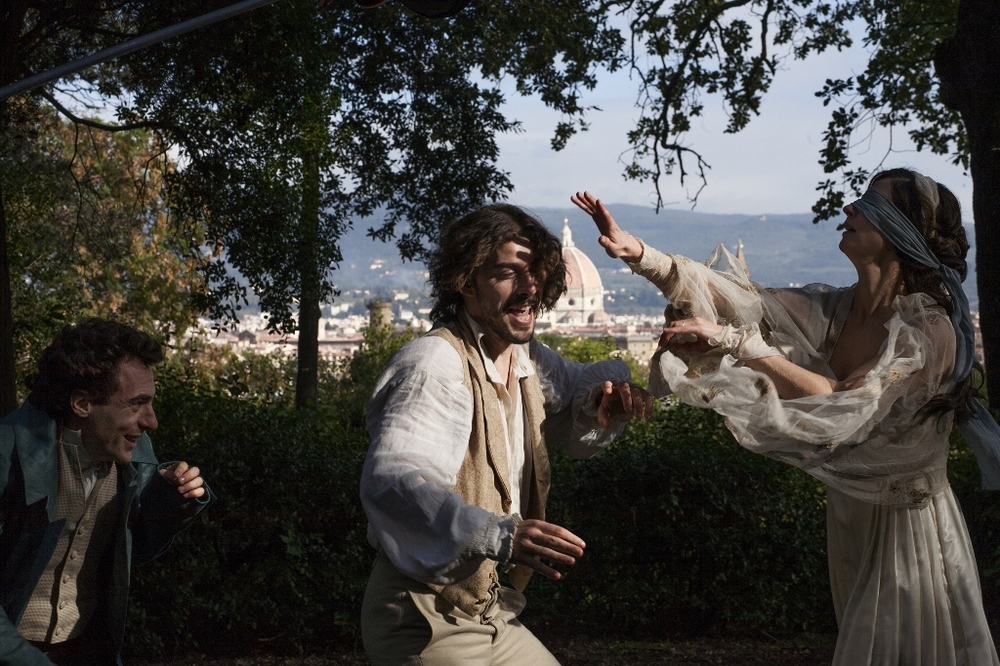
Having fun in Florence with Fanny, who breaks Giacomo's heart. Fanny sleeps with Ranieri, but the two men's friendship survives.
The film was shot on location, in the formative places of the poet's life and work: his birthplace in Recanati, Rome, Milan, Florence and Naples.

Ranieri
The last section is located in Naples, home to the family of  Giacomo's loyal and steadfast friend, historical novelist (the international influence of Sir Walter Scott, the father of historical fiction) and political activist, Antonio Ranieri.
Film Ranieri

Among the wonderful Naples street scenes, one night sequence is musically counterpointed by arabic melismatic singing supported by a hard pounding atabal. This single scene telegraphs enormous amounts of Naples's past and present, as currently North African Islamic immigration again pours its cultural influences into the boot of Italy. The conclusion of the film takes place outside the city, when they move to Torre Del Greco, the jumping-off place for 19th- century tourists going to visit Pompeii and Herculaneum.

From Wiki:
Torre del Greco is the largest city of the Vesuvius area, with about 104,000 inhabitants. It was destroyed several times after the Pompeii eruption in 79 and the last time in 1794 when the lava flow reached the sea, 7 kilometers from the crater. The town shown in the background was built on this lava after 1794.

This section of the film provides a spectacular Vesuvius eruption, which, I think, takes place in 1832 (the poet dies in 1837). We hear voice-overs of the poet declaiming his own poetry about the volcano, the mountain and the desertifcation of its slopes from periodic lava flows throughout, as earlier in the course of the film we've listened through many scenes of the poet's voice-overs during his earlier years in Recanati, Rome, Milan and Florence.

The English subtitles of these voice-overs are from CANTI / Poems / A Bilingual Edition, Giacomo Leopardi; Translated from the Italian and annotated by Jonathan Galassi, President and Publisher of Farrar, Straus and Giroux. (The New York Times review from 2010 can be read here.)  There were several lyrical addresses to the moon in the film. I cannot recall if this particular one was included -- I think it was -- but in any case this Galassi translation gives a good sense of the lunar glow that illuminates several scenes:

What are you doing, moon, up in the sky;
what are you doing, tell me, silent moon?
You rise at night and go, observing the deserts.
Then you set.
Aren't you tired of plying the eternal byways?
Aren't you bored?
Do you still want to look down on these valleys?
We whispered admiring comments (very quietly) to each other during the watching of the film, while continuing to watch the screen. This speaks to the intensity of the visual experience it provides. Turn away one's head and one has missed something splendid. We talked about Leopardi all through dinner -- which we had in a traditional New York southern Italian style restaurant across from Our Lady of Pompeii Church on Carmine Street.

Mario Martone in the Leopardi family library where Giacomo spent his  Recanati youth, in an isolated east coast region that was part of the Papal States; we can imagine then how his noble father then, regarded revolution, Napoleon's conquests and his abduction of the Pope. The old count raised his children according to Enlightenment principles while loathing revolutionary ideas and revering the Church. A poet would have no choice but to rebel.
Reading through the TOC and the Introduction of Giacomo Leopardi's Search for a Common Life Through Poetry: A Different Nobility A Different Love by Frank Rosengarten is a fast way to learn something of  who Giacomo Taldegardo Francesco di Sales Saverio Pietro Leopardi (1798 - 1837) was, and why he remains meaningful to Italians.

Rosengarten is particularly enlightening addressing the differences in the visions of nature between the Italian poet and the British Romantic poets. For Leopardi, nature is not necessarily a cleansing, healing power of the sublime, or at least not always. It frequently is powerfully, indifferently, malign and destructive, not only of man's works but of humanity itself. This is the inspiration of the lyric, "Wild Broom" or, "Flower of the Desert"  Leopardi wrote after removing to Naples, then to Torre del Greco, and witnessing an eruption of Vesuvius.

Mario Martone, who, grew up in Naples, understands what it is to live one's life with the gun of Vesuvius pointed at one's head. It's natural then too, that Leopardi, who shared such experiences of so many Italians, past and present, remains a significant force in Italian poetry and philosophy.

After the extensive credits for this logistical feat of film-making finished rolling, I stood a long time on line for the ladies' room, where women talking in Italian and English seemed to know Leopardi's poetry well, and were praising the film for the seamlesss working of his verse into the film's scene.

Paolina Leopardi


The criticism they expressed -- I think -- was connected to the film having given too little depiction of the women in Giacomo Leopardi's life. More screen time was given to prostitutes and the Florentine beauty, Fanny Targioni-Tozzetti, for whom he suffered unrequited love, than to the devotion of his own sister, and the sister of Ranieri -- both of them named Paolina, both of whom transcribed his writing, and who provided intellectual stimulus and unstinting adoration. The English language literary critics who have written of the poet, those at which  I've glanced, do seem to agree that he was a misogynist, which may have something to do with this criticism.


The poet suffered life-long from what was probably a kind of painful spinal tuberculosis, called Pott Disease.  This is enough to make anyone think that neither nature nor gods intend human life for happiness --  though the poet himself was infuriated by the assumption that it was his infirmity, not his intellect, that informed his irony, pessimism, doubt and passionate melancholy.

His poetic expression contains strong elements of what are now categorized in art and literature as "Gothic." It is more than possible his near contemporary Edgar Allan Poe (1809 - 1849) knew Leopardi's poetry, within which indifferent nature, and her handmaiden, death, oversee all. I can hear perhaps an echo of him in Algernon Charles Swinburne's (1837 - 1909), "The Garden of Proserpine," whose sound scheme melts each word into another, as death inevitably dissolves life:
 . . .Though one were strong as seven,
         He too with death shall dwell,
Nor wake with wings in heaven,
         Nor weep for pains in hell . . .